This section is for those of you who want to take your Airsoft combat simulations a step beyond the ordinary. A protective detail is a security arrangement for a person who may be subject to attack (such as the Secret Service provides for the President, or the State Department's Diplomatic Security Service provides for visiting dignitaries). In this arrangement, several security personnel protect the "client" from all manner of attacks, but the emphasis is on preventing physical attacks. For the purposes of Airsoft combat, pick one person to be the client. This person has to realize they might get shot, and they don't get to shoot back. After that has been done, decide the level of your simulation - it can be anything from one protective officer to a dozen depending on how many players you have and how big your threat is going to be. Generally you should keep things fairly even between the good guys and the bad guys, but for a challenge you can try having one side outnumber the other by various margins. What we usually do is pick three to six security team members, and an equal number of bad guys, with the understanding that the bad guys pick one person among them to be the actual shooter. This way the security team is not aware of who's a threat and who isn't. Even better is when you can have a large number of non-security team members (say twenty), and only one is the shooter. Or maybe two - you never know...
Your protective scenario is going to depend a lot on what facilities you have available. ALWAYS REMEMBER: Never conduct Airsoft combat in view of the public. If you're inside a building that was windows the public can look through, close curtains or blinds or cover the windows any way you can. There is a very great danger to you and the other players if you are seen by the public/law enforcement/etc. For our simulations, we use a restaurant after business hours - the owner is kind enough to give us permission to use his building as long as we pick up all our BBs and don't break anything. We have also used private homes of friends and relatives who were also kind enough to grant us permission to hold exercises. At any rate, above and beyond your security team it's always good to have extras who will fill out the scenario and make it more realistic. If you're in a restaurant, have other diners, wait staff, and so forth. This helps increase the realism and makes shooting more challenging - it's definitely bad for the security team to hit innocent bystanders.
Have your scenario begin with the security team and client off site, but with all others on site in their roles. The client and team arrive and conduct normal activities - at the restaurant it would be eating a simulated meal - and wait for something to happen. The security team has to be on their toes at all times since anyone could be a threat. If you're the bad guys, you may even avoid attacking. This creates a lot of stress for the security team, especially toward the end of the scenario. Play it several different ways - different teams, different scenarios, whatever you see fit.
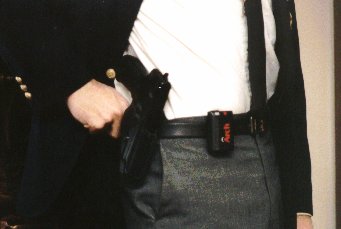
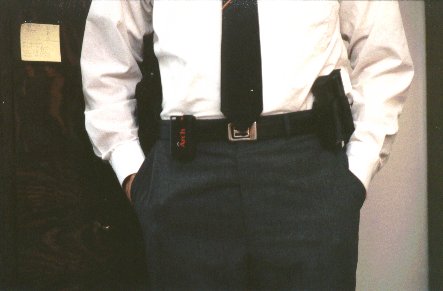
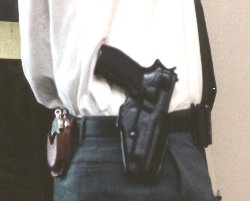
Ideally the security team will be armed with gas blowback pistols. If the team is large enough, one member may be able to utilize an automatic weapon such as a Beretta 93R or an MP5K. usually this is overkill, but it depends on the nature of the threat. When I put together teams for security scenarios, I usually make sure each team member has the following items: gas blowback pistol, at least one extra magazine, a concealment holster, and a magazine pouch. Depending on your scenario you may want to add such items as handcuffs and radios if they're available. The team members should be dressed in suits or sportcoats unless the environment/scenario calls for something else. The security team should practice drawing from the concealed holsters a little bit before the scenario starts. Shoulder holsters are popular for concealment, but not as safe, fast, or as concealable as a belt holster. Please see my section on concealment holster notes for more information regarding concealed carry and deployment, as well as notes on specific types of holsters.
For the hit squad, remember: watch for gaps in security. Try to catch the team off guard. For the security team, there's only one thing to remember: "Dead Clients Don't Pay."