Such battle masks were in for several thousand years. Bronse masks from 12 century b.c., which quite possibly were used in battle in visours, were found in China (see M. Pink's article "Ancient Chineese warriors in Para Bellum ¦ 8). Last masks intended for battle use were probably made in India (sind maile-and-plate face protection) and Japan as recently as 19 century A.D.
Of course it is not possible to discuss or even to describe each and every type of battle mask in such short article and therefore I tried to pick most interesting and staring examples: Roman cavalry helmets masks, Japanese so-men and men-po, european masks (well, mask) from "dark ages" and late medieval tournament helmets with grotesque anthropomorphic visours. Of course there will a section on 12-14 century mask found in Russia and Ukraine - albeit a small one, since they are described in large article wich will be published in upcoming issue of "Para Bellum" dedicated to medieval Russian arms and armour
But collection of materials even for such small article was virtually impossible without help of many professional and amateur fanatics of arms and armour. Most materials for "Russian" section were gathered with help of Dmitry Rukavishnikov, Sergey Kainov and Petr Vasin. "Japanese" section is based on professional opinion of Effingham - his answer to my rookie question on Armour archive really was and eye-opener. And last but not least this work would be impossible without authors of many good books and websites all over the Net. I tried to give credits where they belong but still probably I forgot someone....

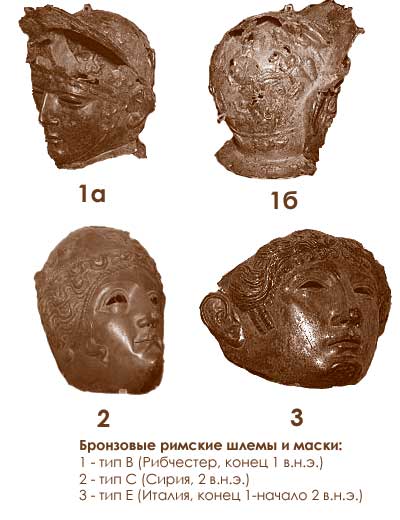 Roman masked hemets of 1st - 2nd centuries A.D. are well known and described.
At first considered to be purelly parade or ritual gear, now they are usualy
refferd to as sport gear: teams of horsemen in such ornate helmets and highly
decorated armour were fighting each other with blunt javelines and spears.
Roman masked hemets of 1st - 2nd centuries A.D. are well known and described.
At first considered to be purelly parade or ritual gear, now they are usualy
refferd to as sport gear: teams of horsemen in such ornate helmets and highly
decorated armour were fighting each other with blunt javelines and spears.
Probably at first masks were fixed to standard domes, as on the helmet from Pergamon altair bas-relief (see Petr Vasin's reconstruction, Para Bellum ¦ 9) but most of survived masked helmets are made as human head, opening like clam-shell and had almost nothing in common with contemporary "field issue" helmets
 These helmets were made from different metals, often quite soft. Mostly bronze was used, but several silver and even iron
specimens
were discovered (quite recently a beatiful iron mask was found in Germany, on possible
site of Varus defeat).
However it is unlikelly that even iron masks were used on
battlefield by someone except standard-bearers. I think that
because of construction materials main purpose of Roman masked helmets
was to protect the face from missiles - blunt on sport ground and on the ones which lost
most of their energy after long flight< if masks were used by standard bearers
on battlefield
These helmets were made from different metals, often quite soft. Mostly bronze was used, but several silver and even iron
specimens
were discovered (quite recently a beatiful iron mask was found in Germany, on possible
site of Varus defeat).
However it is unlikelly that even iron masks were used on
battlefield by someone except standard-bearers. I think that
because of construction materials main purpose of Roman masked helmets
was to protect the face from missiles - blunt on sport ground and on the ones which lost
most of their energy after long flight< if masks were used by standard bearers
on battlefield
Kalkriese mask
Roman masked helmets
Roman helmet with owner's signatures from Wienna
Japanese masks were not, properly speaking, visors, since they were not integral part of the helmet. These masks were created not for sport and games, but appeared as a result of very Japanese approach to one problem: japanese helmets traditionally are secured on the head only by one silk cord tied beneath the chin. Because of the very developed neck-guards these helmets are rear-heavy, and even the prettiest and thick cord will cut deeply into face. Therefore development of japanese masks started from below: at first they were covering only the chin and parts of cheeks, leaving nose, mouth and eyes open.
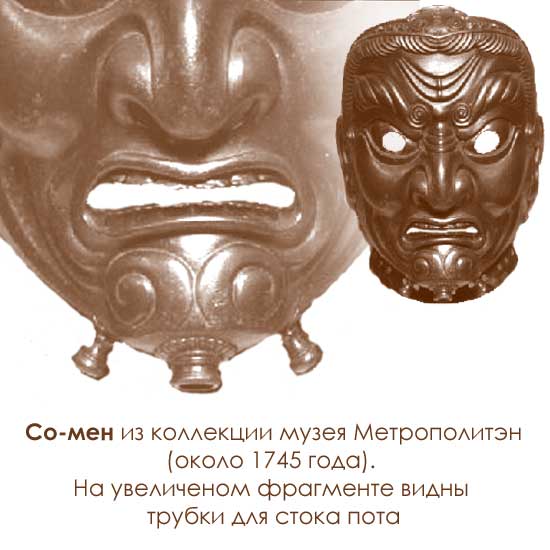
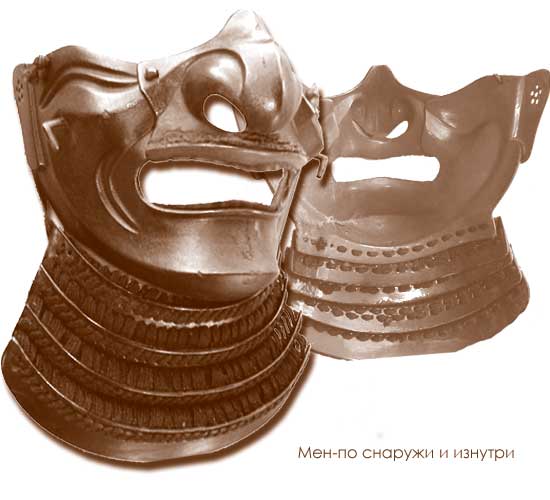 Next stage were men-po, which were covering the face up to the eyes level, and
then full masks, which were called so-men.
Masks were tight-fitted and worn without padding. Helmet cord was
tied on the mask's chin, often secured by additional hooks on cheeks.
Besides , masks were used as "psychologic weapon"
Next stage were men-po, which were covering the face up to the eyes level, and
then full masks, which were called so-men.
Masks were tight-fitted and worn without padding. Helmet cord was
tied on the mask's chin, often secured by additional hooks on cheeks.
Besides , masks were used as "psychologic weapon"
Of course masks were used not only for defending samurai's chins from cord bruises and to frighten their enemies, they were protecting the face - probably mainly from projectiles.
Because it was quite impossible to remove such mask without remvwing helmet, masks and half-masks were often made from several parts: men-po nose can be easily removed, and in case of so-men forehead part was also removable. But even with such enhancements masks were not extremelly popular: they were restricting the view and may became unbearably hot (many japanese masks are equiped with tubes on chin for sweat removal). It is not surprising that most survived masks were made during more or less peacefull Edo period, when more attention was drawn to armourers artistic skill, and not to rationallity of construction.
Metropoliten museumn
Men-po - for sale. Impressive phiotos and prices
So-men.
These two examples of masks from different cultures, separated by thousand miles and more than thousand years, clearly demonstrate that similar conditions are leading to similar solutions: in both cases masks were invented to defend the face from projectiles, but no attempts was made to rationalise their construction (compare this to the development of European visors in 12-15 century). In my opinion this is additional argument in favour of theory that Japanese and Roman masks were primary symbols of status and they protective role was secondary.
In Europe it was a bit different.
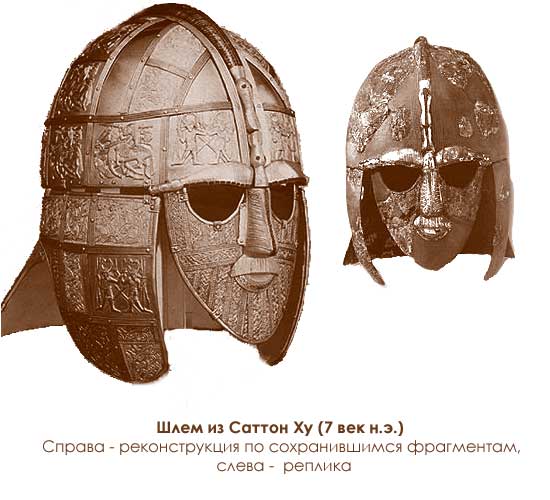 Masks from "dark ages". After fall of the Roman Empire no masks and
other forms of face protection became wery rare - at least until 6th-7th century AD
when, judging from finds in Vendel and Walsgarde, a demispherical helmet with crest
and half-mask became an indispensable part of every successful Scandinavian
chieftain.
Masks from "dark ages". After fall of the Roman Empire no masks and
other forms of face protection became wery rare - at least until 6th-7th century AD
when, judging from finds in Vendel and Walsgarde, a demispherical helmet with crest
and half-mask became an indispensable part of every successful Scandinavian
chieftain.
But the spectacular helmet found in Sutton Hoo (England) proves that the masks were used, too. This highly decorated helmet with dragon-shaped crest, checkpieces, neckguard and very expressive face mask was probably created for local "king" in 6th or 7th century in attempt to imitate with barbaric means the splendour and prestige of Rome, very well remembered in isolated Britain. However, despite all the foil, gold and red gemstones decorating the Sutton Hoo and Vendel masterpieces, they are quite functional and strong iron helmets, quite fitting for even the most heated hand-to-hand combat.
Strangelly enought despite the progress and development of blacksmiting techniques in 8-11 centuries AD, which allowed, for example, to raise a helmet dome from single piece, masks and half-masks did not became popular in Western Europe. Happy helmets owners were usually quite satisfied with face protection provided by mail aventail and nasal and only Norse warriors were consrvative enough to use helmets with half-masks not unlike thos on Vendel helmets. Fragments of such visors were found in Gjemurndbu (Norway), Tjele (Denmark) and Kiev (Ukraine). Eye-opening on last two visors are so large that they look surprisingly like visors of some pot-helms from English Civil war and their main function seems to be protection of the face from slashing strokes.
It is quite possible that tradition of masked helmets usage was preserved in Byzantine army but it was not archeologically prooved yet. Several face masks found in Konstantinople toghether with fragments of armour and horse harness, may not be dated preciselly and it impossible to tell if they were used by Byzantine warriors, nomad mercenearies or were taken as trophies.
Sutton Hoo society
British museum search engine If the link is not working
click here. Search for
Sutton Hoo
"Three faces of Suatton Hoo :) "
We love Sutton Hoo: more that 600 URLs found. Images are usually quite
unusable.
 In 12-13 century AD anthropomorfic visors appears in Eastern Europe.
9 such masks and their fragments were found in Russia and Ukraine, and most of them
seems to be made in beginning of 13th century. Some of them definetly belonged to warriors
from nomadic tribes like "black hoods", polovtsy or bulgars, but others may be used by
Russian warriors. Relativelly large number of such masks, which can be compared
only to number of survived Roman masks, confirms that in 12-13 century masked helmets
were quite common in Russia and steppes.
In 12-13 century AD anthropomorfic visors appears in Eastern Europe.
9 such masks and their fragments were found in Russia and Ukraine, and most of them
seems to be made in beginning of 13th century. Some of them definetly belonged to warriors
from nomadic tribes like "black hoods", polovtsy or bulgars, but others may be used by
Russian warriors. Relativelly large number of such masks, which can be compared
only to number of survived Roman masks, confirms that in 12-13 century masked helmets
were quite common in Russia and steppes.
It seems that these masks appeared suddenly: they usually are highly detailed, skilfully sculptured and it no "transitional" specicemens were found. Masks from Bulgar, Serensk and Rotmistrovka which are executed with less details than others, are probably not older then the masterpieces from Izislavl', Kovali and Lipovets, and may represent further development of tradition, but not the source of it. Perfect, "classical" faces of masks (for example, mask from Iziaslavl') may be the result of byzantine influence. At any rate, it is quite possible that masks were made in Russian (or even Byzantine) workshops for nomad nobles and russian boyars (many of them being sons of mixed marriages). But may be the "byzantine teory" should be corrected, since the only kind of masks found in former Byzantium are crude samples from "treasure" mentioned above. Appearance ot masked helmets is close enough to the time of polovet's invasionion. Actually all known samples were probably created when the period of initial conflicts was over and permanent war was replaced by uneasy peace. Polovtsy started they long way in steppes near Irtysh river, and were quite capable to bring with them tradition of masked helmets which were used in Siberia as early as churchjen time. This tradition in 12-13 century was revived and enriched with help of Russian or Byzantine armourers.
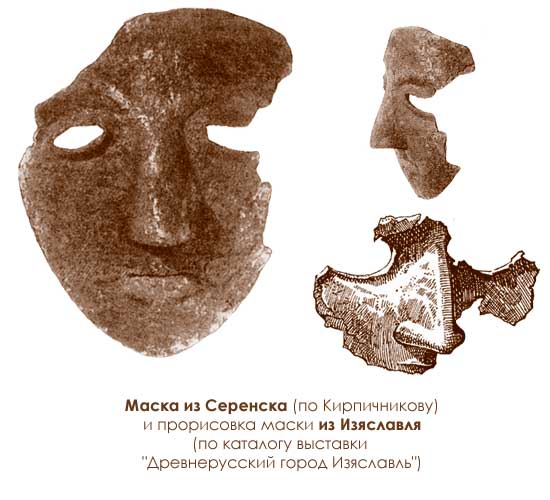 This revival coincedes with general development of facial protection in Europe:
half-masks, covering the face from forehead to upper lip, appeare in first half of 12th century
and were later replaced with earlier version of great helm with visor covering the
face completelly. May be these types of face defence were adopted during crusades
as protection from Moslem arrows, but from the beginning they were smooth,
providing gliding surface to strike of ennemy's "couched lance", usually aimed in
face or shield.
This revival coincedes with general development of facial protection in Europe:
half-masks, covering the face from forehead to upper lip, appeare in first half of 12th century
and were later replaced with earlier version of great helm with visor covering the
face completelly. May be these types of face defence were adopted during crusades
as protection from Moslem arrows, but from the beginning they were smooth,
providing gliding surface to strike of ennemy's "couched lance", usually aimed in
face or shield.
More pictures of Lipovtsy helmet from my web page

In Europe anthropomorphic visors re-appear in
15th -16th century as part of tournament armour. It is worth to mention that tourneys where
masks were used were called "husaria" and were introduced from Hungary, where many
Polovtsy clans fleed from Mongols. Of course this is not enough to prove
that "husaria" masks appeared under Polovtsy influence, especially since Western
armoures of 15-16 centuries were obsessed with new forms in battle and parade armours
and demonstrated unrivalled freedom of arthisitic expression in working with steel and iron.
. One of best examples of style was presented to Henry VIII by emperor Maximilian and
is exhibited in Leeds. But this helmet looks more like a grotesque iron "mask of shame", made in
17 century in some German town: hooked nose, horns and glasses...may be today we
are not able to fully appreciate emperor's practical joke?
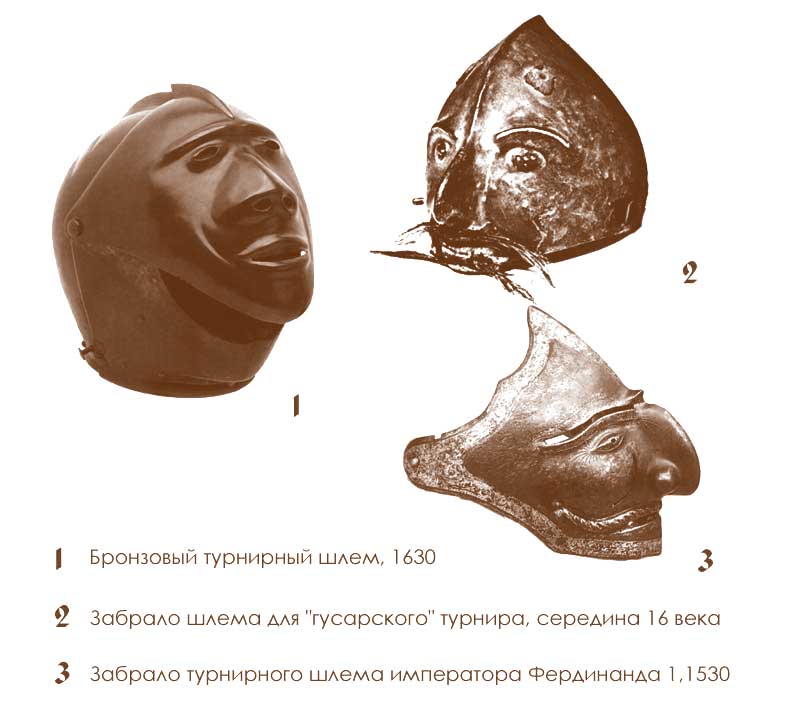
But Leeds speciment is not the only survived European masque. At least one is on display in Wallace collection, couple are in Muse d'armee in Paris, and several may be found in Polish and Hungarian museums (some of these masks still preserve original whiskers, brows and beards made from horsehair.
Where to read more or some books I used
1. Pyatysheva N.V. , Zheleznaya maska iz Hersonesa. M., 1964
2. Izmajlov I.L., Markov V.N, Zheleznaya maska-zabralo s territorii Volzhskoj Bulgarii (v sb. Volzhskaya Bulgariya i mongol'skoe nashestvie) Kazan', 1980
3. Pyatysheva N.V. , Zheleznaya maska iz Serenska v kollektsii GIM
4. Robinson H.R., Oriental Armour / London, 1967
5. I. Bottomley and A.P.Hopson. Arms and Armour of the Samurai
6. A.V.B. Norman. Wallace Collection Catalogues - European arms and Armour supplement
7. David Nicolle Medieval Warfare Source Book, vol 1: Warfare in the Western Christendom