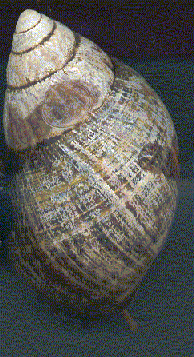
| Achatina immaculata Achatina immaculata are fairly rare and it is illegal to export them out of Africa. They are endangered and the ban on export is there to ensure that the wild population remains undisturbed and able to breed without adult specimins being captured for trade. My snail is not directly from Africa, it is from a breeding population in the U.K. The immaculata is smaller than it's more common cousin the fulica. I do not have figures for maximum shell length, but the specimin I have is considerably smaller than my fulica specimins. It has a brown shell which fades to white at the tip and seems susceptible to losing the outer layer of shell (which is why the shell becomes white) However juvenile immaculata have a striped shell, alternating bands of white and brown. This fades as the snail matures. As can be seen from the picture however the snail is still very interestingly patterned. The body is a dirty orangey-brown, markedly lighter than that of the fulica. The shape of the shell is also different, being slightly more rotund, with a less pointed tip. The shell is still pointed however, but the very end is more rounded than the fulicia. The picture to the right is my adult immaculata. It is not brilliant as I did it by positioning the snail upsidown on the scanner, which has caused water to run down onto the glass, leaving the blotches visible on the two biggest coils! However you do get an idea of the colour of the snail from this picture, and also of the different shell shape. Note that each coil is less pronounced meaning an overall more streamlined effect than on the fulica where each coil is fairly prominently raised. See below for a comparison picture between fulica and immaculata. |
 |
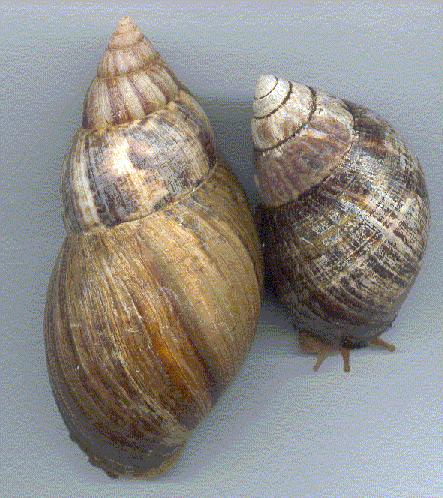 |
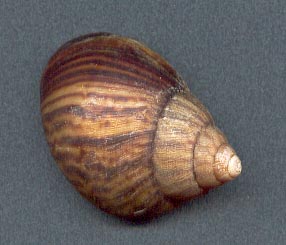
| Here the differences between the two species can be seen very clearly. I am not sure as yet whether this immacuata has reached it's full size, but I am aware it will definitly not grow as big as the fulica. Below you will see a picture of a juvenile immaculata. Note the difference in shell colour and pattern between the adult and juvenile specimins. |
| Click here to return to the snail pages Click here to return to the main site menu. |
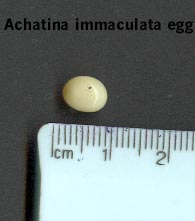
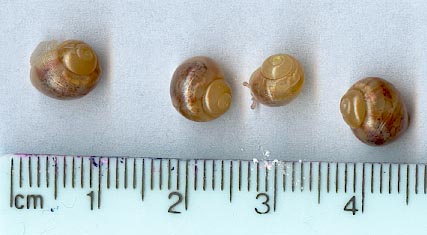
| BREEDING IMMACULATA My adult immaculata laid eggs on 30th of December 2001. They took just under 2 weeks to hatch. They were slightly larger than fulica eggs, and had a more pronounced oval shape. They were the same yellowey colour, with a similar number per batch to fulica eggs. I was surprised by the eggs as the snail is much smaller than my fulica and yet managed to lay such large eggs! I removed the eggs from the tank and kept them moist and warm in a seperate hatching box. When the babies hatched they were bigger than fulica babies and also more coloured. They have patches and stripes of colour through their shells, which are otherwise nearly transparant. Below is a picture of the newborn babies. It is interesting to compare with the juvenile and adult specimins. It is also interesting to compare with newly hatched snails of other species! I CURRENTLY HAVE IMMACULATA EGGS AND AM TAKING ORDERS FOR HATCHLINGS. (APRIL 2002) Please email me if you are interested. |
 |
 |
 |

|
| This counter tells how many hits the immaculata page has had |