
As I advance in my own (civilian, recreational) flight training (working away at the instrument ticket!) I've become more interested in aircraft types. So it is time to add some info about some of the planes my Dad flew to this site honoring him.
I have two of Dad's logbooks - one civilian, one military; doubtless some are missing. Also, the military one is sketchy, it seems clear some entries are missing - common practice in war time? I don't know. Below are some highlights from the log entries, and pictures of the types, or links to pictures, if I can find 'em (I have not found pics of Dad with any of these aircraft yet.) Enjoy!
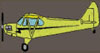 According to the Cub page of enthusiast Johan Lundgren's detailed history site, the first J3 Cub was built in 1937, after William Piper added his name to the company he bought from the Taylor brothers. (So Dad was flying quite a new plane by general aviation standards! The planes I usually fly are at least 20 years old.) This "tail dragger" aircraft is small and light, Dad's logbook notes he was at "Bayside, Mass." I cannot find an airport by that name that now exists.
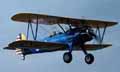 Stearman have those dramatic radial piston engines, and are a mix of fabric and steel, tougher than some earlier aircraft. According to Jeff VanDerford's contribution to the Warbird Alley site, the Army began purchasing these biplanes from the Stearman Aircraft Co. (in Wichita, KS, acquired by Boeing) in 1936, and soon ordered thousands. VanDerford notes, 'The plane was easy to fly and forgiving of new pilots at stall speeds.' There are still thousands of Stearman aircraft - a good place to see them is the National Stearman Fly-In each fall in Galesburg, IL!
ECT went to Sumter, SC in March 1942 to train in BT13 AR Vultees.
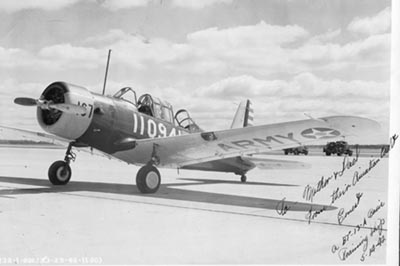
According to the folks at Wright-Patterson Air Force Base, the Vultee (AKA 'Valiant' AKA 'Vibrator') was the basic trainer most widely used by the USAAC during WW II. The Vultee is considered a complex aircraft - has a variable pitch propeller. The Army's version was a (less expensive) scale down of the original Vultee (per the BT Vultee Club), and was all metal construction. There are some of these Warbirds still around, not as many as the Stearmen.
Next ECT's class moved to Spence Field, GA, in June 1942 for training in North American AT-6-A's.
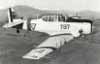 Also called 'The Texan,' AT-6-As are also complex aircraft, with variable pitch props and retractable gear. This plane has aerobatic capabilities. According to the Air Power Museum, it was 'designed to give the best possible training in all types of tactics, from ground strafing to bombardment and aerial dogfighting, and contained such versatile equipment as bomb racks, blind flying instrumentation, gun and standard cameras, fixed and flexible guns, and just about every other device that military pilots had to operate.' The airplane in the class photo from Spence Field posted here http://home.xnet.com/~sarat/wardocs.html is probably an AT-6. ECT's log entries for the AT-6 demonstrate its capabilities:
ECT's class moved on to Rentscher, CT in August 1942 for training in Curtiss Aircraft P-40 E and F 'Warhawk'fighters.
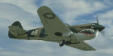 According to the Warbird Alley folks, Warhawks were heavier than previous fighter aircraft, with extra armament and extra fuel capacity. The E series ('Kittyhawks') my dad flew had extra guns, and the F series he flew had a stronger engine and some improvement in armament capabilities. As noted by the Airzoo folks, the P-40s had gear that rotated back into the wing. P-40s were used to combat the Zeros in the attack on Pearl Harbor, and in many battles in the earlier part of the US involvement in WWII.
Then there is a gap in the logbook; many pages are skipped until:
March 24, 1943, when El Kabrit, Egypt entries begin, where ECT was flying P40-F's and North American B25-D twin engine Bombers.
Modified B-25's were used by Doolittle's Raiders - the famous long distance bombing flight to Japan! The D series in ECT's logbook probably indicates these were British-made versions. Until I really read the logbook, I had no idea ECT flew bombers! His stories and his personnel memos did not specifically mention B25s. This helps explain his multiengine rating. Again according to the excellent Warbird Alley contributors, North American was specifically commissioned to make these heavy multi-engine bombers for the USAAC even before the US joined WWII.
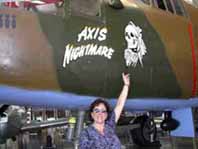
ECT was reassigned to flying what he called 'hospital planes,' C53 and C47 twin engine transport aircraft.
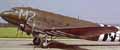 As noted on the chronology from ECT's personnel memos (http://home.xnet.com/~sarat/overseas.html) he was reassigned to transport after he was removed from fighter and bomber flying due to combat fatigue. The Douglas C-47 is the military version of the DC-3. As the Warbird Alley summary notes, 'the Douglas C-47 was one of the prime people movers of WWII.' I remember Dad calling these 'Gooney Birds;' they were also known as Skymasters and Dakotas. The C-53 seems to be an earlier version of the C-54, which was the military version of the Douglas DC-4.
That is the end of the logbook entries. As noted on the chronology page, ECT was stationed in England for awhile, injured (not sure if he got the shrapnel there or in the Middle East), and was sent back stateside. I learned a lot more about Warbirds by doing this research! Hope others who find it enjoy the info!
Return to main ECT page
This page is at: http://www.geocities.com/sarat_57/ectlogbks.html
Last updated 17-November-2002. © Sara R. Tompson