The simplest form of matter is an element, which is a substance that can not be broken down by chemical reactions. Elements are made up of only one type of atom. There are 92 naturally occurring elements.
- The smallest unit of an element is called an atom.
Parts of an atom:- Nucleus: The dense core of an atom made up of two subatomic particles:
- Protons ( p+ ) have a positive charge.
- Neutrons ( no) have no charge.
- Protons ( p+ ) have a positive charge.
- The electrons ( e- ) are negative particles that spin around the nucleus in regions called orbitals or energy levels.
- Their mass is so small (1/2,000 the mass of a proton or neutron) that they are not used when computing the total mass of an atom.
- Nucleus: The dense core of an atom made up of two subatomic particles:
- Atoms of the Periodic Table are neutral, meaning that the number of protons equals the number of electrons.
(+ and � charges cancel each other out).Element from the Periodic Table of Elements
Atomic Number Symbol
Atomic Mass
6 C
12.011
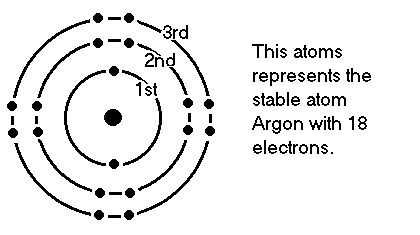
- Valence Electrons: electrons in the outer-most energy level that determine how an atom will react with its environment. If the outer energy level is filled, then the atom is stable and will not react. If the atom is lacking electrons, then it will react to try to complete its outer-energy level.
- Ions: A (+) or (-) charged atom. In an attempt to become stable atoms gain or lose electrons. As a result the atom becomes charged.
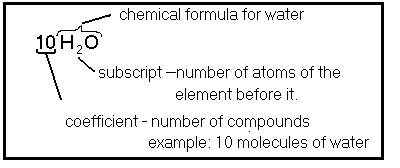
A compound is a substance formed by the bonding of atoms in definite proportions. For example, water is a compound that has one oxygen atom bonded to two hydrogen atoms.
- Elements are represented with chemical symbols. (Ex. C, Na, and O) A Compound combines these symbols into a chemical formula, which shows the bonding ratio of elements in that compound. (Ex. H20, C6H12O6, and NaCl)
What does a chemical formula show?
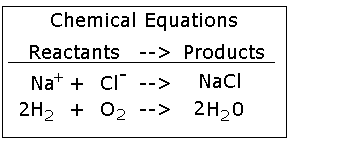
- Chemical equations: show the reaction of two or more substances to form one or more products. The reactants and products are separated by an arrow, which is called a yield sign. Yield signs point the direction in which the chemical reaction will move.
- Compounds are formed when two are more atoms chemically bond to become stable. There are three types of bonding: (1) Covalent bonding, (2) Ionic bonding, (3) Hydrogen bonding (does not create new compounds)
- Covalent Bonding: the strongest type of bonding in which two atoms share pairs of electrons, completing the outer shell of both atoms.
- A molecule is a compound that has covalent bonding.
- Atoms like carbon, hydrogen, and oxygen do not have a filled outer energy level so they are not stable. To become stable they go through chemical reactions to become stable compounds. The force that holds compounds together is a chemical bond. How do atoms bond with each other to form compounds? Look at Oxygen and hydrogen below. Are there outer energy levels full? So what happens? Well, if they are close enough together they will react with each other and end up sharing electrons. By sharing, each atom enjoys a full outer-energy level and is stable. When atoms share electrons it creates a special type of bond called a covalent bond. The shared electrons of the two atoms circle around the nuclei of both atoms.
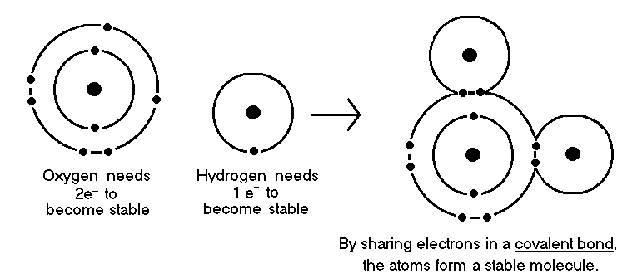
- The more pairs of electrons that are shared, the stronger the bond:
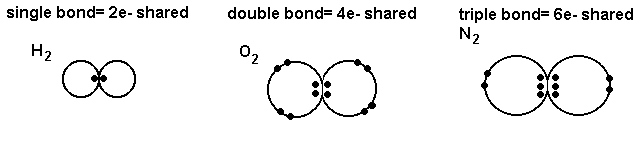
- Why is covalent bonding important to biology? A chemical bond is a store of chemical energy. Alot of energy is required to form covalent bonds. So when a bond is broken, energy is released. This is an important way energy is stored and transferred in the environment and in us.
- A molecule is a compound that has covalent bonding.
- Ionic bonding: type of bonding in which there is a transfer of electrons from one atom to another.
- By gaining or losing electrons in their outer energy level, an atom becomes a �charged� atom called an ion. Ions can either be positive or negative having a plus or minus 1,2,or 3 charge.
- If an atom loses an electron to another atom, then it will become a positively charged ion due to the loss of the negative electron. Example: A hydrogen atom that loses an electron ends up with one p+ and no e-. The resulting hydrogen atom will have a +1 charge: H+
- If an atom gains an electron from another atom, then it will become a negatively charged ion due to the addition of a negatively charged electron. Example: A chlorine atom that gains an electron ends up with 17 p+ and 18 e- The resulting chlorine atom will have a �1 charge: Cl-
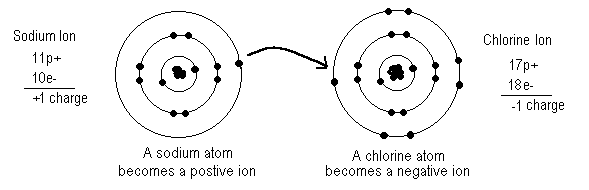
- The resultant positive and negative ions attract each other forming an ionic compound.
- Ionic compounds are not as strong as covalent molecules. Famous ions are H+, Na+, K+, and Cl-. Famous ionic compounds are NaCl, KCl, and HCl
- By gaining or losing electrons in their outer energy level, an atom becomes a �charged� atom called an ion. Ions can either be positive or negative having a plus or minus 1,2,or 3 charge.
- Hydrogen bonding: The very weak attraction of a slightly positive hydrogen atom on one molecule to a slightly negative atom on another molecule. These bonds can hold two different molecules together, but does not create new ones.
- Covalent Bonding: the strongest type of bonding in which two atoms share pairs of electrons, completing the outer shell of both atoms.
- Properties of Water:(an aqueous solution)
- Water is a polar molecule, which means it has both a positive and negative end. Water is polar because the bigger oxygen nucleus pulls more on the electrons. This pull causes electrons belonging to the hydrogen to spend most of its time spinning around the oxygen atom. As a result, the oxygen atom ends up with a slightly negative charge. The hydrogen ends up with a slightly positive charge.
- Hydrogen bonding between water molecules--
- creates �Cohesion� or stickiness to each other, which is responsible for water�s high surface tension.
- creates �adhesion� or stickiness to other polar molecules, which is responsible for capillary action or the drawing up of water into a tube. (Plants transport water with little effort due to adhesion.)
- makes water the universal solvent. Water can dissolve polar molecules. Water can also cause ionic compounds to come apart.
- Solvent dissolves/ solute is dissolved
- Our bodies are about 65% water. Water inside and outside our cells dissolve and transport nutrients and wastes.
- Water can not dissolve non-polar molecules like oils and fats.
- Water is slow to heat up and slow to release heat. Large amounts of heat must be absorbed/released by water to break/create hydrogen bonds.
- Evaporative cooling: Tremendous amounts of heat energy must be absorbed to evaporate water. This property of water keeps body temperature constant.
- Water can dissociate (come apart) into ions. Ions produced are a hydrogen ion (H+) and a hydroxide ion (OH-).
- These two ions are the most reactive ions in nature.
- Water is a polar molecule, which means it has both a positive and negative end. Water is polar because the bigger oxygen nucleus pulls more on the electrons. This pull causes electrons belonging to the hydrogen to spend most of its time spinning around the oxygen atom. As a result, the oxygen atom ends up with a slightly negative charge. The hydrogen ends up with a slightly positive charge.
- Acids and Bases
- An acid is any compound that produces H+ ions when it dissociates in water. Some examples are HCl and H2SO4.
- A base is any compound that produces OH- ions when it dissociates in water. Some examples are NaOH and KOH.
- The pH scale is a measurement of the concentration of H+ ions. (Range from 0-14)
pH <7 = acid. (0-6) The lower the pH, the stronger the acid.
pH >7 = base. (8-14) The higher the pH, the stronger the base.
pH of 7 = neutral. The concentrations of hydrogen and hydroxide ions equal each other. [H+]= [OH-] - An acid and base can neutralize each other to form a salt and water.
Example: NaOH + HCl => NaCl + H20
- An acid is any compound that produces H+ ions when it dissociates in water. Some examples are HCl and H2SO4.