Name________________________________________Date_______________Period___________
Basic Chemistry Review
[Basic Chemistry Notes]
[Fall Semester]
[Home]
Hand-write your answers on separate paper. Number your answers correctly.
Terms to Know:(Define All)
Element
Atom
Proton
Neutron
Electron |
Valence Electron
Compound
Covalent Bond
Molecule
Ionic Bond |
Ion
Hydrogen Bond
Solution
Polar
Cohesion |
Adhesion
Solvent
Evaporative Cooling
Acid / Base
pH Scale |
Objectives: (Discuss the following objectives using complete sentences.)
- Identify the three particles of an atom including location, symbols, and charge.
- Discuss the importance of valence electrons of an atom.
- Discuss the components of a chemical formula and chemical reaction.
- Discuss why compounds and chemical bonds form.
- Compare and contrast covalent, ionic, and hydrogen bonding.
- Describe the importance of covalent bonding to life.
- Discuss how and why molecules form.
- Discuss how and why ions and ionic compounds are formed.
- Identify common examples of “covalent” molecules and ionic compounds.
- Describe the properties of water.
- Discuss how the properties of water relate to life.
- Compare the properties of acids, bases, and neutral solutions.
- Investigate and describe the effects of pH on organic compounds.
Practice Questions: (Use complete sentences when necessary.)
- Draw at least 2 different models of a typical atom labeling correct components.
- Any model of an atom is not a true representation of what an atom really looks like, but they are used anyway. Why do we use models?
- What will determine how an atom will react with its environment?
- First and foremost, does an atom prefer to be neutral or stable? What does this mean?
- A neutral carbon atom only has 4 valence electrons. How will carbon react with its environment? Why?
- Identify the number of compounds and the total number of atoms in the compounds below.

- Form a table to list the reactants and products of the following chemical equations.
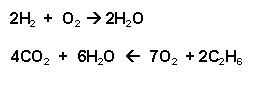
- How does the left and right sides of the each equation above compare in its number of atoms?
- In each equation above, a reaction is shown in which new molecules are formed. What is required to create these new bonds and ultimately make these reactions occur?
- The atoms below are listed with their number of valence electrons. Typically, each participates in covalent bonding to form organic molecules. How many times will each bond to become stable?
C-4
O-6
H-1
N-5
- Which of the above atoms can easily become an ion? Would it be a positive or negative ion?
- Draw an illustration of the arrangement of water molecules in solution due to hydrogen bonding.
- Why does “polar” water not mix with “nonpolar” oil?
- Why would the gulf coast be less likely to experience extreme temperature differences while western Texas experiences extremes from day to night?
- At the doctor’s office, a nurse pricks your finger and a bead of blood appears. The nurse then places a very thin tube to the bead. To your surprise, the blood quickly fills the tube. Explain why this happened.
- In water, which is neutral, concentrations of H+ and OH- ions are still found. Where do these ions come from?
- Identify the following as an acid, base, or neutral solution.
- pH of 7
- pH of 14
- HCl
- NaOH
- pH of 4
- Solution with a high concentration of H+ ions.
- Solution with a very low concentration of H+ ions.
- pH of 9