|
History
The first Ibizans came from Ancient Egypt and Africa. There are records on papyrus, rocks, stone, tombs and pyramids, including sculptures from the Saqara Temple, as early as 3,000 BC. More conclusively, bone discovery from the Proto-Dynastic period of Ancient Egyptian history date them to 4,770 BC, however, prehistoric drawings on walls of the �Tassili� caves at Hoggar, in the Sahara desert, date back to 8,000 BC. They feature primitive, spear-bearing hunters and clearly depict trained, domesticated, lean and agile, �prick-eared� hounds, pursuing and seemingly entrapping Mountain Sheep.
When the Phoenicians, Carthaginians and Moors traded around the Mediterranean, these hounds were bought to the Balearic Islands were they bred in isolation and reportedly, even refused to mate with other canines. The breed was refined there for several thousand years and can still be located today on the islands of Formentera and Mallorca but in particular, on the island of Ibiza, approximately 250 kms from Valencia, located off the mid-western coast of Spain.
Early, famous UK dogs were
SOL - from first U.K. litter, bred by Mrs. Isobel D G Holt,
LEO the BRAVE - imported from Ibiza by Archeologist, John West
IVICEN CLEOPATRA - bred by Ms. Diana Berry (UK �standard� based on her)
The first litter in Australia was born in 1985, with the early dogs to arrive being:
Aust Ch Divels Tallula (imp UK) - Sin�s Late Night Extra x Divels Lareina
Eng Ch Sin�s Blithe Spirit (imp UK) - Ra Benji Hassan (imp Ibiza) x Sin�s Blitzen
Aust Ch Sin�s Wild Cazador (imp UK) - Sin�s Summer Lightning x Eng Ch Sin�s Exquisite
Aust Ch Sin�s Escarxas Stardrift (imp UK) - Claerwen Borelly from Sin x Escarxas (imp Ibiza)
Aust Ch Sin�s White Extrovert (imp UK) - Ra Benji Hassan (imp Ibiza) x Eng Ch Sin�s Exquisite
Character
This breed is very kind, is loved by children and has to be hard pressed to fight. He has a lovely �Peter Pan� nature but can be easily crushed by rough handling or shouting, due to his acute hearing and sensitive nature.
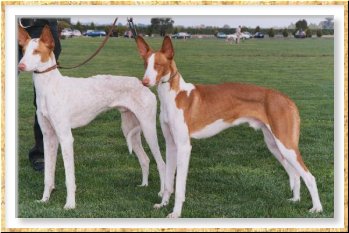
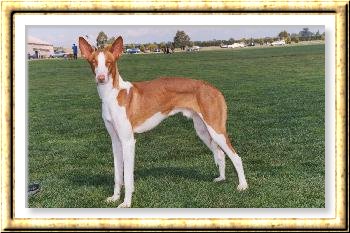
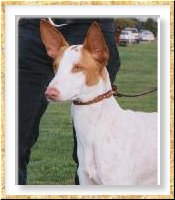
They have great stamina and can work all day, and even by night. Extremely alert and curious, they are usually very cautious with strangers. They are an agile, tall hound, usually between twenty-three and twenty-nine inches tall at the shoulder, lightly built with erect ears and a long tail. They can be smooth or rough coated and must have NO black anywhere. Colours are White, Chestnut, Lion or any mixture of these. Alert and determined, they are able to leap eight feet high from a standing position. They are very versatile hounds; able to free hunt, to lure course, to flush out and pick-up on shoots, to track race, in the show ring, for obedience and also as a household pet and companion.
Future
In England, the English Ibizan Hound Club is very active in all these areas and their prior Honorary Secretary, the late Diana Berry (of Belgrave, Baldock in Hertfordshire UK) had given tremendous support, inspiring interest internationally. Ms Berry gladly advised on every aspect concerning the breed being introduced and campaigned in Australia, initially by Mary Hunt of �Inpu� kennels. The few successive breeders here are happy to share experiences, pass on information, and assist anyone who wishes to help promote and preserve this rare breed in all aspects; not only within Australia and New Zealand, but also throughout the world. We intend to keep this unique breed in the same shape and temperament as they have been for many thousands of years, and will not allow him to be spoilt by showing under judges who wish to alter them. It is very important to encourage the sporting side of the breed, as judges should not fault hounds that have been damaged in their work.
The Pharoah Hound & The Ibizan Hound
by
Mary Hunt - �INPU� Ibizan Hounds
&
Barbara Skilton - �KING TUT� Pharaoh Hounds
This discourse comprises Barbara Skilton�s talk at the seminar for potential and practicing judges of the hound group. Given under the auspices of the R.A.S.K.C., it is written in conjunction with Barbara�s association with Mary Hunt�s �Tallula�, the first Ibizan in Australia and the accepted standard of the Ibizan Hounds (identical to the English Kennel Club�s UK accepted standard).
The English Ibizan Club has always related as close as possible with the best Ibizan hounds of the islands of Ibiza and Formentera. Fresh blood injected by way of direct imports of hounds from Ibiza has proven the wiseness of their idea, because the quality of hounds in England has continued to improve.
The text as presented to the R.A.S.K.C. Seminar - 8th July 1983
(re-typed and amplified on the 26th February 1985)
Both breeds have the same basic origin and one�s first impression should be of a dog that has walked off the wall of a Pharaoh�s tomb. Spread throughout the Mediterranean by the Phoenician traders, they have developed differently due to the terrain they were required to hunt over and the type of work they were required to do. Both breeds use their sense of hearing and scent, as well as their sight, although the Pharaoh is classified as a sighthound in Europe the Ibizan Hound is classified in the utility group with such groups as the German Shorthaired Pointer due to the fact that they will work well with the gun and retrieve, and are used quite frequently as gundogs, usually in pairs. They are worked with gun as well in England, but are classified as Hounds. The Ibizan is a leggier, finer built dog than the Pharaoh, though both should be muscular, agile dogs, shown in a lean, hard condition. It should be noted that the Ibizan is more cautious of strangers than the Pharaoh Hound. Other differences become
more apparent as we compare the point by point.
HEAD: The Pharaoh is a blunt wedge with muzzle slightly longer than the scull with a slight stop so the foreface and skull are parallel planes. The Ibizan has a finer, narrower head with practically no stop; the foreface and skull is of equal length, a slight roman nose and a prominent occiput. Both breeds have flesh coloured noses and amber, oval or almond shaped eyes. The nose of the Ibizan protrudes rather more than the Pharaoh.
EARS:Both have large, mobile eyes, held erect when alert, however no judge should expect either breed to have their ears erect all the time. If they were, they would lack the mobility, which allows them to turn and pick up sounds. The Ibizan has a stiffer ear, which does not fold back the way a Pharaoh�s will. It should be in a continuous line with the neck when seen in profile. Ears should be broad at the base, the outer corner of the ear being set level with the eye.
NECKS:Both have long, muscular, arched necks.
FOREQUARTERS:The Ibizan forequarters are of completely different construction from that usually seen on a hound. They have a shorter, more steep set shoulder blade with far less angulation to the humerus which is also shorter and more upright, whereas the Pharaoh Hound has a more usual forequarter with a well laid back shoulder with a more acute angulation to the upper-arm which brings the forelegs under the body. Due to this difference the pasterns will be more erect on the Ibizan Hound than the more normal slightly sloping pastern of the usual sighthound, and their feet will turn out slightly to give them balance.
BODY: Both breeds have slightly more length of body than height at the withers, with a long, rather narrow rib-cage. The Pharaoh Hound is more heavily built with depth of brisket almost to the elbows and a moderate tuck-up, whilst the Ibizan Hound has 2.5� to 3� (approximately three fingers width) between brisket and elbows, with a more defined tuck-up. Both should be comparatively short cropped, as they need a longer rib-cage to give them heart and lung room. Top-lines are practically level. Sway backs and Roach backs are faults in both breeds.
HINDQUARTERS: To correspond with his forequarters, the Ibizan Hound has very little angulation in the rear. The Pharaoh Hound has more, but he too should not be over angulated.
FEET:The feet of both breeds have long, arched toes with well-padded paws. The Pharaoh Hound may have his dew claws in front removed. The Ibizan Hound standard states the dew claws should not be removed. Neither should have hind dew claws.
TAIL:In Pharaoh Hounds, medium to low set; Ibizans - long, whip-like, reaching below the hock. The tail is carried high when excited, or level to the back. In motion, it should never fully curl over the back.
COAT:The coat of the Pharaoh Hound is short, glossy and finer than that of the Ibizan Hound, who can have a smooth as well as a smooth coat. Colour is also different with the Pharaoh Hound having the minimum of white marking on tan-chestnut coat, whilst the Ibizan is allowed white, chestnut or lion in solid colours, or any combination of these. Neither has any black pigmentation of skin of hair.
NO BLACK ANYWHERE.
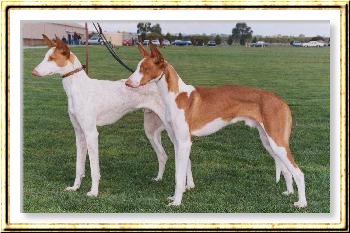
GAIT:As would be expected from the differently constructed forequarter, gaits are quite different. The Pharaoh having more normal, straight-through flowing stride, whilst the Ibizan has a suspended trot; a through-flowing, long-reaching stride with slight hover-hesitation-suspension before putting the foot to the ground.
It must be stressed that in no way can the Ibizan gait be compare to that of the Afghan. There is no doubt that some people may have misconstrued the American standard, which (formerly) stated -
a trot in suspension, elegant and graceful, in the manner of an Afghan.�
to mean they are similar, which is impossible because of their different forequarter confirmation. Even American Ibizan people writing in depth on their interpretation of their standard, quote -
The gait from side view should show joint flexion, is not hackney, but an up and forward movement that is not desirable in any other sighthound, but is proper side movement for the Ibizan Hound. This movement is elegant, graceful and floating.
HEIGHT:Also varies with both Pharaohs ranging from 21� to 25� and the Ibizan from 22� to 29� but balance is the overriding factor.
BLEMISHES:Both standards state that hunting blemishes should not be penalized, indicating that a true hunting type of hound should be maintained, not sacrificed for purely cosmetically pleasing animals as so often happens in the show ring.
Upon examining the skull structure of the hound found on the Balearic Islands (Ibizan Hound) the skull appeared to be quite hollow in the front of the eyes. This unusual structure matched the same peculiar skull formation found in the Egyptian �Tesem� and further, closely matched one type of Egyptian jackal, �Canis Lupaster�. This, along with the �square� shaped ear of the Ibizan makes the breed very different from the Eurastic type of �Grey�hound
- from an article titled �Dogs�, by Dr. Max Hilzheimer, appearing in the German �Zeitschrift f�r Hundeforschung� - April 1931.
Dr. Max Hilzheimer stated that the Egyptian Tesem was found to have existed in Africa when there was no other trace of �Greyhounds� in Europe or Asia. (�Greyhound� is the general term used to describe �sighthound� type dogs).
Since the ancient Egyptians were considered experts in the domestication of wild animals (which is proven by the fact that they raised animals that were found nowhere else in the world), Dr. Hilzheimer�s belief in the Egyptian domestication of the ancient Tesem (Jackal) was strengthened. He also felt the Tesem had eventually died out in Egypt, but continued to exist on the remote islands of Crete, Pityusa and through the Balearic Islands, including Formentera and Mallorca, with Ibiza being their chief breeding center.
From studying the ancient archaeological sites, researchers know that sight hound-type dogs lived in various areas of the Mediterranean region as far back as 10,000 BC - from �Ibizan Hounds - A Celebration' by Lisa Puskas.
The Podenco Ibicenco (Ibizan Hound) is a direct descendant of the oldest canine breed in the world, namely that which is found on the tomb of Pharaoh Ptolomey in Egypt - Dr. Schultz, Swiss Naturalist, early 1800's.
|