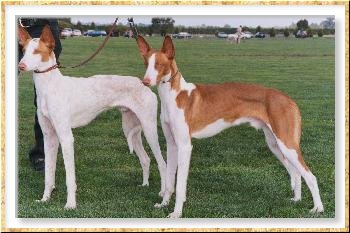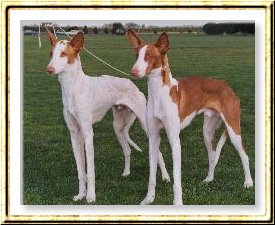
CHARACTERISTICS - A tireless controlled hunter; retrieves to hand, is very kind, rather cautious with strangers, has the ability to jump great heights without a take-off run. An agile hound.
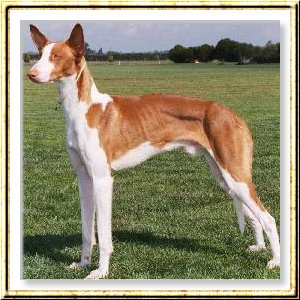
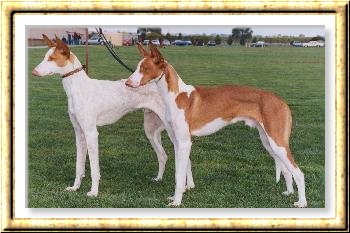
GENERAL APPEARANCE- Tall, narrow, finely built, large erect ears.
HEAD & SCULL - Fine, long, flat skull with prominent occipital bone. Stop not well defined. Slightly convex muzzle, the length of which from the eyes to the tip of the nose should be equal to the length from the eyes to the occiput. Nose flesh coloured should protrude beyond the teeth with jaw strong and lean.
EYES - Clear, amber, expressive. Almond shaped, not prominent, large or round.
MOUTH- Perfectly even teeth, scissor bite, thin lips with no dewlap.
NECK - The mouth should also be pink, but should not show on the nose as it catches the light and prevents the blending into the background.
FOREQUARTERS- Rather steep short shoulder blade. Long, straight legs. Erect pasterns of good length.
BODY - Level back, sloping slightly from the pinbones to the rump. Long, flat ribcage; short coupled with well tucked up waist. Breast bone very prominent. Depth measured between the bottom of the ribcage and the elbow 2.5� to 3�
HINDQUARTERS- Long, strong, straight and lean, no great angulation, long second thigh turning neither in nor out.
FEET- Well arched toes, thick pads, light coloured claws. Front feet may turn slightly outwards. Dew claws should not be removed in front. No hind dew claws.<
GAIT- A suspended trot, which is a long reaching stride, with a slight hover before placing the foot to the ground.
TAIL- Long, thin, low set, reaching well below the hock. When passed between the legs and round the flank should reach the spine. May be carried high when excited, but not curled within itself, or low over the back.
COAT- Either smooth or rough, always hard, close and dense. Longer under the tail and at the back of the legs. Hunting scars are not to be penalized.
COLOUR- White, Chestnut or Lion solid colour, or any combination of these.
WEIGHT - The Standard in the country of origin varies from 22 inches and 29 inches, but balance is the overriding factor.
FAULTS- Any departure from the foregoing, the degree of the departure stipulating the seriousness of the fault. NOTE: Male animals should have two apparently normal testicles, fully descended into the scrotum.
The Reason Why
The Ibizan Hound Standard
Is As It Is
By
Diana Berry
HEAD & SKULL
The long narrow head is a must to allow the picking-up of game and the nose protruding beyond the teeth allows a length of nostril to collect scent; as does the slightly convex muzzle. The eyes need to be almond shape to allow the sight to be clear and unimpeded, round or protruding eyes would be vulnerable to damage; inset eyes impede sight.
The ears must, as in all wild animals, be large and offset to catch all sound, as they hunt by sound as much as scent, although the ears may be carried backwards when working, to prevent damage. They must not be high-set or they cannot have one forward and one back as with deer.
Teeth need to be level for catching and there must be no dewlap, as this would impede the catching ability. The neck must be long to allow the hound to easily reach the ground when picking-up game. If a hound is 28� at the shoulder, the head & neck must be at least this length to pick up game easily, without pausing.
BODY
The level back with slight slope to the rump allows for strength to leap and twist in mid air. The depth of the rib cage should not be so great that the elbow can not be tucked under it at all times.
The rib cage should be flat for the same reason, but it must be long, with a prominent breastbone to compensate for lack of depth and spring of rib. They must be short coupled to aid the midair twisting and ability to turn very short in mid-flight.
LEGS
These must be long according to size of the hound. They must be strong and straight but not clumpy or heavy boned. The short, straight shoulder blade allows the direct jump without a takeoff run, as do the less angulated hind legs.
The front paws may be slightly turned out, in consequence, but must not be weak. The front dewclaws must be left on as they are used for work on loose stone or hilly ground, hence the long pasterns to keep it from damage.
The feet are hare feet, well padded with fur and well arched. Some young hounds have cat feet up to 12 months of age, but once out of puppy, this is a fault; the foregoing construction is the reason why the hound is able to jump up to eight feet without takeoff and clear hedges and ditches as an extra bound, without checking his flight.
MOVEMENT
This is very important. Must be long reaching and the hover allows for the spring changing direction as the need arises when working.
TAIL
The ancient drawings in many cases show a ring-tail. As we are dedicated to keeping the hound in its original form, as it has been for well over 5,000 or more years, we cannot be too strict on this, but we all prefer the single curve when moving.
The ring spoils the general balance of the hound and should be taken into consideration when assessing overall balance. The tail must be long to direct the hound in full flight and should be well protected with hair.
COLOUR & COAT
No black anywhere as this would be certain of a mixture of other breeds, hence the amber eyes and liver nose.
The mouth should also be pink, but should not show on the nose as it catches the light and prevents the blending into the background.
The coat must be hard and dense, be it long or short, and be completely waterproof. It is stupid to penalise hunting scars, as we would quickly have soft, protected show dogs and strong virile hunting hounds; this we do not want.
SIZE
We have a great range of size for different work; large hounds for open ground and smaller for dense cover. Many judges find it difficult to end up in the ring with best male 24� and best female at 27�, but so be it.
Reproduced with permission from Mr. Benjamin Reynolds-Frost, son and benefactor of the late Ms Diana Berry who was the founder of the breed in the United Kingdom, subsequently establishing the Australian bloodlines with Championed exports in the early �80s.
Her �Sins� prefix can be found in almost every pedigree today; not only in England and the U.K., but also all throughout Europe, including Greece, Germany, Holland, and all of Scandinavia, Africa, Asia, Canada, Australia, New Zealand, Sth. America and all through the United States of America.
In 1956, it was reported that there were only about 200 (original/authentic) Ibizan Hounds left on the Island of Ibiza�� (from �Ibizan Hounds - A Celebration� by Lisa Puskas)
Ms Berry�s principals, objectives and life long dedication and devotion to the preservation of these unique and ancient hounds has been upheld by Ms Barbara Skilton and Ms Mary Hunt of �Inpu� kennels, the succeeding breeder of the Ibizan Hounds first imported into Australia.
Since the early �90s, �Sherrak� and later �Woodshack� kennels have maintained our limited, world-class breeding program, culminating in a litter bred by �Xarnego� in 2001. �Saqara� Ibizan Hounds in Gisborne, Victoria (just outside of Melbourne) has confirmed a 2002 import of a �Benjique� bitch pup from the UK, ensuring future conservation of our highly acclaimed, internationally praised Australian bloodlines. Our dogs have brilliant
movement and ideal head shape; alert, yet loving temperament, and are certified as free of any known medical problems. Full pedigrees available.
|