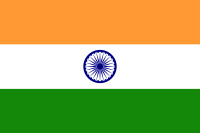
| India, officially the Republic of India, is a country located in South Asia. It is the seventh-largest country by geographical area, and the second most populous country in the world. India has a coastline of over seven thousand kilometres, and borders Pakistan and Afghanistan to the west, Nepal, the People's Republic of China and Bhutan to the north-east, and Bangladesh and Myanmar to the east. In the Indian Ocean, it is adjacent to the island nations of Sri Lanka and Indonesia. | ||
 |
The Republic of India is considered as one of the possible future superpowers of the world. This potential is attributed to several indicators including the country's strategic geographic and demographic factors, and its fast expanding economy. However the country reels from several economic, social and political problems that cloud serious concerns over its candidature. | |
| The history of India can be traced in fragments to as far back as 9,500 years ago. The Indus Valley Civilization, one of the oldest in the world, dates back over 4,000 years. This was followed by the Vedic Civilization of the Indo-Aryans. The origins of the Indo-Aryans is under some dispute. Most scholars today believe in some form of the Indo-Aryan migration hypothesis, which proposes that the Aryans, a semi-nomadic people, possibly from Central Asia or northern Iran, migrated into the north-west regions of the Indian subcontinent between 2000 and 1500 BCE. The nature of this migration, the place of origin of the Aryans, and sometimes even the very existence of the Aryans as a separate people are hotly debated. The merger of the Vedic culture with the earlier Dravidian cultures (presumably of the descendants of the Indus Valley Civilization) apparently resulted in classical Indian culture, though the exact details of this process are controversial. The births of Mahavira and Buddha in the 6th century BCE mark the beginning of well-recorded Indian history. For the next 1500 years, India produced its classical civilisation, and is estimated to have had the largest economy of the ancient world between the 1st and 15th centuries CE, controlling between one third and one quarter of the world's wealth up to the time of the Mughals, from whence it rapidly declined during British rule | ||
| Human civilisations in India are some of the earliest recorded, and were contemporaries of civilisations in ancient Mesopotamia and Egypt. India's history essentially includes all of the Indian subcontinent, including the more recent nations of Pakistan and Bangladesh. India is also inalienably linked with the history and heritage of the other South Asian nations like Sri Lanka, Nepal and Bhutan. India's culture, economy and politics has had an influence on the history and culture of the nations in South East Asia, East Asia and Central Asia, such as Indonesia, Cambodia, Thailand, China, Tibet, Persia and Afghanistan over thousands of years, and in turn, India has been influenced by Persia, and to an extent, China and Afghanistan. After Arab incursions into India during the early part of the second millennium CE, similar quests for access to India's fabled wealth strongly influenced the history of medieval Europe, after the landing of Vasco Da Gama. Christopher Columbus discovered America whilst seaching for a new route to India, and the British Empire gained much of its resources after the incorporation of India as the 'Jewel in the Crown', from the late 18th century to 1947. | ||
 |
The name India /'ɪndiə/ is derived from the Old Persian version of Sindhu, the historic local appellation for the Indus River (see Origin of India's name). The Constitution of India and common usage also recognise Bhārat (Hindi: भारत ), as an official name of equal status. A third name, Hindustan (Hindi: हिन्दुस्तान ) listen (Persian: Land of the Hindus) Old Persian Hindu, India / land of the Indus ( Sanskrit Sindhu, any river/the Indus) has been used since the twelfth century, though its contemporary use is unevenly applied. | |
|
Acknowledgment Wikipedia - The free encylopedia All text is available under the terms of the GNU Free Documentation License |
||
