 |
| "Whoo..." |

|


|
| Sandspur Villa Aviaries...Established 1988 |
| *A special Thank You goes out to the people at CursorSkins.com for allowing us to use their free CursorSkins installation on our website...please visit their site today... |
| **This page is dedicated to Keith & Susan Reimer of Durham, North Carolina. Keith and Susan are the guardians of Peacock Park Aviary in Duke Forest, and are two of the most wonderful people we've ever been lucky enough to meet. We are thankful for their continued friendship...distance isn't everything... "Whoo" came to us by way of Keith and Susan in 1993 and has been a wonderful addition to our family at Sandspur Villa Aviaries...so much so that we have returned to Peacock Park Aviaries again and again for more babies...There were times when we suddenly found ourselves in charge of 25 or 30 of Keith's babies to handfeed...Ain't Life Grand?...We really miss those times...Seems like Keith was always going home with 2 or 3 less than he'd dropped off to us...They are both active in the National Cockatiel Society and the Raleigh/Durham Caged Bird Society... Miss you guys...Bobby & Vikki...Sandspur Villa Aviaries |
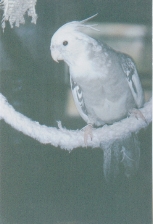
| A White-faced Pearl Pied split to Fallow Female Cockatiel. They call her "Whoo" because they think that she looks like a snow owl. Humans can be sooo wierd that way.. personally, I always thought she looked like... well, like a cockatiel...But "Whoo" am I to judge? Notice how she doesn't have any yellow or orange coloring in her feathers, the way that I do? That's because she's a very special mutation...Someone** went to a lot of effort in selecting and then breeding cockatiels of various genetic strains to achieve such a beautiful work of art. And that's just what she is too, poetry in motion, a song in the air, wings of white, a streak of light...any way that you look at her, she is a totally exquisite, thoroughly unique, warm, funny and dazzlingly personable parrot. She's called White-faced because, of course, she is. Cockatiels living in the wild are almost invariably what are referred to as Normal Greys, meaning a grey bird, with orange cheek patches, and yellow faces. White-faced cockatiels do not visibly exhibit genetic markers for orange and yellow, although they may carry those markers as recessive genes, and sometimes those genes can establish a harmonious balance with the genes carried by their mates. Of course, the "pearl" reference is to the white oval patterns in the coloration and the "pied" to the seemingly random display of melanin. "Split to Fallow," the primary recessive trait present in the genetic codex of this particular parrot. Visually identifiable "Fallows" are very light brown, almost "dusted," in contrast to "Cinnamons," who tend toward the medium shades of brown. "Fallow"can be suspected from visual observation of the reduced presence of melanin in the eyes, giving them a blood-red tint However several strains of cockatiel exhibit this same red gleam, to greater or lesser degrees. Only sure knowlege of the genetic origins of this bird, or equal knowlege of her offspring can be used to establish a reliable position in a breeder's portfolio, if indeed, coloration and pattern are your sole criteria for success. Unfortunately for us all, there are far too many breeders who think in exactly those terms. And while it is an acknowleged goal of many cockatiel associations to breed, in time, an entirely black specimine, greater consideration must be give to overall health, size, conformation, hardiness, life span, prolifigacy, fertility and of course, intelligence, personality, adaptability and sociability. |
 |
 |
 |
 |
 |
|
|
| Install Free CursorSkins from CursorSkins.com |
 |
|
|

