 |
| Established in 1988 |
 |
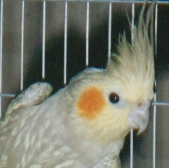 |
| Hi, welcome to my page... What? Surprised to see a cockatiel with her very own page? That's just because you don't know me very well yet...But if you did, you'd know, just like my friends Bobby & Vikki, that I almost always get my own way...And that's not just because I was the first parrot to come to Sandspur Villa. I'm also the prettiest. And the smartest. And I've got sooooo |
| many babies that if it weren't for Bobby & Vikki, I would have lost track of them all a long time ago. Whenever you visit here, you will find that we've made some changes, from page layouts, or backgrounds, to new photos and information in response to your requests in our guestbook and online. We'll talk about color and patterns, mutations, size, conformation, different society standards, groups of bird lovers around the country and shows where you can see cockatiels looking and behaving their best. This picture of me was taken when I was a bit younger. I'm 13 years old now. Most cockatiel breeders would call me a Primrose Cinnamon Pearl Female Cockatiel...See how bright red and orange my cheek patches are? That's because I get lots of beta carotine in my diet, from foods like yellow squash and carrots and especially from sweet potatoes, my personal favorite. Hey guys, that was supposed to be a hint... Anyway...My yellow polka-dots are called "pearls" or "opaline." The term "cinnamon," besides being my most perfect name, comes from my light chocolate brown coloring, caused by "melanin," the same thing that causes humans to tan in varing degrees, dependant upon how much melanin they have in their bodies. As cockatiels grow older, the amount of melanin they have in their bodies grows, and their colors tend to darken. "Primrose" refers to my warm yellow shading... |
 |
|
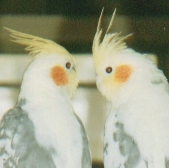
| This is Lace and Angel... Lace, on the left, is a Pearl Pied Split to Cinnamon Male Cockatiel, and Angel, on the right, is a Pied Split to Cinnamon Female Cockatiel...When Bobby & Vikki named these two they didn't know that "Lace" would turn out to be a boy. That's because pearls, pieds, lutinos and any combinations of these three all look like girls in the beginning. A Pearl Male cockatiel will lose his pearls at about six months of age. Pearl Females never lose their pearls. Pied Males and Females are difficult to distinguish visibly the first six months. Once these cockatiels hit the six month mark and go through their first moult, losing their baby feathers and growing their adult feathers, you can often tell by placing a tail feather over a light source, like a flashlight, and observing the colors. If the tail feather appears solid, you probably have a male. If you see stripes of light and dark alternating shades, you probably have a female. One of the best indicators of gender in cockatiels at a young age is going to be behavior. And we'll talk about that soon... |
|
 |
 |
| We recommend The New Cockatiel Handbook, available from Barnes & Nobel.com Associates...to search their extensive listings... |
 |

|
|
|