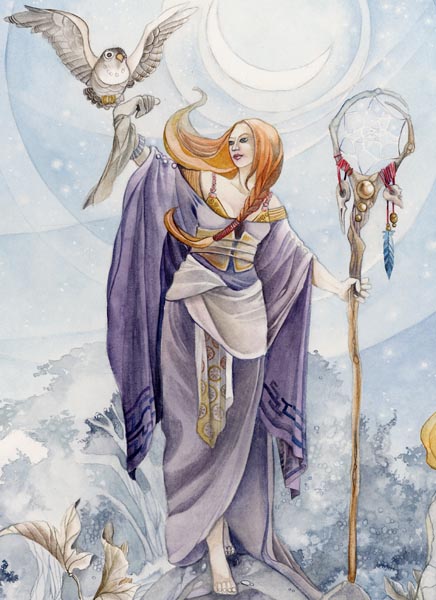
by Stephanie Pui-Mun Law
SHR Main Page | Galfraidus' Sanctum
|
by Stephanie Pui-Mun Law |
The first and single most important distinction within Hermetic society is nearly so obvious as to be almost invisible - possession of the Gift. The Order of Hermes divides the world swiftly and readily into two camps: those with the Gift and those without. One may not be a true member in full standing of the Order without the Gift. As such, no matter who respected a non-Gifted individual may be, no matter how intelligent, admired, or talented, such an individual will never be the true equal of a Hermetic magus.
Those who have the Gift but do not receive Hermetic training are hedge wizards. This makes them second-class citizens as far as the Order is concerned, less even than most apprentices, though with allowances, however grudging, for a certain amount of power, however limited it may be by Hermetic standards. These individuals must be accounted for, as they still have potential, but most will never come to much politically, even if they enter House Ex Miscellanea.
Now let us turn to rankings within the Order of Hermes itself.
The simple rank of apprentice actually has subtleties within it. The first step is a beginning apprentice, one who has not yet learned Latin; this stage may be swiftly passed through if the apprentice has had some education prior to entering the Order. Until the apprentice masters Latin, however, they are as much a liability as anything else; they cannot read from the library and cannot join in learned conversation. Above this grade is the apprentice-proper, a student slowly learning the various Arts and methods of the Order of Hermes and a particular house. Certainly many such apprentices, assuming there is more than one in a given covenant, would constantly test and challenge each other to create a pecking order, but this is of little concern to the magi. Then there is the status of an apprentice ready to be Gauntleted; this is similar to the status of a doctoral student who has passed examinations but has yet to complete his dissertation. Such an individual is precariously placed, in that not every apprentice passes the Gauntlet on the first attempt. Until they have passed the Gauntlet the person is simply an apprentice; after passing the trial they are a magus. The two positions are worlds apart. The pinnacle of this status is being a Gauntleted apprentice, one who has passed the final magical examination but has yet to be fully documented in the Order as an official magus. How long it takes to move from being a Gauntleted apprentice to being a magus may be a matter of moments or as much as seven years, depending on how a given tribunal arranges such matters.
The apprentice, of whatever level, would also at least potentially reflect back on the standing of his parens. If an apprentice were to excel in a specialty of a given house this would bode well for the master. House Verditius in particular sets great store by both personal and reflected glory and accomplishment, thus an apprentice (or ex-apprentice, now magus) who creates particularly beautiful, powerful, or useful objects would underscore the abilities of the parens, adding to the master-magus' position within the house. Certainly other houses would have this to a lesser extent - a filius from Bonisagus who makes a Hermetic breakthrough will spread some of the glory back to their parens, a filius of Guernicus who becomes a Chief Quaesitor would endow some honour bestowed retroactively to their parens, and a Criamon filius who delves deeply into the Enigma or one of the particular paths would be said to have been prepared by their parens. Reflective glory should not be regarded lightly within the Order.
A final note on apprentices, or rather ex-apprentices, must be made regarding House Tremere. After the Gauntlet the ex-apprentice is considered a magus but does not receive their voting sigil; instead this item is left with the parens for an indeterminate period of time, essentially until the ex-parens deems the ex-apprentice worthy of holding the voting sigil. This places the non-sigil-holding Tremere on a slightly lower social standing than his fellows simply because he is unable to voice an independent opinion in tribunal.
Awkwardly, there is another status that needs to be addressed at this point, that of the failed apprentice. Such individuals are in a difficult position whether in or out of the Order. Consider the position - this is a person who knows of the inner workings of the Order of Hermes, knows names of magi and covenants, and was being groomed for a position of authority within that group. The failed apprentice may still possess the Gift, probably does to some extent, but has no real place in the Order of Hermes and has some highly specialized knowledge that is of little to no use in the mundane world. If the failed apprentice stays within the Order's structure, he will have no comfortable status. He would need to be acknowledged and, in certain matters, would probably rate above a beginning apprentice in capability, thus being similar to a standard apprentice, though without the ability to advance further and thus perpetually condemned to be a second-class citizen. Such individuals may make fine consortis, but many of them would even feel uncomfortable in that regard. They could, however, fill some very valuable and specific slots within a given covenant's hierarchy, such as librarian, scribe, or even permanent laboratory assistant, especially if they have at least some amount of Magic Theory. While not magi and no longer apprentices, they would have a working knowledge of the ways of the Order in general and their ex-parens in particular, thus presenting a unique set of abilities as well as a familiarity with the specific covenant. One imagines that there might even be a society that could spring up within the Order to take care of failed apprentices. More darkly, there could be Hoplites assigned to make sure they never speak of the Order to mundanes.
Once one is officially a magus, a process that apparently varies slightly from tribunal to tribunal, one has certain status markers that may be achieved, though they rarely have specific designations as such. Obviously there is a separation between magi who may take apprentices and those who may not. According to the mechanics of the game, a magus may only take an apprentice once they have raised all their Arts to level 5; to have less knowledge than this means that the apprentice would have a Deficiency in the Art.1 As this is a Low Crime in the Order of Hermes, magi try to avoid this. This suggests, however, that there is some way that magi in the Order rate each other, perhaps in magnitudes, regarding knowledge in the Arts. Perhaps there is some form of examination or even a practicum that one may participate in to be certified as powerful enough to train an apprentice? In any case, there is a significant social difference between those able to train apprentices and those who may not. This might be seen as a second "coming of age" in the Order of Hermes, the point where one becomes a true adult.
The next status point is much more obvious, that of actually training an apprentice. Fifteen years is a long time to devote to the education of a single person, and while there obviously will be influences upon the apprentice other than the parens, they are the prime influence on their apprentice, the face of the Order and all that it stands for, the exemplar of the house. Taking an apprentice is more, however, than simply training someone. This is the equivalent of being a parent and would be seen as such - without apprentices there is no "next generation" in the Order of Hermes. So those who have an apprentice, or have trained one in the past, are seen in a different light than those who have not, even if they are capable of doing so. Those who have fully trained an apprentice, which is next step in the hierarchy, are taken seriously, with a certain amount of gravitas; they have fulfilled a major requirement in the life of a magus. They have forged the next link in the chain.
Somewhere in the midst of this learning and training there is another demarcation point, that of one's first longevity ritual. Before this point the magus, though well schooled in the Hermetic arts, is still in some small way part of the mundane world. After a magus partakes of a longevity ritual, they may never have "vulgar" children again, only Hermetic offspring (apprentices). Perhaps this threshold is passed in private, perhaps publicly. In any case, it marks the magus as something utterly different, something other than strictly human. Though many magi may not recognize it, it is indeed a differentiation in status.
Tied to concept of the longevity ritual is the attendant matter of vulgar children. What are vulgar children, especially unGifted ones, to the Order and the magus? We know that The Gift is not something that passes along invariably through bloodlines; thus the chances of a given magus' vulgar child having the Gift might be no greater than that of mundane parents. The child, however, would have a parent who is a wizard and would very likely be raised within the confines of the covenant. Such children would undoubtedly have the Covenant Raised Flaw, but what is their precise status and how does this reflect back on the magus-parent? Most likely this would be resolved on a case-by-case basis. The child is automatically an Arcane Connection to the magus, thus a potential liability in terms of security to the covenant and the magus;2 such a child might well be seen first and foremost as a danger to the magus. Conversely it might well be assumed that members of House Jerbiton and Mercere, with their strong ties to the mundane world, would look upon vulgar children as sources of joy and pride simply through their existence. Most, however, would probably view children as a minor annoyance or petty concern, something to be left in the care of the vulgar mother or father; an unimportant matter as the child has absolutely nothing to do with the magus' Hermetic career. Such children might, if they stay within the Order as covenfolk, might gain a certain amount of reflected status themselves due to connection with the magus-parent, but the parent would, in most cases, gain nothing back, barring peculiarities such as quests and great deeds.
Somewhat related to this are two other personal goals of most magi - the creation of a familiar and the creation of a talisman. The former certainly marks a magus in the Hermetic landscape in that he now has an identifiable extension of himself, his familiar. Some familiars are able to communicate with others, thus acting under certain circumstances as a surrogate for the magus, potentially even conducting negotiations in his name. Familiars are very obvious, especially as the two eventually take on certain traits of the other. Again, this denotes a certain amount of "seriousness" in the magus, a clear step along the path of magehood. The creation of a talisman is less obvious as it is often subtle. While certain magi are known for their talismans, most are not, at least on the surface. As such the creation adds little to the overt status of the magus, though it may add a measure of respect amongst those who know about the specific talisman and its effects.
Archmagus status is in the eyes of many magi the pinnacle of success. There are realistically four different status breaks here - the challenger, the archmagus, the almost-out-of-challenges archmagus, and the ex-archmagus. The archmagus sets a specific challenge for those wishing to overtake them in status. The mere fact that one is ready to challenge an archmagus marks one as being in a different class from those unable to mount such a challenge. Once one announces that one is willing to challenge an archmagus, one is seen differently; one is a challenger, not simply a magus. An archmagus may only be defeated in his challenge seven times; if one is defeated more often than this one is an ex-archmagus, a humiliating circumstance. There is a tradition in the Order, therefore, that it is unseemly to challenge an archmagus with only one challenge left, and some even consider it bad form to challenge an archmagus who has suffered five losses.3 An archmagus who has suffered six defeats no longer has precisely the same status, being viewed as something between walking wounded and professor-emeritus.
There are certain administrative positions that must be taken into account as well, of course. The first two are fairly common offices - those of Redcap and Quaesitor. The status of a Redcap is somewhat problematic. They are non-practitioners, un-Gifted individuals who are granted the status of magus, though with the understanding that they will never actually vote at a tribunal meeting. As such they, though legally magi, are of a lower social status. Quaesitores, conversely, begin with a slightly higher status than most magi. As investigators and judges of the Order of Hermes they are granted a certain respect and authority, if at times grudgingly.4 Quaesitores, like Redcaps, traditionally do not vote at tribunals, but their moral weight is felt by most. Somewhat lower than the Quaesitor, yet still viewed with respect as well as a certain amount of fear, are the Hoplites, their defenders and co-investigators.
Higher than these are the Praeco and the Chief Quaesitor of the tribunal. The powers of these offices have been detailed in the core rulebook and Houses of Hermes: True Lineages, but some points bear underlining. The Chief Quaesitor is the last word and arbitrator on most legal matters within the tribunal; this means that he has many subtle powers, potentially shading many arguments and debates by citing specific precedents and case histories as well as decisions from the Peripheral Code. The Praeco, of course, may silence individuals and set the order of debate and vote at the tribunal. Both of these offices are obvious in their power and status.
Various houses within the Order also have rankings that they apply to their members. Each house, of course, has a Primus. The power and status in this office varies greatly from house to house; in House Bonisagus, for example, the Primus may dictate lines of research amongst other magi of the House; conversely, in House Verditius the office, apparently, is primarily ceremonial. The Primi do collectively have status and power in the Order, as they always gather at the Grand Tribunal every 33 years, thus putting a stamp on Order-wide dealings for the next generation.
The Mystery houses also have internal differentiations relating to those who have gained Minor and Major Mystery Virtues, as well as those who are able to act as mystagogues. However, a full discussion of these positions is somewhat beyond the scope of this article.
In the end it is readily seen that social status within the Order of Hermes is far more complex and less directly egalitarian than it appears on the surface. What does all of this mean, however? Human beings are social creatures; as such matters of hierarchy are often of great importance within a given social organization. The Order of Hermes would, like most of 13th century society, view the world in a deeply hierarchical manner. This is an era when the fine gradations between a cottar, a sokeman, and a serf are as important as those between a knight, a count, and a king. Why would the Order of Hermes be any different? None of the points brought up in this article are particularly earth-shattering; this is merely a listing of matters that are already known thrown into slightly sharper relief.
Once this material is known, however, what use is it? Therein lies a large and important question. Matters of social status and precedence are important in society. Just as a Count usually outranks a Baron, but there are times when a newly-minted Count is held in lower esteem even by his putative inferiors, so too may such matters rear their ugly head in the Order of Hermes. Consider some of these potential situations:
My thanks to both Niall Christie and Brian Watson for valuable feedback on this article. I couldn't do it without you two!
Text copyright © Angus Macdonald 2006.