SHR Main Page | Galfraidus' Sanctum
There are certain underlying questions to Ars Magica that always nag at me. One that has been seriously gnawing away at my roots recently relates to problems with The Gift. Consider these points. The Order of Hermes wants to eliminate all practitioners of magic from the face of Mythic Europe who do not fall under the Order's auspices. The Order accepts anyone willing to follow the Code. The Order does not care if the person with The Gift is male or female, peasant or noble. All with the single requirement of The Gift are equal within the Order. But this is not altogether the case. The Order, whether it says so or no, only wants scholars.
Think to your various sagas, or ones you have heard about. How often do we find magi with an Intelligence 0? How about Intelligence -1, -2, -3, or even **shudder** -5? Occasionally such a magus arises, but only as comic relief. Why so? Because one's lab total is inherently based on one's intelligence. Also if one looks at the curriculum of the Order in training its apprentices, one sees the whole of the Order of Hermes is geared towards scholarship. In the end the view of the Order presented in Mythic Europe is one of scholars diligently working away, often on tracks of knowledge as obscure to their contemporaries as the minutiae of particle physics are to most of us in the 21st century.
This suggests that The Gift is inherently tied to intelligence. However this makes very little sense. Consider the various "hedge magi" so far identified in Ars Magica. Both Cunning Folk and Natural Magicians certainly require intelligence, but a Spirit Master requires Presence and Communication. The Ascetics require Stamina above other attributes, but Purity above all else. Gruagachan are seemingly tied to Intelligence, yet most of their skills seem more tied to Communication than the rules indicate. Vitkir require Intelligence, which seems appropriate. The Volkhv? Presence, but backed up with Stamina. Shamans need Stamina and Communication. Finnish Wind Wizards are tied to Dexterity and Communication. Kabbalists require Intelligence, Stamina, Perception, and Communication, quite the range, in addition to their Purity. The Baal Shem is back to Intelligence, as is the Necromancer, although the latter also requires good Communication and Presence. Why would only intelligent individuals, then, be able to work magic within the Order? On the one hand there might be a vast conspiracy within the Order of Hermes itself to hide the less-than-scholarly brethren within its bounds, but I think it is just as likely that there are styles of magic that the Order has not considered that are not inherently based on one's ability to comprehend Plato and Aristotle.
The image of a magus with Int -3 seems counterintuitive. Why would anyone play such a character in Ars Magica? But as shown above The Gift can be manifest somehow through almost every attribute (Strength and Quickness are the only ones not represented), yet the Order of Hermes assumes that Intelligence is the base attribute required for all magic. What happens, then, when a member of the Order finds someone who has The Gift, but has a substandard Intelligence?
|
Characteristics: Int -3, Per +1, Str +1, Stm +2, Com +2, Pre +2, Dex +1, Qik +1
Age: 20
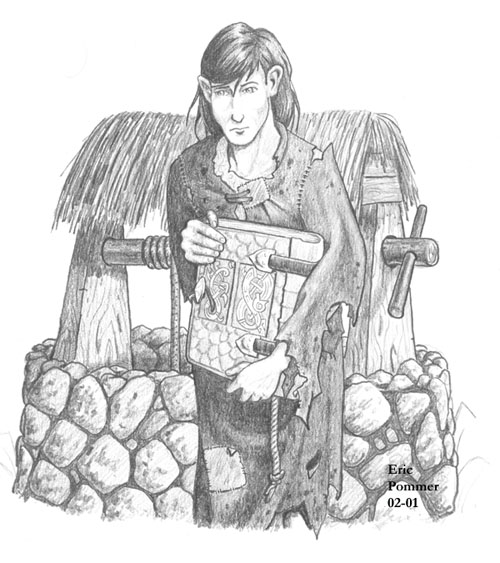
Not such a bad fellow, all things considered. Okay, a bit slow on the uptake, but other than that he is quite competent. He is "legal" by the rules and utterly hopeless as a magus.
First of all let us follow the standard path for an apprentice. Our poor Stultus, taken apprentice at age 7, has spent 15 long, grueling years fighting against his master. And yet here is someone who is not widely proficient in speaking (5) and reading (3) Latin, Magic Theory (5), and other obscure lore (Hermes Lore 2, Parma Magica 2). One wonders how he came to acquire such ability with Latin alone (a skill based on Intelligence, as are Magic Theory and Hermes Lore)! Barring any notable Flaws, such as Stingy Master, he has at his fingertips a wide array of magical powers (150 levels, just like anyone else) that would make him the envy of his back-at-home peers. He would also have about 23 points (age + 3 for an "average" House) to place, without restrictions, into further skills, including such topics as Artes Liberales.
But then Stultus hits the stumbling block. Unlike his colleagues, despite a more or less equal footing at the beginning of a saga, poor Stultus will never keep up. His lab total (Technique + Form + Intelligence + Magic Theory) is forever hampered by his Intelligence, as is his ability to gain further levels in the Arts (study total based on Intelligence + Concentration) that might counter this deficiency. Each season he will lag a bit further behind his new peers, an object of derision. In addition his ability to cast spontaneous magic will likewise be hampered (Technique + Form + Intelligence). With time poor Stultus will probably become a bitter and frustrated individual. What Covenant would want him? What expedition would take him? How often would he be allowed to speak at a Tribunal? And yet, due to The Gift, Stultus is a magus.
If Stultus had only been found by a Spirit Master or a Volkhv! Then, while his requests to spirits and gods might be a bit less imaginative than those of his quicker thinking colleagues, he at least would have had a chance for his native talents to shine to some extent.
This suggests possible areas of enquiry for the Order however. Is it possible that some Original Research Discovery™ might occur that would allow someone like poor Stultus to become a worthwhile member of the Hermetic community? Certainly with his Strength, Stamina, and Dexterity it appears that he would do fine as a Verditius craftsman. No, he would win no awards at the House competitions, but still he would make a fine Mage-Smith in most regards.
Almost of necessity Stultus would be shunted aside into House Ex Miscellanea; no other House would want him under the standard rules. But would this mean that he would be trained in non-standard Arts or that he would merely be a poor magus? The position of an Ex Miscellanea magus is tenuous and ill-defined in the rules. Following the basic rulebook alone this House is merely a wide open version of the other Houses -- the House Template in the core book certainly suggests that members of the House can move around their base skills to a wide extent, but in the end they use exactly the same rules as the other Houses. This would be of no help to Stultus. Of course he might be designed using another magical system, as suggested through such supplements as Hedge Magic. This would probably be his best "out" in the game.
But this does seem to represent a problem to the Order of Hermes overall. The avowed goal of the Order is to bring all those with The Gift to heel, to bring them all under one overarch set of rules and regulations, yet the verities of The Gift itself work against this. While the Order of Hermes has created a powerful model of magic, it assumes that all adherents are necessarily of a scholastic bent. Even the Church is not as rigid as this, in that there are many allowances for monks and those of lesser orders to participate richly in the life of the Church without necessarily being deeply versed in scholarship. If the Order is to fulfill its own goal of gathering all those with The Gift under one roof, then, the theories of magic must be made broader to allow for those who have the wherewithal to become magically powerful while not having the mind (or inclination) to be shut within a library for the rest of their lives.
Text copyright © Angus Macdonald 2003. Artwork copyright © Eric Pommer 2003.