| Burma |
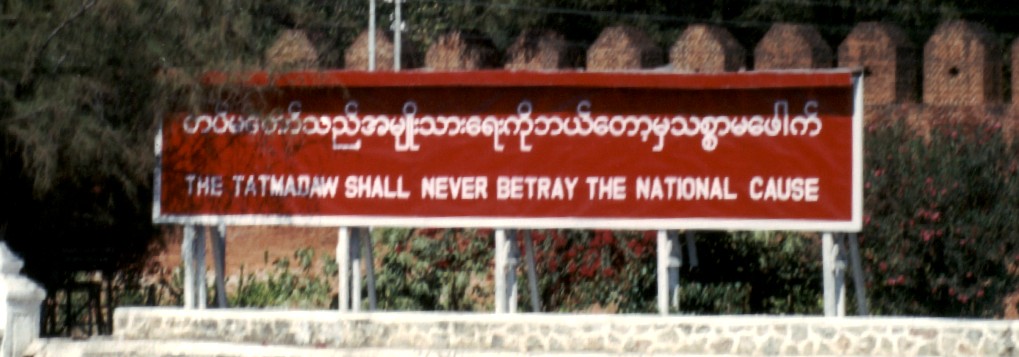
| The Military Regime (Tatmadaw) Their are Orwellian signs (above) displaying government propaganda all over the country, stating such things as : "Tatmadaw and the people cooperate and crush all those harming the union". The country name was changed in 1989 to Myanmar. It is recognised only by those living in Burma. There are many government spies, and the Burmese interaction with the tourists is closely watched. Many people do not speak out against their government for fear of imprisonment or execution, and those who do are taking a great risk. Propaganda fills the one TV channel and one newspaper. Military marching and stories of the government's 'wonderful' work are the only news the Burmese are allowed to receive. No outside magazines or newspapers are allowed in the country, and only books and music in Burmese can be distributed. Therefore, a radio is a most valued possession. BBC World Service can be received, and those that speak English pass on the world news to others. I met one woman who had been listening to BBC World Service for over 40 years, and all she wanted in the world was a BBC calendar so she could put faces to the voices she had been listening to. Most of Burma is off limits to tourists. Permits are required for many areas, yet not often granted. Visa extensions are hard to come by, and bribes are paid to achieve even the most simplest of things. I had to pay a bribe upon entering the country to avoid paying more money than necessary to the government. Fighting has continued for many years between the large hill tribes that exist within Burmese borders. All are fighting for independence, and this fragmentation has dogged Burmese politics for hundreds of years. The largest of these groups, the Shan people, have an army of over 30,000 troops. It is rumoured (and no doubt true) that the majority of government funds comes from opium. It is estimated that 50% of the heroin in the USA is exported from Burma. Opium is not used on a grass roots level by the Burmese, except in the very remote areas. Forced labour is the norm, and thousands of Burmese have been relocated to make way for hotels as the tourist industry increases. |
| EXPERIENCES AND STORIES |
 |
|
 |