|
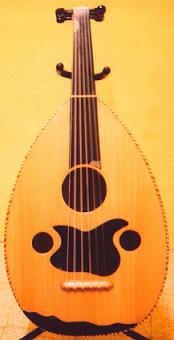
The 'ud , also spelled oud, is a direct descendent of instruments depicted in the wall paintings and carvings of Egyptian, Assyrian, Sumerian and far east civilizations. It has a deep, pear-shaped body; a fingerboard; and a relatively short neck and somewhat less acutely bent-back peg box than the European lute. The tuning pegs are set in the sides of the peg box. Its strings are plucked with a plectrum and are fastened to a tension bridge on the instrument's belly. The earliest �uds were thought to be carved from a single solid piece of wood, with a neck and two crescent-shaped sound holes and an animal-skin sound board, much like some East Asian lutes and the Persian barbat.
The instrument musically and technically evolved during the Islamic period in Spain (711-1492) and gained its current characteristic appearance; it was the parent of the European lute.
Surviving pictures of the 'ud show no frets, but it is possible that both fretted and unfretted types were used. Modern �uds are fretless and are not completely standardized in size or number of strings; five courses of string-pairs are common, six and seven pairs are also found. The 'ud is known in Turkey as the lauta and in the Balkans as the oud or uti. The kuwitra, a longer necked, narrower variety, is common in North Africa.
Issa Boulos |
|