


Samba Bangor
Web diary from Brazil
|
|
|
|
|
Samba Bangor Web diary from Brazil
|
Back to Brazil Exchange Home Page 1 On to page 3 Page 4 Page 5
Kate & George's Web Diary - Page 2
This is the second installment of the web diary of Kaich and Giovanna - the intrepid cultural adventures of clueless in Savador. In this installment, I shall tell you all about the craziness that is carnival in Salvador and I shall wiffle on about some of the music encountered ....so they�ll be lots for any Samba geeks out there.
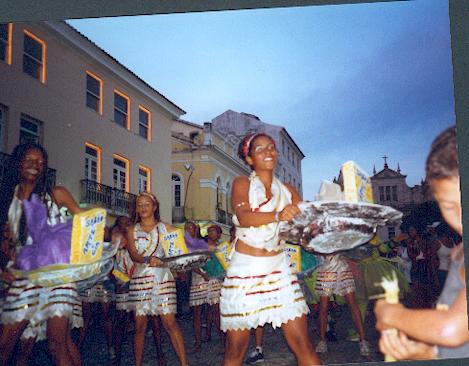 What can I
say...Carnival is the craziest thing I have ever seen. For those of you that
don�t know, Carnival in Brazil is a week long festival that falls on the week
before Ash Wednesday. Although carnival takes many different forms throughout
Brazil, the basic idea is to have a week long knees-up....and indeed that�s
what Salvador does. These people can party with a vengeance -- during Carnival
sleep is impossible.For a whole week
the streets are filled with total silliness: music, huge puppets, men in
skirts, lots of dancing, wiggling bottoms and people wearing the most
ridiculous outfits. beer, more beer, and even more beer (and a concoction
known as tamarino which will pick you up when you�re about to fall over and the
beer doesn�t work any more). This, of course, goes on all night. There is
perhaps a brief period of tranquility between 7am and midday in which people
either go home or just crash on the streets until the next bloco or trio
electrico goes thundering past (unless
you happen to be a street cleaner in which case you do your thing with binbags
and disinfectant -so a big shout for the geezers in blue and orange).
What can I
say...Carnival is the craziest thing I have ever seen. For those of you that
don�t know, Carnival in Brazil is a week long festival that falls on the week
before Ash Wednesday. Although carnival takes many different forms throughout
Brazil, the basic idea is to have a week long knees-up....and indeed that�s
what Salvador does. These people can party with a vengeance -- during Carnival
sleep is impossible.For a whole week
the streets are filled with total silliness: music, huge puppets, men in
skirts, lots of dancing, wiggling bottoms and people wearing the most
ridiculous outfits. beer, more beer, and even more beer (and a concoction
known as tamarino which will pick you up when you�re about to fall over and the
beer doesn�t work any more). This, of course, goes on all night. There is
perhaps a brief period of tranquility between 7am and midday in which people
either go home or just crash on the streets until the next bloco or trio
electrico goes thundering past (unless
you happen to be a street cleaner in which case you do your thing with binbags
and disinfectant -so a big shout for the geezers in blue and orange).
Carnaval in Salvador happens in three main places. Campo Grande, Pelorinho, and Barra.Campo Grande is for the hard core partiers...there�s no place to hide: cash in yer bra, take one last look at sanity, and start movin� (just don�t go near the gutter).The trio electricos pump out some serious voltage and, whether you like the music or not, if you�re in the crowds that fill the Avenida you�re gonna be dancing. The energy is fantastic, and although people told me they wouldn�t go near Campo Grande because of the violence, later on in the night it gets calmer; what�s more, if you're with a good bunch of friends and Ilê Ayê, (and a top afro dance teacher, big thanks and love Luamar), there�s nothing better.Weaving along a three lane, one way highway, as the sun�s rising, surdos giving out some serious samba reggae...the whole street, the whole city, its ours.
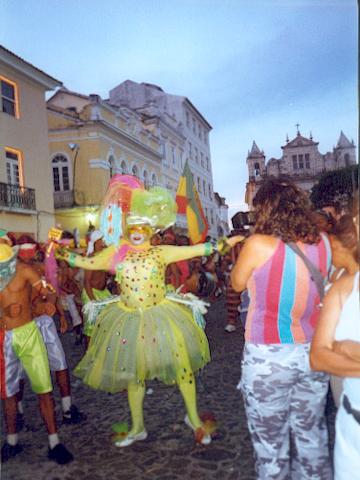 In Pelorinho, on the other hand, forget the trios, this is where you get the
smaller more traditional percussion groups in carnaval. Fancy dress plays a really important
role:in the trio electricos in Campo Grande and Barra, the costume or (�Fantasia`) is a tee shirt and a pair of
shorts; for the Afro blocos, like Ilê Aiyê, Male de Bale, and Cortejo Afro, the
Fantasia is based on african dress and conveys a strong sense of cultural
identity; in Pelorinho, anything goes - sparkles, strings of nylon flowers,
ruffles, big green lycra bottoms, massive puppets, and men wearing nothing but
silver spray (gorgeous as the silver men were, it did put you in mind of Goldfinger). Every so often, you�d some across a bloco made up of muscley he-men in
slinky frocks and false bosoms. It wouldn�t have been quite so funny had they
not been strutting around acting macho and trying to pull all the women.
In Pelorinho, on the other hand, forget the trios, this is where you get the
smaller more traditional percussion groups in carnaval. Fancy dress plays a really important
role:in the trio electricos in Campo Grande and Barra, the costume or (�Fantasia`) is a tee shirt and a pair of
shorts; for the Afro blocos, like Ilê Aiyê, Male de Bale, and Cortejo Afro, the
Fantasia is based on african dress and conveys a strong sense of cultural
identity; in Pelorinho, anything goes - sparkles, strings of nylon flowers,
ruffles, big green lycra bottoms, massive puppets, and men wearing nothing but
silver spray (gorgeous as the silver men were, it did put you in mind of Goldfinger). Every so often, you�d some across a bloco made up of muscley he-men in
slinky frocks and false bosoms. It wouldn�t have been quite so funny had they
not been strutting around acting macho and trying to pull all the women.
(right - bloke in frock with fake bazonkas)
According to Gary, a dreadlocked capoeira teacher with a school in Elephant and Castle and party guru to `up for it� gringos, Pelorinho is for women and children while Barra is for men.Unfortunately, I�m unable to comment on this, because we didn�t spend much time there, but generally its a younger trendier crowdthat go there. The only time we made it to Barra was for the `arrastaão�, the end of carnaval, on Ash Wednesday. After 5 days of carnaval it was an effort to drag ourselves along but it was worth it. Luckily, Timbalada and its musical director Carlinhos Brown continue to resist the pressures of churches and religious groups, who consider Ash Wednesday a non-carnival religeous festival, and play one last time to close the carnaval celebrations. Barra consists of a similar combination of Trio Electricos and Afro Blocs but is more open than Campo Grande. The circuit runs parallel with the sea and when things get too much you can escape to the beach to chill out.
Carnival music also tends to fall into three categories. First, there are the trio electricos which basically play pop music mounted on big lorries that chunder through the streets. To me, all trio electrico music sounds a bit like the hokey cokey on speed but when the whole street is wiggling, you just can�t help going with it. Secondly, the music of Afro Blocs such a Ilyê Ayê, Timbalada, Olodum, Male de Bale is percussion played by massive batterias of at least 50 drums accompanied by a similar number of dancers and an amplified singer who belts out songs whose lyrics speak of black conciousness and a common Africa heritage. Lastly, there are also afoxe blocos who play percussion music derived directly from candomble rhythms; Filhos de Gandi are one of these. Smaller blocos playing everything from traditional samba de roda to heavy nyabingi reggae stylee also trapse around the streets of Pelorinho. Some blocos are lead either by brass bands who play traditional carnival songs or by packs of caviquinho players who bob along singing with their mates.
As far as the main carnival circuit is concerned, carnival is very much dominated by the trio electricos. This wasn�t always the case, but these days, bands are expected to pay for the privilage of playing in carnival (Yes, indeed you did read that correctly!). The price is simply too high for many small community bands.
So a big thumbs up for organisations like Ilê Aiyê who, despite the government's attempts to push grassroots black music out of carnival, have survived and are acting as a voice of the dispossessed black majority. In fact, we followed Ilê Ayê out of Liberdade to the main carnival circuit on the Saturday night of carnival. Liberdade is one of the poor black bairros of Salvador and the stomping ground of many of the musicians (On the Saturday nights throughout the summer preceding carnaval Ilê Aiyê play in the streets of Liberdade to an audience of thousands who hang out of windows, cram onto the balconies or fill the streets). When Ilê Aiyê left Liberdade to join the carnival circuit, they were joined by the whole community. There are so many people following the band that we could barely hear them.....but it hardly mattered because the whole crowd sang along with all the songs carrying the music right through the crowd. It was just great!
Carnival is one of those rare opportunities for people who have nothing to make some money: it seemed that half of Bahia was selling beer from massively heavy portable coolers while the other half was drinking it. What can I say, apart from fair play to those people who work 20 hours per day selling beer, food , collecting cans, sweeping streets, manning the ropes of the trios and blocos and then party with a vengeance in the remaining 4 hours. The capacity of Brazilian people to counteract the effects of poverty in their lives with joy is just incredible. All the same, it is a bit sickening: the government spends huge quantities of cash each year decorating the streets for carnival and yet the people that work the streets during carnival live in communities where houses regularly get washed away into the open drains.
The idea that I am trying to convey here is that it is increasingly difficult for
disadvantaged people to do carnival the
way they want to: government policies exclude resourceless groups from the
carnival circuit and the mere opportunity of making some money during carnival
means that many people have to work. Nonetheless, this doesn�t seem to stop
people from doing that explosive carnival thing. In fact, one of the most positive
things we did in Salvador was become involved with the activites of Buscapé (a
childrens carnival collective which allows kids of disadvantaged communities to
participate in Carnival.) I spoke about Buscapé in the last entry - but, just to remind you, for the months
preceeding carnival hundreds of kids all over Salvador become invoved in making
recycled instruments learning dances, songs and rhythms.
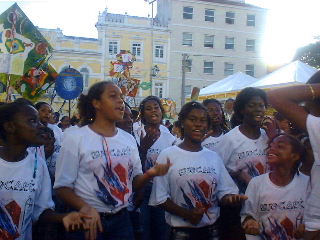
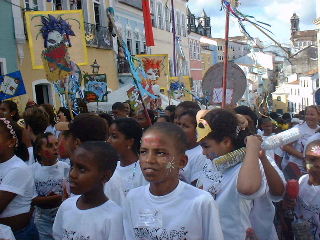
Hundreds of Buscapé kids processed through the streets
on the Saturday of carnival dressed in costumes and playing instruments that
they had made themselves. The energy was really positive and the kids really
seemed to get a buzz out of it. We loved it, not least because we had spent the
previous couple of days with a bunch of fantastic, lovely people frantically
doing last minute preparations.
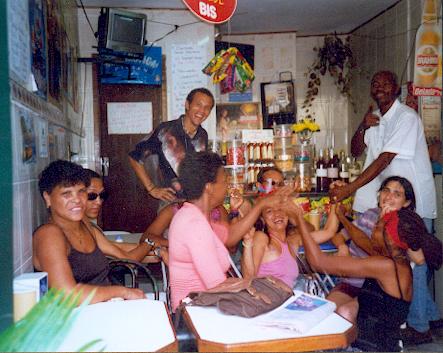
Now, I promised I would wiffle on in a semi technical way for you samba geeks out there, so here goes. The Samba Reggae here is, of course, absolutely brilliant - it quite often consists of a timbalada-style surdo line and bossa clave on the hepinique or caixa. Interestingly enough, we rarely saw tamborims (sorry Dewi!), however, the heppies would often break from their bossa clave line to add the colour that might otherwise be provided by the tamborims. Further, timbas also seem to play a really important role in providing movement and variety. Now, this may come as a shock to British Sambistas but we have rarely seen a bloco without a singer or a brass band - the percussion itself appears to play a relatively minor role, at least in the carnival repertoire of most bands: the spectacle, and song are considered far more important. This may be the reason why a lot bands appeared to be playing anything but the basic samba reggae stuff.
We played with a band called Kizumba - well, I say played.......I shook the chequore and giggled around lots. The music was fantastic. The band is led by a guy called Bira Reis who is my hero: he is infinitely smiley and an inspirational musician. He�s involved in an organisation called OIMB (Organização Investigação Musica de Bahia) who, among other things make traditional hand-made instruments. His shop seems to act as a focus for visiting musicians who somehow get incorporated into Kizumba by a seamless process of good musicianship. Within Kizumba, all the action is focused on the timbas, surdos and repis who played a complicated set of virados, and calls from a huge cow bell. Kizomba also includes instruments not usually found in a modern batteria, for instance the west african Dun Dun with a series of cow bells and jam blocks attached which mark clave and bass line, or the atabaques played with stick and hand.
Before I leave the topic of carnival, I should also mention a thing or two about some of the other music we have heard both before and after carnival. For the month preceding carnival there is free music in Pelorinho every night on three different stages. It�s like living in the middle of a permanent festival. We have just seen too much music is describe it all but the stuff that had really grabbed our attention is the reggae. Roots reggae here is light and laid back. However it is difficult for a lot of reggae bands to get gigs because the market is flooded by free government supported concerts. In addition, the music is political and challenges the government.
One such government-challenging reggae group is Bem Adventurados (which means something like �well adventured�). This group is particularly interesting because they are involved in a campaign called SOS Filhos de Centro Historico which is a campaign to save the homes of those families who live in Pelorinho and support children who became homeless during the restoration of the centre. Perhaps I should explain, Pelorinho is the old centre of Salvador - Pelorinho means �whipping post� and it is where slaves were brought to be sold and tortured. Pelorinho is replete with beautiful, narrow, cobble-stoned streets, colourful, ornate buildings and fantastic churches originally built using the profits from slavery. Around 10 years ago, Pelorinho was a completely different place - a poor locality of Salvador, a community that faced the same problems of poverty everywhere: crime, drugs, prositution. It was UNESCO that initiated the preservation of this area of historical and cultural importance.
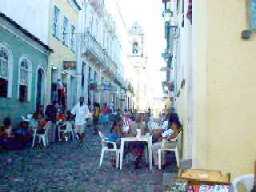
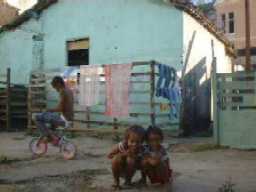
During the restoration of the historic centre families were moved out and the problems of poverty moved. Today much of Pelorinho only houses boutiques and restaurants aimed at tourists, but on the streets of the neighbouring Bairro de Sapoteiros people are sleeping rough. As always in Brazil it seems that injustice, abuse of power, drugs, misery and crime form a back drop to the tourist dollars. On the other hand, the restored Pelorinho is a very beautiful place and provides a more accessible base for the cultural groups of Salvador.
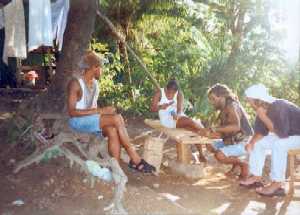
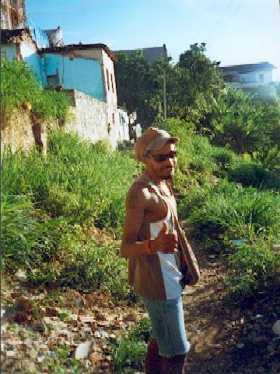
Pelorinho - left, work in the scrubland behind the tourist mecca; below, rasta in the back alleys
Thats all folks. "Next Week" Ahem.... Good bye Salvador... travails of website production, cultural wonders, hippy hut-on-sea, and signing off from paradise. Wish you were here! Beijos, Kate and George.
Back to Brazil Exchange Home Page 1 On to page 3 Page 4 Page 5