


Samba Bangor
Web diary from Brazil
|
|
|
|
|
Samba Bangor Web diary from Brazil
|
Back to Brazil Exchange Home On to Page 2 Page 3 Page 4 Page 5
This is the first entry in the web diary of Kate and George - or Kaich and Giovanna as we have become known, due to the fact that Brazilians can�t pronounce the final "t" or cope with a lass who has a boy's name. For those of you who don�t know, we�re here to do a project funded by Millenium Youth Awards scheme. The project is all about an exchange of skills: we aim to bring computer skills and English language teaching to Brazil and, at the same time, learn as much as we can about Brazilian culture (music, dance, capoeira) in order bring all this cultural gumph back to North Wales. We�ve been here three weeks but it feels like we�ve gone through a time warp in which we�ve squeezed a year into 3 weeks. Our crazy schedule has meant that we really haven�t had time to do the diary thing before now - apologies to those of you who were sitting on the edge of your seats waiting for the first instalment (....not!). These first few weeks has felt like living in the middle of a whirlwind of cultural richness: I haven�t really had time to digest it all. My first impression is that Brazil is a country of huge contrasts in which every vacuum or niche is filled. Almost all the people we have met have been immensely kind, imaginative, full of energy, and immeasurably cheeky. It also appears to be a country full of divisions - hey, but more about this later - lets get to the diary. Too much has happened to describe it all, so here�s a few highlights so far.....
The festival of Iemanj�
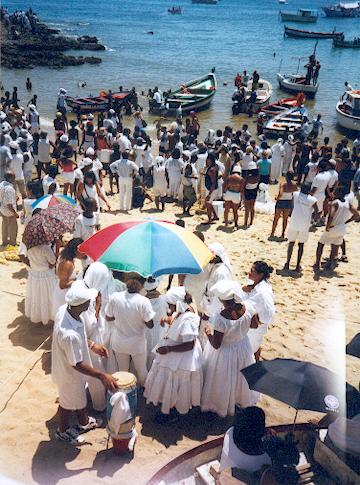 One of the first things that we did after arriving in Salvador was attend the festival of Iemanj� (left - people gather on the beach). Perhaps I should explain for those of you that don�t know, this festival is a
candomble festival -- candomble is the religion brought to Brazil by the
African slaves. Orixas are the gods of candomble and the year is punctuated
by festas de candomble which celebrate particular orixas. At these festas,
drums are played to summon spirits which are said to enter to bodies of
participants. The orixa Iemanj� is the mother of the sea (and most other
orixas). She is depicted as a beautiful woman with long black hair, robed in blue and white.
One of the first things that we did after arriving in Salvador was attend the festival of Iemanj� (left - people gather on the beach). Perhaps I should explain for those of you that don�t know, this festival is a
candomble festival -- candomble is the religion brought to Brazil by the
African slaves. Orixas are the gods of candomble and the year is punctuated
by festas de candomble which celebrate particular orixas. At these festas,
drums are played to summon spirits which are said to enter to bodies of
participants. The orixa Iemanj� is the mother of the sea (and most other
orixas). She is depicted as a beautiful woman with long black hair, robed in blue and white.
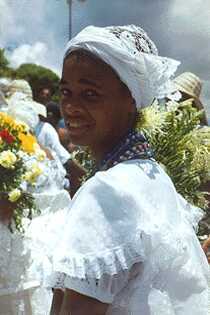 Women have a special role
in candomble - the women who practice candomble typically dress in beautiful
full white lace dresses and large headresses.
Women have a special role
in candomble - the women who practice candomble typically dress in beautiful
full white lace dresses and large headresses.
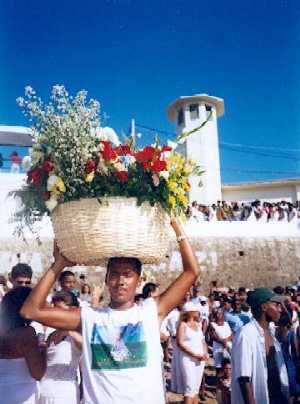 At the festival of Iemanj�, baskets laiden with flowers (left)are taken by local fishing boats and cast into
the sea as a way of showing respect for the god.
At the festival of Iemanj�, baskets laiden with flowers (left)are taken by local fishing boats and cast into
the sea as a way of showing respect for the god.
For us, the festival de Iemanja was a crazy day filled with both moments of beauty and bizarre comedy happenings. We stupidly forgot to dress in white, so, on the way to the festival, we popped into a shop and brought the first things we could find that were white. For Kate, this was a slinky dress and for me this was a pair of extremely short knicker sandwich shorts. This, of course, wouldn�t have been a problem were it not for the fact that, according to sexual morals of Brazil, foreign gringo women are seen as dead attractive (particularly when wearing a slinky dress). Having shrugged off the first volley of potential suiters, we headed down to the beach where groups of musicians were playing candomble rhythms. We found our way to the hut on the end of the peninsula which was the epicentre of candomble activities in order to present Iemanj� with a flower. At first, we peered in at the people participating in the candomble from the outside of the, hut but it wasn�t long before we were invited in. It�s hard to describe what we both felt surrounded by the hypnotic drumming and dancing. Maybe it was the music, but when we finally left the condomble the world seemed to have changed in some almost imperceptible way. Once anointed with perfume we placed our flowers in a basket and Kate made a wish. (I would have made a wish too had I understood that you could - oh well)
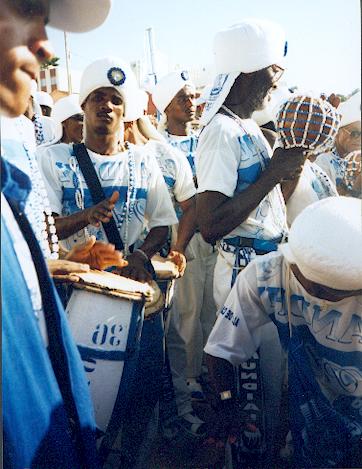 When we emerged Filhos de
Gandi (right) were playing on the beach. I confidently marched up to the band with a
mini-disk and microphone - they seemed delighted by the idea of being
recorded and grabbed the microphone and held it in the middle of the band.
Unfortunately, to my eternal embarrasment, he simultaneously pulled the lead
out of the recorder. Niether of us realised until just about everyone around
was laughing at our futile recording efforts. Meanwhile, Kate, who had turned
salmon pink on account of sunburn, had decided to take a swim (in slinky
white frock). She emerged from the sea looking like a participant in a wet
t-shirt competition into the arms of a priest who was performing a blessing
ceremony. Dripping, pink, and dressed in insubstantial fronk, the priest sung
and chanted while Kate simply smiled and glowed with delight and sunburn.
Meanwhile, a procession of flower laden baskets had made its way up the beach
to be greeted by a fanfare from Filhos de Gandhi. Our wishes, encapsulated in
the flowers, were loaded on to boats and taken out to sea. We sat and watched
as the sun set over the sea and I wandered what Iemanja would make of my
bewildered wishless flower. However, in Brazil there�s never much time for
wistfulness and we soon found ourselves boogieing along the street following
bands, wiggling our bottoms, and shaking off the attention of dodgy blokes.
When we emerged Filhos de
Gandi (right) were playing on the beach. I confidently marched up to the band with a
mini-disk and microphone - they seemed delighted by the idea of being
recorded and grabbed the microphone and held it in the middle of the band.
Unfortunately, to my eternal embarrasment, he simultaneously pulled the lead
out of the recorder. Niether of us realised until just about everyone around
was laughing at our futile recording efforts. Meanwhile, Kate, who had turned
salmon pink on account of sunburn, had decided to take a swim (in slinky
white frock). She emerged from the sea looking like a participant in a wet
t-shirt competition into the arms of a priest who was performing a blessing
ceremony. Dripping, pink, and dressed in insubstantial fronk, the priest sung
and chanted while Kate simply smiled and glowed with delight and sunburn.
Meanwhile, a procession of flower laden baskets had made its way up the beach
to be greeted by a fanfare from Filhos de Gandhi. Our wishes, encapsulated in
the flowers, were loaded on to boats and taken out to sea. We sat and watched
as the sun set over the sea and I wandered what Iemanja would make of my
bewildered wishless flower. However, in Brazil there�s never much time for
wistfulness and we soon found ourselves boogieing along the street following
bands, wiggling our bottoms, and shaking off the attention of dodgy blokes.
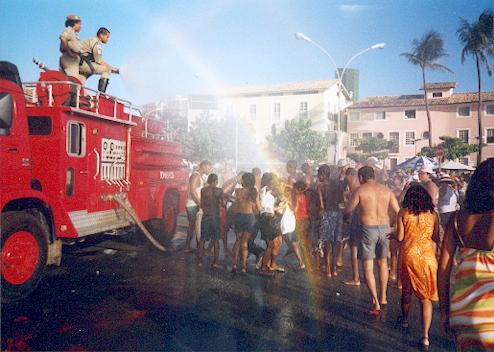
kids cool off during Iemanja Festival
Capoeira
 Capoeira is a Brazilian martial
art brought to Brazil by african slaves. There are two main kinds of
capoeira, these are: Capoeira de Angola and Capoeira Regional. Capoeira
Angola is a traditional form of capoeira that is close to that practiced by
slaves; it contains many elements of dance and ritual. Movements are
typically slow and performed close to the ground. Regional, in contrast, was
developed early this century by Mestre Bimba, who focused on the martial art
elements of capoiera. Regional typically uses spectalular kicks and acrobatic
movements. Both forms are extremely beautiful and, unwilling to miss out on
anything good, we�ve decided to train both forms of capoeira.
Capoeira is a Brazilian martial
art brought to Brazil by african slaves. There are two main kinds of
capoeira, these are: Capoeira de Angola and Capoeira Regional. Capoeira
Angola is a traditional form of capoeira that is close to that practiced by
slaves; it contains many elements of dance and ritual. Movements are
typically slow and performed close to the ground. Regional, in contrast, was
developed early this century by Mestre Bimba, who focused on the martial art
elements of capoiera. Regional typically uses spectalular kicks and acrobatic
movements. Both forms are extremely beautiful and, unwilling to miss out on
anything good, we�ve decided to train both forms of capoeira.
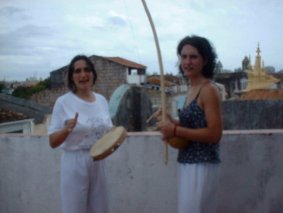
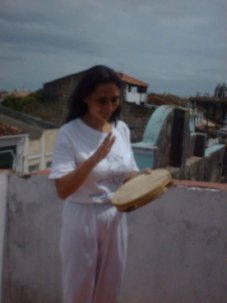
We are training Angola with Mestre Moa do Catendé at 8am three times per week on the balcony of an apartment near the centro historico of Salvador. Beneath the morning sun and overlooking Salvador, Moa puts us through our paces, constantly reminding us to always look at our opponent, to remember that capoeira is also a dance in which the ability to respond is all important -- �capoeira est uma dialoguo� -- capoeira is a dialogue between two people. Moa has smiling eyes, a cheeky grin and a wicked sense of humour. He is also teaching us capoeira music. We really couldn�t wish for a teacher with a lovelier voice or with less tolerance of the fact that playing the berimbau makes my finger completely numb.
We�re training regional with Filhos de Bimba. Filhos de Bimba also have a school in Newcastle where Kate used to train. Our Mestre is Mestre Nenel who is Mestre Bimba's son and he also seems to have the same capoeira glint in his eye that I observed in Moa. There are people of all abilities in the class and, at the moment, I am the wally of the class - I always manage to get caught out in some stupid comedy way. The classes typically start off with relatively easy movements and then progress to the kind of movement I consider to be a denial of the laws of gravity
Work with community groups
We have been working with two community groups: Activação and Buscape. Activação is a community theatre collective. It exists to help community theatre organisations train and function. There are six separate groups involved in Activação; our aim is to help each of these groups build a website and also build a central website for Activação. Progress is a little slow at the moment - but we�ve visited most of these groups in their home communities and started building the website for some of them.
One of the groups (called Degraus de Arte) invited us to attend a street performance they were giving in their own community. This group typically does issue-focussed street theatre. Robed in the craziest of carnivalesque costumes and face-paint, they marched through the streets singing and collecting a entourage of curious kids in true pied-piper fashion. They performed two pieces; one about domestic violence and the other about drug abuse. About 50 children watched the performance wide eyed and fascinated by the spectacle. It was truly inspiring to see such an effective and fun piece of grassroots activism.
One of the other groups (called Choque Cultural)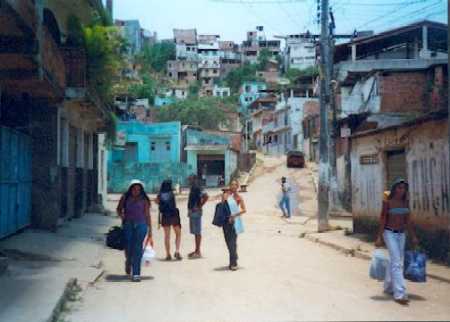 allowed us to participate in one of their workshops.
This group is based in San Martins (left) - a community that has virtually nothing
apart from ingenuity. Houses frequently get washed away when it rains, there
are open drains, and very little by way of school facilities. Nonetheless, as
we walked around the bara, Giovanni (our host for the day) introduced us to
all the people who had some involvement with community music, theatre, or
social projects - it seems that half the community is invoved in some way.
allowed us to participate in one of their workshops.
This group is based in San Martins (left) - a community that has virtually nothing
apart from ingenuity. Houses frequently get washed away when it rains, there
are open drains, and very little by way of school facilities. Nonetheless, as
we walked around the bara, Giovanni (our host for the day) introduced us to
all the people who had some involvement with community music, theatre, or
social projects - it seems that half the community is invoved in some way.
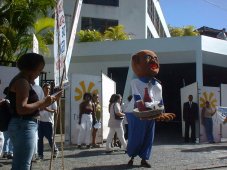
One of the larger and
more established groups (called Gueto Poetica) is based in a similarly
deprived area. Without resources, this group has managed to become firmly
established within their community, but also goes beyond this and has
participated in all kinds of other campaigns (such as J2000 campaign and campaigns
for better working conditions). They build huge puppets made of fabric and
foam that act as an excellent focus for street theatre. The commitment and
energy displayed by these groups who have to work without resources, with
really tough kids is incredible
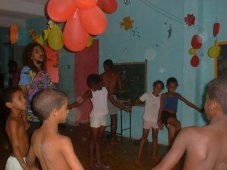
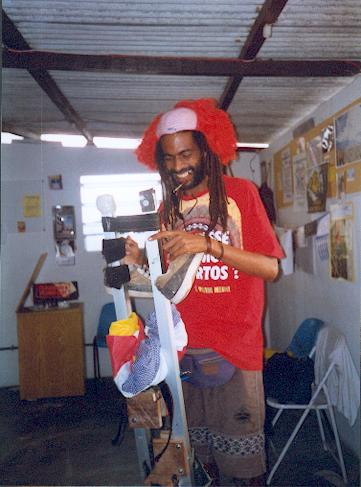
We have also been working
with a group called Buscapé: this is a childrens carnival collective and works
to give kids the opportunity to play, sing and participate in Carnival: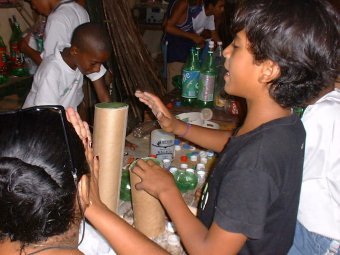 For
the three months before carnival Buscapé runs music, dance, and instrument-making workshops for kids (right). Some of the kids are disabled, others are street
kids or come from poor communities. Most of the instruments and costumes are
made from rubbish (bottles, tins, cardboard, and tubs) and then brightly
painted by the kids.
For
the three months before carnival Buscapé runs music, dance, and instrument-making workshops for kids (right). Some of the kids are disabled, others are street
kids or come from poor communities. Most of the instruments and costumes are
made from rubbish (bottles, tins, cardboard, and tubs) and then brightly
painted by the kids.
Each year they adopt a
theme: this year the theme is �Troca sua arma por um instrument musical�
which means swap your weapon for a musical instrument. The songs, the dance
moves, and costumes all reflect this theme. Twice a week we have been helping
out at the instrument-making workshops: this normally entails sticking my
fingers together, crushing my fingers with a hammer or getting completely
covered in paint.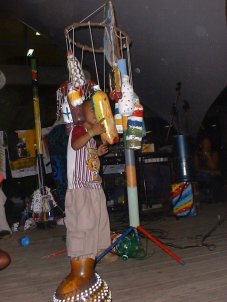 Maybe it's because these kids come from communities where
life is tough but they typically work together in a very adult way: when
there aren�t enough pairs of scissors they just share; where there are only a
few pots of paint they work around it. There is very little possessiveness
and they take delight in stuff that British kids might take for granted, such
as painting or throwing glitter around (or painting George). The volunteers
at the project are a great group of people - they are totally welcoming and
very tolerant of my propensity to mangle their language
Maybe it's because these kids come from communities where
life is tough but they typically work together in a very adult way: when
there aren�t enough pairs of scissors they just share; where there are only a
few pots of paint they work around it. There is very little possessiveness
and they take delight in stuff that British kids might take for granted, such
as painting or throwing glitter around (or painting George). The volunteers
at the project are a great group of people - they are totally welcoming and
very tolerant of my propensity to mangle their language
Believe it or not, this is a musical instrument.....you shake it (or hide in it)
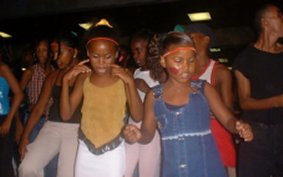
Launch party for Buscapé
Anyway, that�s quite enough for now. There�s loads more I could tell you about, but it can wait until I next get a chance to sit at the computer for a couple of hours. All the best
Ate breve
George and Kate
Beijos
Back to Brazil Exchange Home Forward to Page 2 Page 3 Page 4 Page 5