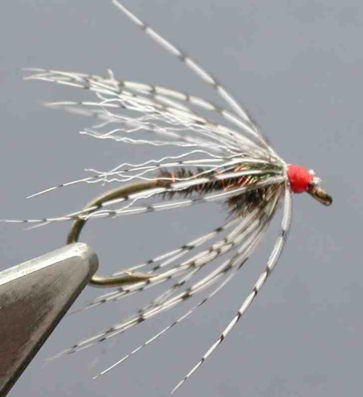
Sylvester Nemes popularized the soft hackled fly in recent times through his trilogy on the subject and some refer to him as the dean of the American soft hackle. Dave Hughes is another author that wrote eloquently about the same subject matter in his book, Wet Flies, and can also be credited for some of the resurgence in soft hackle popularity. However, for an in-depth history pertaining to the anglers, streams and some of the great soft-hackled patterns of yore, no better work has been done than Fly Fishing; The North Country Tradition by Leslie Magee. Sometimes difficult to locate, this British book contains a wealth of information and is one that no soft hackle afficionado should be without. The fine works authored by these gentlemen and some influence of a few fly-tying friends in conjunction with angling results from astream form the basis for my �improved� soft hackle patterns.
The most important deviation from the standard soft hackle style requires the application of an additional material. The additional material is a few crinkly fibers of clear, Antron yarn tied in directly in front of the dubbed thorax. Some might argue this material is serving as a wing. Its purpose is not to project the silhouette of a true wing but rather to produce a bit of flash in a location on the fly where emergence would be initiating if it was in fact a real insect. A few (5-7) fibers are tied in forward of the thoracic ball of dubbing and prior to the hackling procedure. The length of these fibers can vary a little with shank-length found to be about optimum. In field tests of flies tied with this emergent �wing�, it was preferred about seven to one over the same pattern tied without the addition.
I believe much of the allure of soft hackled flies stems from their inherent simplicity, ease of use and manufacture and the rate at which they induce strikes. The suggested improvement will increase the efficacy of these classic patterns without detracting from their positive attributes.