THE LIFE OF SAINT NEKTARIOS
Saint Nektarios of Aegina, is the most widely
known of Greek Orthodox Saints of the last two centuries.
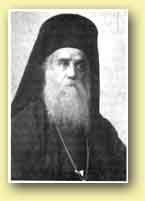 He
was born in October 1st, 1846 in Selybria in Eastern Thrace (now in Turkey).
He was one of seven children of Dimosthenis and Mpalou Kefalas and at Holy
Baptism was given the name Anastasios. His parents were pious Christians
and they brought him up according to the teaching of the Church. Having
completed elementary school in his home-town, at the age of 14 he left
his family to seek work and education in Constantinople (Istanbul).
He
was born in October 1st, 1846 in Selybria in Eastern Thrace (now in Turkey).
He was one of seven children of Dimosthenis and Mpalou Kefalas and at Holy
Baptism was given the name Anastasios. His parents were pious Christians
and they brought him up according to the teaching of the Church. Having
completed elementary school in his home-town, at the age of 14 he left
his family to seek work and education in Constantinople (Istanbul).
There he worked as a shop assistant in a tobacconist's
shop and was able to earn a meagre living. He read as much as he could
the Holy Scriptures and Writings of the Holy Fathers, and made a collection
of wise sayings, which he used to write on the paper used to wrap his customers'
goods. Later he worked as a teacher of the lower grades in the orphanage
of the All-Holy Sepulchre. In 1866, at the age of 20, he went to the island
of Chios, where he was appointed a teacher at a village named Lithi.
After seven years he entered the famous monastery
of Nea Moni, and at the age of 30, having completed three years as novice
under the care of the venerable Elder Pachomios, he was tonsured as a monk
and given the name Lazaros. A year later, in 1877, he was ordained a deacon
and received the name Nektarios. Elder Pachomios convinced him he should
complete his high school studies in Athens, which was made possible through
the financial support of a wealthy local benefactor, Mr Horemis.
After graduation he went to Alexandria to serve
Patriarch Sophronios. The Patriarch insisted that Nektarios should complete
his theological studies and sent him back to Athens. He graduated from
the School of Theology in 1885. Upon return to Alexandria he was ordained
priest in Cairo in 1886. His great service to the Church, his prolific
writings and teachings, his energy and zeal, led to Father Nektarios' being
ordained as Metropolitan of Pentapolis in Egypt, at a relatively young
age.
As a Metropolitan he was greatly admired and
loved by his flock for his virtue and purity of life. But this great admiration
by the people aroused the envy of certain priests, who did not want to
see him elevated as Patriarch. They made accusations about him to the old
Patriarch and succeeded in having the blessed Nektarios removed from office
in 1890, in a manner clearly improper in the Church of Christ.
He returned to Greece without trial or any explanation.
He arrived in a very bad financial situation, and was refused any position
because he was not a Greek citizen. Finally he was assigned to Evia. In
1894 the blessed Nektarios became Director of the Rizarios Ecclesiastical
School in Athens, where he was to remain for 15 years. His own example,
as priest and man, was the most important lesson for his students. These
years were also productive for the writing of many of his books.
By 1900 his health became weak from all his pastoral
and scholarly work. In 1904 he founded a monastery for women in Aegina,
the Holy Trinity Convent, which flourished under his guidance. In March
1908 he resigned his position at the Rizarios and withdrew to the monastery.
He lived the rest of his life as a true monk and ascetic. His holy and
pious life shone forth like a guiding light to all near him. Through his
prayers many people were healed.
In September 1920 he went into a hospital in Athens.
He was placed in a ward reserved for the poor and unwanted. At 10.30 in
the evening of November 8th, in terrible pain but in peace and at prayer,
he gave up his spirit to God, at the age of 74. After his repose his Holy
Body emitted a beautiful fragrance and many came to venerate his Holy relics.
He was buried in his monastery in the place he had chosen, under a tree.
For various reasons his tomb was opened a number of times after his burial.
For 20 years his body was found intact and emitted a wonderful and heavenly
fragrance.
Many people had regarded him as a Saint in his
lifetime, because of his purity of life, his virtues, the theological nature
of his publications, true to the tradition of the Church, his gift of foreknowledge
and the miracles he performed. This recognition of him as a Saint spread
rapidly after his repose. The Ecumenical Patriarchate of Constantinople
proclaimed him a Saint on April 20, 1961. His memory is celebrated on November
9th.
Dismissal Hymns (Apolytikia) of Saint Nektarios
O ye faithful, let us honour Nektarios: child
of Selybria and patron of Aegina; true friend of virtue, manifest in the
last times a godly servant of Christ: for he poureth forth healing abundantly
upon them that cry in reverence: Glory be to Christ who hath glorified
thee; glory be to him who hath magnified thee; glory be to him who through
thee worketh healing for all.
Thou hast lived holily, being a bishop rich in
wisdom; thou hast glorified the Lord by thy virtuous life, O Saint Nektarios.
Wherefore, being glorified by the power of the Comforter, thou drivest
out evil spirits and healest the sick who come unto thy sacred relics in
faith.
