Phantom DSL: Introduction
Introduction:
We begin with the definition of Phantom Mode DSL and its comparison
with the Normal Mode DSL. Along with an intuitive feel of Phantom mode
is developed.
First comes to what Phantom Mode DSL is
all about? When telephones were first used, they started with
single wire transmission [2]. The reference ground to the wireline
system was provided at the customer premise. In this case, only
one wire per customer line was used.
The communication system had a big drawback. In summers,
it was usual that the reference ground (wire) at customer premise
is dried up and did not provide sufficient grounding. The
substantial loss in the quality of service was noted in dry
weather. At a later stage, a ground wire was also provided along
with the wire used as communication channel to provide a good
ground reference to the communication system both at customer
premise as well as the central office. It facilitated the robust
quality of service against the environmental changes. For every
single connection a reference ground was provided e.g. for
n connections, 2n wires were used.
Due to several lines running in parallel, crosstalk
between the lines started appearing as a degradation to the
quality of service for long lines. As the number of telephone
lines increased, there were concerns about feasible solutions for
the crosstalk. By that time, Maxwell's equations of
electrodynamics were understood well. As an intuition (and a fact
for physicist), it became clear that twisting of the wires would
cancel the electromagnetic interference to an acceptable level at
that time. The twisted wire pairs were introduced by Bell company
to the telephone market. It substantially decreased the crosstalk
levels and proved to be a considerable improvement in the quality
of service in telephone sector.
DSL [1] technology was introduced to convert these traditional
voice band channels to wideband information bearing channels. It
is a widely popular technology and is well understood in wireline
community. In our discussions now on, we will refer this as Normal
mode DSL technology, unless otherwise specified.
Phantom Mode
The Phantom mode DSL picks up the idea from early days
of telephone line deployment. Instead of providing a ground to
every single wire separately, it suggests to provide only one
ground reference wire to a single customer premise. It can as well
be a residential colony or a small business center, but it all
depends on the performance of this system which is still to be
explored.
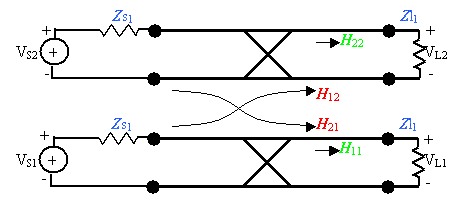
Figure 1:
Normal Mode DSL (two active loop-pairs)
|
|
Only one reference ground translates into more number of
data channels availability with the same number of pairs. If there
are n telephone lines to the customer premise, in all
2n-1 data channels should be available for the data
transfer above voice band. It is opposite to that of only n
data channels in the previous (existing) schemes. A direct benefit
of n-1 channels could be translated into a higher available
data rates at DSL distances.
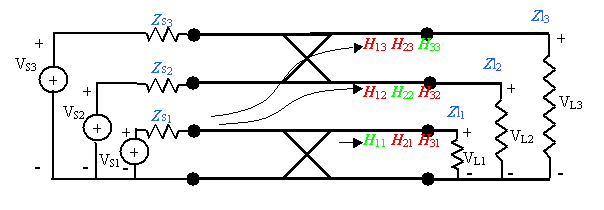
Figure 2:
Phantom Mode (three active data-wires)
|
|
The phantom mode DSL is explained graphically through
Fig. 2. A comparison with normal mode DSL is also provided with
Fig. 1. For example, consider two twisted wire pairs are
available to a customer premise. One of the pair is being used in
a DSL loop and the other is used only for voice band
communications (telephone). More than one telephone lines to a
single customer premise are not very uncommon in Europe and
America.
In Figure 1 and Figure 2, a wire-pair with a cross
designates a twisted pair. For normal mode DSL, Figure 1. applies
where each twisted pair is assumed to be one stand-alone channel
in practice. It is assumed that both the loops are being used as
DSL channel. Figure 1.2 depicts a Phantom mode of DSL loop where
two twisted pairs are sharing a single ground (reference) and
hence we have an extra data channel with the same number of
twisted pairs. If n is the number of twisted pairs involved
in a Phantom mode then the number of parallel channels so obtained
will be 2n-1.
In more general terms, a Phantom mode (or sometime
referred as multi-line DSL [11, 12], can have a 2n-1 data
wires with any one arbitrarily chosen reference wire from the
bundle (or cable).
Crosstalk in Phantom DSL
It is obvious that in such a scenario the crosstalk is
inherent to the system and for efficient use of Phantom mode DSL
will mostly depend on the crosstalk mitigation techniques.
In magnitude, the near-end-crosstalk (NEXT) is much
larger than the far-end-crosstalk (FEXT). In discrete-multitone
(DMT) systems NEXT is controlled via frequency division duplexing
(FDD). The FEXT remains the main source of crosstalk in the long
lines. This degrades the signal-to-noise ratio (SNR) at higher
frequencies and limits the effective loop length for considerable
data rates. FEXT mitigation schemes would gain importance in
future so as to increase the data rates on the existing DSL loops
as well as in terms of loop-length. Fig. 1 and 2 assumes that
the NEXT is not present (also for overlapping upstream and
downstream DSLs using echo-cancelation schemes) and FEXT is the
only source of crosstalk noise. Hereafter we will assume FEXT
crosstalk noise to be the dominant source of noise in DSL. The
FEXT transfer functions from one line to the rest of the
data-wires in the system are shown as Hi,j(f), where
i,j = 0, ...,n (for normal mode) and i,j = 0,
...,2n-1 (for phantom mode) are data-wire in the system
(Normal or Phantom) under consideration. For i = j, it is
the direct transfer function of the ith data-wire.
Frequency notation f is omitted for the simplicity.
It is assumed that as the loop-unbundling is taking
place, service provider would incline to use the packet based
service with single DSLAM at the CO and coordination among
different DSL loops should be possible [13].
Considering Phantom mode as a Multi-Input-Multi-Output
(MIMO) system can lead to the reduction or total mitigation to the
FEXT crosstalk. Vectored transmission [13] is seen as a solution
to the crosstalk in such a scenario where the coordination among
the wire is possible at the CO. In this case, a Phantom channel
can be considered as a MIMO system at each tone, considering
Frequency Division Duplex (FDD). The downstream channel is
therefore considered as broadcast channel (BC) and the upstream
channel can be modeled as a multiacess channel (MAC).
The multiline and phantom DSL are the DSL techniques of
the future. It is obvious from the proposals of 10MDSL and
100MDSL. Multiline copper pair transmission has also been referred
in the recent draft of Ethernet in First Mile (EFM) task force
[9], constituted by IEEE [6] (802.03ah). The final draft of the
EFM standards is available. The quest of high data rate on twisted
pairs would eventually lead to the evolution of multiline
communication theory and practices.
Reference
[1]. "Telecommunications - Network and Customer
Installation Interfaces - Asymmetric Digital Subscriber Line
(ADSL) Metallic Interface", ANSI T1.413-1995.
[2]. "Understanding Digital Subscriber Loop", Thomas
Starr, John Cioffi and P. J. Silverman, Prentice Hall PTR.
[3]. "Requirements for multi-pair link aggregation for
higher rates" - 10MDSL or Enhancements to G.shdsl or Multi-pair
link aggregation, T1E1.4/2002-143 (DSL Access)
[4]. ETSI Technical Committee Transmission and
Multiplexing (TM) Working Group TM6 - ACCESS NETWORKS, ETSI TC TM
WG TM6(02)2 April 2002
[5]. "The twisted-pair telephone transmission line", R.
Lao, High Frequency Design, November 2002.
[6]. "Ethernet in First Mile", IEEE 802.3ah, EFM-task
force, www.ieee802.org/3/efm/public
[7]. "Microwave Engineering", D. M. Pozar,
Addison-Wesley Publishing Co.
[8]. "A frequency-domain approach to crosstalk
identification in xDSL systems", S Galli, C Valenti, K. J. Kerpez,
IEEE journal on Selected Areas in Communications, August 2001
[9]. "IEEE Draft FP802.3ah" EFM task force, April 2004,
[10]. "Proposal for New Work Item in T1E1.4: 10 Mb/s
DSL", T1E1.4/2002-042
[11]. ANSI contribution on DSM - John Cioffi
[12]. Thesis, Jannie Lee Fang
[13]. "Vectored-DMT: A FEXT Cancelling Modulation
Scheme for Coordinating Users", G. Ginis and John Cioffi,
Proceedings of IEEE ICC 2001, Vol 1, Helsini, Finald, pp 305-309,
June 2001