Urinalysis
can reveal diseases that have gone
unnoticed because they do not produce
striking signs or symptoms. Examples
include diabetes mellitus, various
forms of glomerulonephritis, and chronic
urinary tract infections.
The
most cost-effective device used
to screen urine is a paper or plastic
dipstick. This microchemistry system
has been available for many years
and allows qualitative and semi-quantitative
analysis within one minute by simple
but careful observation. The color
change occurring on each segment
of the strip is compared to a color
chart to obtain results. However,
a careless doctor, nurse, or assistant
is entirely capable of misreading
or misinterpreting the results.
Microscopic urinalysis requires
only a relatively inexpensive light
microscope.
MACROSCOPIC
URINALYSIS
The first part of a urinalysis is
direct visual observation. Normal,
fresh urine is pale to dark yellow
or amber in color and clear. Normal
urine volume is 750 to 2000 ml/24hr.
Turbidity
or cloudiness may be caused by excessive
cellular material or protein in
the urine or may develop from crystallization
or precipitation of salts upon standing
at room temperature or in the refrigerator.
Clearing of the specimen after addition
of a small amount of acid indicates
that precipitation of salts is the
probable cause of tubidity.
A
red or red-brown (abnormal) color
could be from a food dye, eating
fresh beets, a drug, or the presence
of either hemoglobin or myoglobin.
If the sample contained many red
blood cells, it would be cloudy
as well as red.
URINE
DIPSTICK CHEMICAL ANALYSIS
pH
The glomerular filtrate of blood
plasma is usually acidified by renal
tubules and collecting ducts from
a pH of 7.4 to about 6 in the final
urine. However, depending on the
acid-base status, urinary pH may
range from as low as 4.5 to as high
as 8.0. The change to the acid side
of 7.4 is accomplished in the distal
convoluted tubule and the collecting
duct.
Specific
Gravity (sp gr)
Specific gravity (which is directly
proportional to urine osmolality
which measures solute concentration)
measures urine density, or the ability
of the kidney to concentrate or
dilute the urine over that of plasma.
Dipsticks are available that also
measure specific gravity in approximations.
Most laboratories measure specific
gravity with a refractometer.
Specific
gravity between 1.002 and 1.035
on a random sample should be considered
normal if kidney function is normal.
Since the sp gr of the glomerular
filtrate in Bowman's space ranges
from 1.007 to 1.010, any measurement
below this range indicates hydration
and any measurement above it indicates
relative dehydration.
If
sp gr is not > 1.022 after a
12 hour period without food or water,
renal concentrating ability is impaired
and the patient either has generalized
renal impairment or nephrogenic
diabetes insipidus. In end-stage
renal disease, sp gr tends to become
1.007 to 1.010.
Any
urine having a specific gravity
over 1.035 is either contaminated,
contains very high levels of glucose,
or the patient may have recently
received high density radiopaque
dyes intravenously for radiographic
studies or low molecular weight
dextran solutions. Subtract 0.004
for every 1% glucose to determine
non-glucose solute concentration.
Protein
Dipstick screening for protein is
done on whole urine, but semi-quantitative
tests for urine protein should be
performed on the supernatant of
centrifuged urine since the cells
suspended in normal urine can produce
a falsely high estimation of protein.
Normally, only small plasma proteins
filtered at the glomerulus are reabsorbed
by the renal tubule. However, a
small amount of filtered plasma
proteins and protein secreted by
the nephron (Tamm-Horsfall protein)
can be found in normal urine. Normal
total protein excretion does not
usually exceed 150 mg/24 hours or
10 mg/100 ml in any single specimen.
More than 150 mg/day is defined
as proteinuria. Proteinuria >
3.5 gm/24 hours is severe and known
as nephrotic syndrome.
Dipsticks
detect protein by production of
color with an indicator dye, Bromphenol
blue, which is most sensitive to
albumin but detects globulins and
Bence-Jones protein poorly. Precipitation
by heat is a better semiquantitative
method, but overall, it is not a
highly sensitive test. The sulfosalicylic
acid test is a more sensitive precipitation
test. It can detect albumin, globulins,
and Bence-Jones protein at low concentrations.
In
rough terms, trace positive results
(which represent a slightly hazy
appearance in urine) are equivalent
to 10 mg/100 ml or about 150 mg/24
hours (the upper limit of normal).
1+ corresponds to about 200-500
mg/24 hours, a 2+ to 0.5-1.5 gm/24
hours, a 3+ to 2-5 gm/24 hours,
and a 4+ represents 7 gm/24 hours
or greater.
Glucose
Less than 0.1% of glucose normally
filtered by the glomerulus appears
in urine (< 130 mg/24 hr). Glycosuria
(excess sugar in urine) generally
means diabetes mellitus. Dipsticks
employing the glucose oxidase reaction
for screening are specific for glucos
glucose but can miss other reducing
sugars such as galactose and fructose.
For this reason, most newborn and
infant urines are routinely screened
for reducing sugars by methods other
than glucose oxidase (such as the
Clinitest, a modified Benedict's
copper reduction test).
Ketones
Ketones (acetone, aceotacetic acid,
beta-hydroxybutyric acid) resulting
from either diabetic ketosis or
some other form of calorie deprivation
(starvation), are easily detected
using either dipsticks or test tablets
containing sodium nitroprusside.
Nitrite
A positive nitrite test indicates
that bacteria may be present in
significant numbers in urine. Gram
negative rods such as E. coli are
more likely to give a positive test.
Leukocyte
Esterase
A positive leukocyte esterase test
results from the presence of white
blood cells either as whole cells
or as lysed cells. Pyuria can be
detected even if the urine sample
contains damaged or lysed WBC's.
A negative leukocyte esterase test
means that an infection is unlikely
and that, without additional evidence
of urinary tract infection, microscopic
exam and/or urine culture need not
be done to rule out significant
bacteriuria.
----------------------------------------
MICROSCOPIC
URINALYSIS
Methodology
A sample of well-mixed urine (usually
10-15 ml) is centrifuged in a test
tube at relatively low speed (about
2-3,000 rpm) for 5-10 minutes until
a moderately cohesive button is
produced at the bottom of the tube.
The supernate is decanted and a
volume of 0.2 to 0.5 ml is left
inside the tube. The sediment is
resuspended in the remaining supernate
by flicking the bottom of the tube
several times. A drop of resuspended
sediment is poured onto a glass
slide and coverslipped.
Examination
The sediment is first examined under
low power to identify most crystals,
casts, squamous cells, and other
large objects. The numbers of casts
seen are usually reported as number
of each type found per low power
field (LPF). Example: 5-10 hyaline
casts/L casts/LPF. Since the number
of elements found in each field
may vary considerably from one field
to another, several fields are averaged.
Next, examination is carried out
at high power to identify crystals,
cells, and bacteria. The various
types of cells are usually described
as the number of each type found
per average high power field (HPF).
Example: 1-5 WBC/HPF.
Red
Blood Cells
Hematuria is the presence of abnormal
numbers of red cells in urine due
to: glomerular damage, tumors which
erode the urinary tract anywhere
along its length, kidney trauma,
urinary tract stones, renal infarcts,
acute tubular necrosis, upper and
lower uri urinary tract infections,
nephrotoxins, and physical stress.
Red cells may also contaminate the
urine from the vagina in menstruating
women or from trauma produced by
bladder catherization. Theoretically,
no red cells should be found, but
some find their way into the urine
even in very healthy individuals.
However, if one or more red cells
can be found in every high power
field, and if contamination can
be ruled out, the specimen is probably
abnormal.
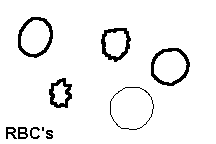 |
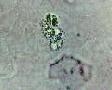
RBC's may appear normally shaped,
swollen by dilute urine (in fact,
only cell ghosts and free hemoglobin
may remain), or crenated by concentrated
urine. Both swollen, partly hemolyzed
RBC's and crenated RBC's are sometimes
difficult to distinguish from WBC's
in the urine. In addition, red cell
ghosts may simulate yeast. The presence
of dysmorphic RBC's in urine suggests
a glomerular disease such as a glomerulonephritis.
Dysmorphic RBC's have odd shapes
as a consequence of being distorted
via passage through the abnormal
glomerular structure.
White
Blood Cells
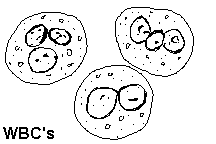
Pyuria refers to the presence of
abnormal numbers of leukocytes that
may appear with infection in either
the upper or lower urinary tract
or with acute glomerulonephritis.
Usually, the WBC's are granulocytes.
White cells from the vagina, especially
in the presence of vaginal and cervical
infections, or the external urethral
meatus in men and women may contaminate
the urine.
If two or more leukocytes per each
high power field appear in non-contaminated
urine, the specimen is probably
abnormal. Leukocytes have lobed
nuclei and granular cytoplasm.
Epithelial
Cells
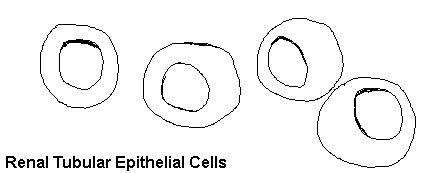
Renal tubular epithelial cells,
usually larger than granulocytes,
contain a large round or oval nucleus
and normally slough into the urine
in small numbers. However, with
nephrotic syndrome and in conditions
leading to tubular degeneration,
the number sloughed is increased.
When lipiduria occurs, these cells
contain endogenous fats. When filled
with numerous fat droplets, such
cells are called oval fat bodies.
Oval fat bodies exhibit a "Maltese
cross" configuration by polarized
light microscopy.
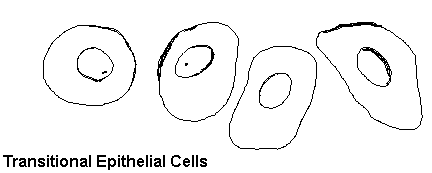
Transitional
epithelial cells from the renal
pelvis, ureter, or bladder have
more regular cell borders, larger
nuclei, and smaller overall size
than squamous epithelium. Renal
tubular epithelial cells are smaller
and rounder than transitional epithelium,
and their nucleus occupies more
of the total cell volume.
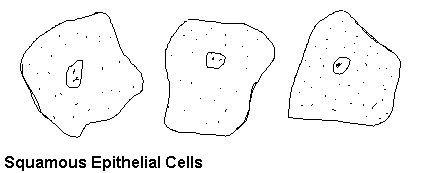
Squamous epithelial cells from the
skin surface or from the outer urethra
can appear in urine.
Their significance is that they
represent possible contamination
of the specimen with skin flora.
Casts
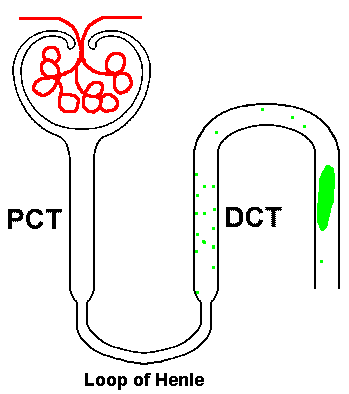
Urinary casts are formed only in
the distal convoluted tubule (DCT)
or the collecting duct (distal nephron).
The proximal convoluted tubule (PCT)
and loop of Henle are not locations
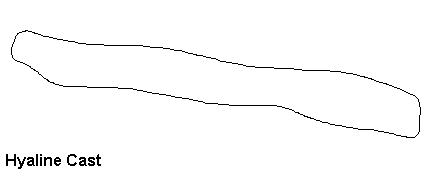
for cast formation. Hyaline casts
are composed primarily of a mucoprotein
(Tamm-Horsfall protein) secreted
by tubule cells. The Tamm-Horsfall
protein secretion (green dots) is
illustrated in the diagram below,
forming a hyaline cast in the collecting
duct:
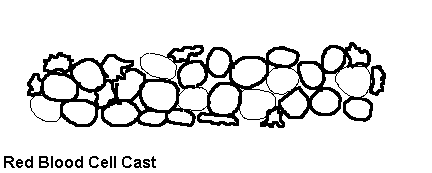
Even with glomerular injury causing
increased glomerular permeability
to plasma proteins with resulting
proteinuria, most matrix or "glue"
that cements urinary casts together
is Tamm-Horsfall mucoprotein, although
albumin and some globulins are also
incorporated. An example of glomerular
inflammation with leakage of RBC's
to produce a red blood cell cast
is shown in the diagram below:
The factors which favor protein
cast formation are low flow rate,
high salt concentration, and low
pH, all of which favor protein denaturation
and precipitation, particularly
that of the Tamm-Horsfall protein.
Protein casts with long, thin tails
formed at the junction of Henle's
loop and the distal convoluted tubule
are called cylindroids. Hyaline
casts can be seen even in healthy
patients.
Red blood cells may stick together
and form red blood cell casts. Such
casts are indicative of glomerulonephritis,
with leakage of RBC's from glomeruli,
or severe tubular damage.
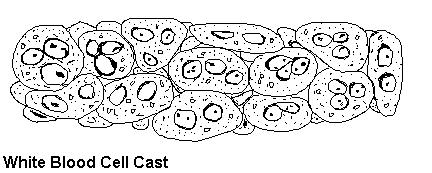
White blood cell casts are most
typical for acute pyelonephritis,
but they may also be present with
glomerulonephritis. Their presence
indicates inflammation of the kidney,
because such casts will not form
except in the kidney.
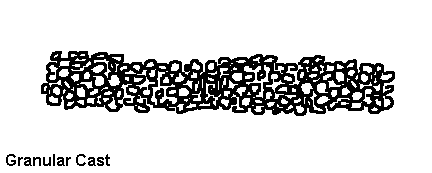
When cellular casts remain in the
nephron for some time before they
are flushed into the bladder urine,
the cells may degenerate to become
a coarsely granular cast, later
a finely granular cast, and ultimately,
a waxy cast. Granular and waxy casts
are be believed to derive from renal
tubular cell casts. Broad casts
are believed to emanate from damaged
and dilated tubules and are therefore
seen in end-stage chronic renal
disease.
The
so-called telescoped urinary sediment
is one in which red cells, white
cells, oval fat bodies, and all
types of casts are found in more
or less equal profusion. The conditions
which may lead to a telescoped sediment
are: 1) lupus nephritis 2) malignant
hypertension 3) diabetic glomerulosclerosis,
and 4) rapidly progressive glomerulonephritis.
In
end-stage kidney disease of any
cause, the urinary sediment often
becomes very scant because few remaining
nephrons produce dilute urine.
Bacteria
Bacteria are common in urine specimens
because of the abundant normal microbial
flora of the vagina or external
urethral meatus and because of their
ability to rapidly multiply in urine
standing at room temperature. Therefore,
microbial organisms found in all
but the most scrupulously collected
urines should be interpreted in
view of clinical symptoms.
Diagnosis
of bacteriuria in a case of suspected
urinary tract infection requires
culture. A colony count may also
be done to see if significant numbers
of bacteria are present. Generally,
more than 100,000/ml of one organism
reflects significant bacteriuria.
Multiple organisms reflect contamination.
However, the presence of any organism
in catheterized or suprapubic tap
specimens should be considered significant.
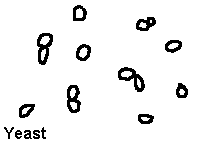
Yeast
Yeast cells may be contaminants
or represent a true yeast infection.
They are often difficult to distinguish
from red cells and amorphous crystals
but are distinguished by their tendency
to bud. Most often they are Candida,
which may colonize bladder, urethra,
or vagina.
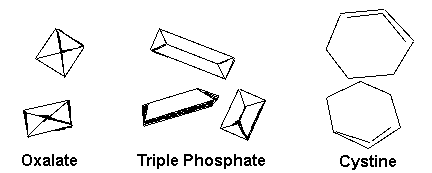
Crystals
Common crystals seen even in healthy
patients include calcium oxalate,
triple phosphate crystals and amorphous
phosphates.
Very uncommon crystals include:
cystine crystals in urine of neonates
with congenital cystinuria or severe
liver disease, tyrosine crystals
with congenital tyrosinosis or marked
liver impairment, or leucine crystals
in patients with severe liver disease
or with maple syrup urine disease.
Miscellaneous
General "crud" or unidentifiable
objects may find their way into
a specimen, particularly those that
patients bring from home.
Spermatozoa
can sometimes be seen. Rarely, pinworm
ova may contaminate the urine. In
Egypt, ova from bladder infestations
with schistosomiasis may be seen.
---------------------------------------------
METHODS
OF URINE COLLECTION
Random collection taken at any time
of day with no precautions regarding
contamination. The sample may be
dilute, isotonic, or hypertonic
and may contain white cells, bacteria,
and squamous epithelium as contaminants.
In females, the specimen may cont
contain vaginal contaminants such
as trichomonads, yeast, and during
menses, red cells.
Early
morning collection of the sample
before ingestion of any fluid. This
is usually hypertonic and reflects
the ability of the kidney to concentrate
urine during dehydration which occurs
overnight. If all fluid ingestion
has been avoided since 6 p.m. the
previous day, the specific gravity
usually exceeds 1.022 in healthy
individuals.
Clean-catch,
midstream urine specimen collected
after cleansing the external urethral
meatus. A cotton sponge soaked with
benzalkonium hydrochloride is useful
and non-irritating for this purpose.
A midstream urine is one in which
the first half of the bladder urine
is discarded and the collection
vessel is introduced into the urinary
stream to catch the last half. The
first half of the stream serves
to flush contaminating cells and
microbes from the outer urethra
prior to collection. This sounds
easy, but it isn't (try it yourself
before criticizing the patient).
Catherization
of the bladder through the urethra
for urine collection is carried
out only in special circumstances,
i.e., in a comatose or confused
patient. This procedure risks introducing
infection and traumatizing the urethra
and bladder, thus producing iatrogenic
infection or hematuria.
Suprapubic
transabdominal needle aspiration
of the bladder. When done under
ideal conditions, this provides
the purest sampling of bladder urine.
This is a good method for infants
and small children.
Summary
To summarize, a properly collected
clean-catch, midstream urine after
cleansing of the urethral meatus
is adequate for complete urinalysis.
In fact, these specimens generally
suffice even for urine culture.
A period of dehydration may precede
urine collection if testing of renal
concentration is desired, but any
specific gravity > 1.022 measured
in a randomly collected specimen
denotes adequate renal concentration
so long as there are no abnormal
solutes in the urine.
Another
important factor is the interval
of time which elapses from collection
to examination in the laboratory.
Changes which occur with time after
collection include: 1) decreased
clarity due to crystallization of
solutes, 2) rising pH, 3) loss of
ketone bodies, 4) loss of bilirubin,
5) dissolution of cells and casts,
and 6) overgrowth of contaminating
microorganisms. Generally, urinalysis
may not reflect the findings of
absolutely fresh urine if the sample
is > 1 hour old. Therefore, get
the urine to the laboratory as quickly
as possible.
------------------------------------------









.gif)