
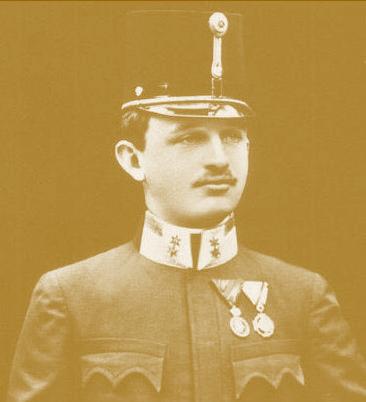

Archduke Karl Franz Josef Ludwig Hubert Georg Maria von Habsburg-Lothringen was born on August 17, 1887 to the Archduke Otto and Archduchess Maria Josefa. He grew up to be known as a very bright and religious young man, pushed closer to the throne by the death of Crown Prince Rudolf, the prior death of his father and the unequal marriage of Archduke Francis Ferdinand. In 1911 he married Princess Zita of Bourbon-Parma, a deposed Italian family, with the blessing of Pope St Pius X. The couple were a big hit in Vienna for their charm, dignity and humble warmth. Charles was also serving in the military during this time, as Hapsburg princes were expected to do, already preparing himself for the responsibility of the crown.
In 1914 of course, the great disaster came. Franz Ferdinand was assassinated, making Charles heir to the throne, and he served with distinction with the Austrian army on the Italian front, where the K.u.K. army won many victories. Alot of nonsense has been written, by anti-Catholic, anti-Hapsburg sensationalists about Charles' army using poison gas, a claim which is absolutely false. He was a humane commander, no one on the front ever used poison gas, and Charles had a well-known reputation for piety, attending mass regularly, even when in the field. His prayers would certainly be needed as in 1916 the aged and beloved Emperor Francis Joseph died, thrusting Charles into the role of Emperor of Austria and King of Hungary. While it was not possible in Austria, Charles insisted on a traditional ceremony in Hungary as a way to pledge himself to God to reign as a true, traditional Catholic monarch. In a spectacular ceremony, the last of its kind, he was crowned with the crown of St Stephen and established a link with the Magyar people that was never to go away.
Yet, he had immediate problems to deal with. Austria-Hungary had sustained crippling losses and in many sectors it was only by the presence of German troops that saved fronts from collapsing. Emperor Charles was determined to break the hold of the German command over his armies and to find a way to end the fratricidal devestation of the war. When Pope Benedict XV called on the monarchs to make peace, it was Emperor Charles who responded. Through his brother-in-law, Prince Sixtus, an officer in the Belgian army, he contacted the Allies and tried to open negotiations for a peaceful end to the war. He even offered to cede parts of his own territory if it would make the difference in ending the war. Frustratingly, the Allies not only refused to consider his requests for peace, they called for the total destruction of the Hapsburg Empire and made the letters public, an act which infuriated the Germans and seriously endangered the position of the Emperor Charles. This all but left Austria-Hungary at the mercy of the Germans who had already drawn up plans for the invasion of Austria if their ally attempted to negotiate a seperate peace.
Emperor Charles was also thwarted by members of his own government who opposed his more traditional policies. It was the primary aim of the new Emperor to save the Hapsburg Empire by going back to the Catholic principle of subsidiarity, which previously existed under the Holy Roman Empire (of which Charles as Emperor of Austria was heir) and meant that each of the nationalities would be given free reign to govern themselves on the local level under the unifying force of the Hapsburg crown. The problem with this, however, was that many conservative Austrians saw this as a sign of weakness, and feared the other ethnic groups would do the same; that German-Austria was losing control. Likewise, there was the problem were of today are still familiar with, and that is the various nationalities being unable to agree on exactly what territory is rightfully theirs. The Hungarians in particular, though they long complained about Austrian domination, were completely unwilling to give up territory for the many ethnic minorities within the large Kingdom of Hungary. Minority exile groups also opposed the plan as this would have removed their primary tool of propaganda to agitate for the overthrow of the House of Hapsburgs, rather like the Serbs shooting Archduke Franz Ferdinand specifically because he wished to give the Slavs equal status in the Empire.
