
In a way, it could be said that the Greeks were too successful. Emperors began to dominate the Church, leading eventually to schism with Rome, Byzantine court intrigue became famous and rather than fighting foreign enemies, the Greeks became caught up in one imperial coup d'etat after another. Warfare was increasingly left to hired mercenaries while the Byzantine Empire became wealthy and prosperous as the hub of all trade with the Far East. It is ironic that, during this period of decline, the Turks, who ultimately became the arch-enemy of the Greeks, were actually invited into the Empire by the Byzantine Emperor to help suppress rebellions in the Balkans. Unfortunately, once the Turks had their foot in the door, the combined powers of Christendom have not yet been able to force them out.
However, if anything can be said about the Greeks, it is that they are survivors. Greek history is full of alternate stages of unheard of power and prosperity in betweens periods of terrible oppression and poverty. After the fall of Constantinople under the last Byzantine Emperor Constantine XI, the Greek Empire became Turkish, although the Greek homeland had actually been under Muslim rule for much longer. However, even though the Greeks spent hundreds of years under Turkish rule, they never submitted to the situation and never forgot that they were better than this, they never stopped thinking of themselves as a great empire rather than a conquered province. People all across Europe, hearing of Turkish atrocities and Greek heroism were motivated to go to Greece to aid them in their war for independence, a war which was finally won in 1829.
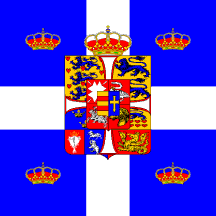
First, Greece was established as a republic, but it proved totally unable to unite and solidify the new Greek state, and after a period of some chaos a monarchy was established under the Bavarian House of Wittelsbach, which gave Greece their national colors of blue and white. Their first King was Prince Otto, who took the Greek form of King Othon of Greece, who reigned for 30 years but who became quite unpopular due to the efforts of his ministers favor of German over Greek traditions. A military coup overthrew King Othon in 1862 and with the cooperation of the international community a new monarchy was established by King George I of the ancient Danish Royal Family. Many liberal reforms were adopted in this time, with the powers of the king being reduced and the vote extended to all adult males. The country was very poor at this time, but the sort of modernization Greece required after so many years of Ottoman rule could not happen overnight, and the situation slowly improved. After the defeat of Turkey by Britain and Russia, Greece was able to reclaim some lost territories, though the strategic island of Cyprus was denied them. The fate of those Greeks still living under foreign control continued to be the main concern of the people for some time. During the Balkan Wars, Greece was able to double her land and population, though at considerable cost.
In 1913, King George was assassinated by an anarchist and was succeeded by his son, King Constantine I. Due to the fact that he was the first king born in the independent Greece, and the first to be Greek Orthodox, he was proclaimed by many of his subjects as "Constantine XII" heir to the legacy of the Byzantine Emperor Constantine XI. His reign was soon overshadowed by World War I in which many wanted to enter the war on the allied side in order to attack Turkey, but in which the King, knowing how exhausted the army was since the Balkan Wars, decided to remain neutral, a neutrality, it must be said, the allies didn't really respect. Eventually, Constantine abdicated in favor of his son and Greece did enter the war on the allied side which won Greece some more territory, though they never regained the ultimate symbolic prize of Constantinople, and in the following war with the new liberal government in Turkey, lost some of their prior gains which caused a great deal of dissatisfaction and government turmoil, opening the era of conflict between the liberal republicans and the conservative monarchists.
