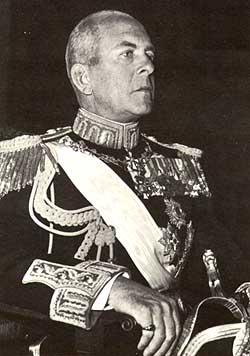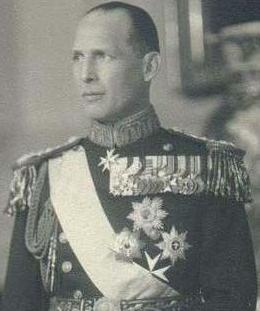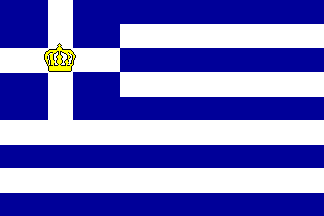

Greece fell into even greater poverty, Communist groups began to infiltrate the country and there was a succession of coups by military dictators to hold power over the country. Looking back to the great gains made in the earlier decades of the century, more and more people realized that they had been exploited by the liberal politicians and wished for their king to return. The situation became even more tense in the 30's with the growing threat from Fascist Italy. Finally, in a 1935 plebiscite, 97% of Greeks voted to restore King George (Georgios) II to the throne. However, the question then facing the monarch was whether or not the situation was too far gone to save. Although the restoration was a great thing, the King had no "magic wand" to wave and revive the united greatness of Greece.
Greece faced desperate times, and desperate measures were certainly called for. In 1936 King Georgios appointed General Ioannis Metaxas to the post of prime minister, who established a rather authoritarian government, but one which succeeded in cleaning up Greece considerably. He managed to expell the Communists and suppress the liberal subversives while also building up the military, all of which were to prove vital in the coming years. In 1939, after conquering Greece, the Italians turned toward Greece and demanded the virtual submission of the kingdom to Benito Mussolini. Presented with this ultimatum, General Metaxas famously replied to Mussolini with a single word: "NO!" Italy then launched a massive invasion of Greece, but thanks to the military build-up, much to the horror of Mussolini and the surprise of most of Europe, the Greeks managed to thrash the Italians within an inch of their lives, driving them out of Greece and even capturing previously Italian territory in the north. It seemed to many that the old, powerful Greece had finally returned.
Unfortunately, as usual, Mussolini turned to Hitler to bail him out of trouble and the German military, the most advanced, modernized and professional in the world, soon crushed the Greek defenses and marched victoriously into Athens, begining a period of harsh miltary rule. The King went to Egypt and continued to lead the government, and in fact, in spite of everything, Greece was never fully pacified by the Germans and Italians. However, Greek resistance was harmed by the divisions between the Communists and monarchists. Even before the war ended, Britain and America became involved in the civil sub-war between the communist and royalist factions. By 1949 however, the royal government had taken back control of the country, with outside aid from countries already worrying about the post-war spread of Soviet Russian influence.
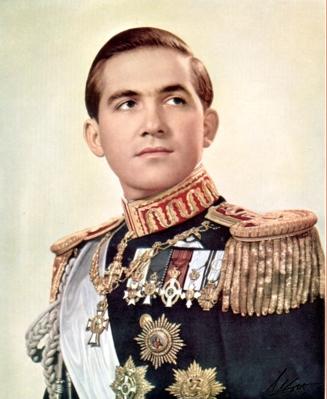
The problem was, too many people inside of Greece were not concerned enough with the dangers of encroaching liberalism while those outside seemed to care about nothing else. The short-sightedness within Greece was demonstrated by George Papandreou's socialist regime, while that of the Western democracies was demonstrated by their support of the "Regime of the Colonels" which overthrew Papandreou in 1967. King Constantine, throughout this time, was doing his best to return things to a normal situation, actions which eventually caused the military to depose him in 1973 though it was not until two years later that a referendum was held, though even this was mostly just for appearances. King Constantine was forced to go into exile and has only recently been allowed to even set foot in his homeland again. Much of what has been written about King Constantine II has been extremely harsh and quite unfair. The last "King of the Hellenes" was an honorable man, not always successful, but one who tried to do what was best for his people. His opposition to Papandreou resulted from his desire to control the military, which would have put entirely too much power in the hands of the Prime Minister. He is therefore blamed for the military regime, but in fact he attempted to overthrow this government and it was his opposition to any sort of dictatorship which prompted his removal from the throne. Perhaps the day will come when we can arrive at a more reasonable and accurate view of Constantine and thus overcome the propaganda so many Greeks have been subjected to and see what a great asset to the nation the monarchy actually was.