 |
|
|
|
|
|
|
|
|
|
|
|
|
|
|
|
|
|
|
|
|
|
 |
|
|
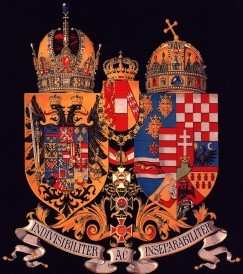
The Dual Monarchy of Austria-Hungary |
|
|
|
|
|
 |
|
|
|
|
|
The world does indeed owe a debt of gratitude to the nation of Austria, for carrying on long after all others, the spirit and ideals of Catholic civilization in the High Middle Ages. This has been largely thanks to their Imperial House of Hapsburg, which has provided such leaders as Kaiser Ferdinand II, Kaiserin Maria Theresa and Kaiser Franz Josef I. There have been the statesmen like Prince Klemens von Metternich and common people of great loyalty and heroism like Andreas Hofer, who gave everything, "Fur Gott, Kaiser und Vaterland". |
|
|
|
|
|
Most people, even in modern Austria, do not realize that the Federal Republic of Austria of today is the successor of the Dual Monarchy of Austria-Hungary, which was the successor of the Empire of Austria, which was the successor of the Holy Roman Empire--quite a proud lineage. When the Turks were invading Europe via the Balkans, who stood fast at the gates of Vienna saving Europe from Muslim conquest? Austria. They took the lead in fighting the forces of revolutionary Protestantism in the Thirty Years War, they championed the cause of Christian unity. When France was gripped by |
|
|
revolution it was the Emperor of Austria who led the defense of Europe. They were the most immediate enemy of Napoleon's state and it was Austria who led the counter-revolutionary effort after the war ended.
Prince Metternich based the policy of Austria and Europe as far as he could on legitimacy and law. He wisely said, "Without order as a foundation, the cry for freedom is nothing more than the attempt of some group or other to achieve its own ends. When actually carried out in practice, that cry for freedom will inevitably express itself in tyranny."
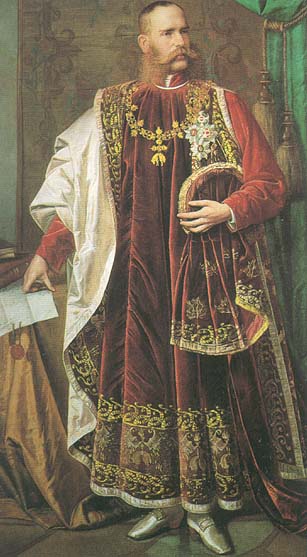
However, much of the thanks for the steadfast position of Austria goes to the very strong principled and long reigning Emperor Franz Joseph I, who was in every way a worthy successor of such venerable ancestors as Maximilian, Charles V, Ferdinand II and Maria Theresa. He was, as he himself admitted, the "last monarch of the old school". He was totally committed to the Church, his people and the honor of the Hapsburg monarchy he represented.
Thanks to Franz Joseph, Austria did not have to endure many of the hardships of other countries. He reformed the judiciary and made it a seperate branch to balance power in government, established trial by jury, abolished the use of internal passports and opened up high office to those who were capable, not just high-born. He also showed great kindness to the Jewish community who hailed him as the "King of Jerusalem". This open and tolerant attitude was one of the things Adolf Hitler found so sickening about his homeland.
Today, after so many wars and massacres in the Balkans, we can see the true value of the order and |
|
 |
|
|
|
|
|
|
stability Austria brought to the region. Their government was proud without being nationalistic, united by religion but not intolerant of other faiths, traditional without being absolutist and conservative without being greedily capitalist. When Austria had their imperial dignity stripped from them after the atrocity of World War I, the western Allies all but paved the way for Hitler to succeed with Anschluss. The danger of militant German nationalism could even be traced all the way back to Napoleon when he |
|
|
abolished the Holy Roman Empire, thus ending Austrian primacy in German affairs. Racial nationalism then slowly replaced the role of the Church as the basis of unity in central Europe.
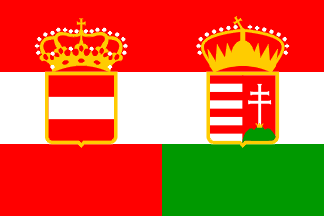
What is remarkable is that Austria was able to survive and flourish for so long after being seperated from the rest of the Germanies, particularly the Catholic south. Part of this was due to men like Windisch-Graetz and Graf von Radestky who were ready to fight for the unity of the empire, but it was also just as much due to the ability of the government to grant partner status to Hungary and thus turn them from rebellious subject to staunch ally, despite other problems which may have resulted. In fact, it is ironic that Hungary later seemed even more loyal to the Hapsburgs than the Austrians themselves in the time of Kaiser Karl I. |
|
|
|
 |
|
|
|
Hapsburg Hall of Fame |
|
|
 |
|
|
Emperor Maximilian I |
|
|
|
Emperor Charles V |
|
|
|
Emperor Ferdinand II |
|
|
|
Empress Marie Theresia |
|
|
|
Emperor Franz Joseph I |
|
|
|
Emperor Charles I |
|