 |
|
|
|
|
|
|
|
|
|
|
|
|
|
|
|
|
|
|
 |
|
|
|
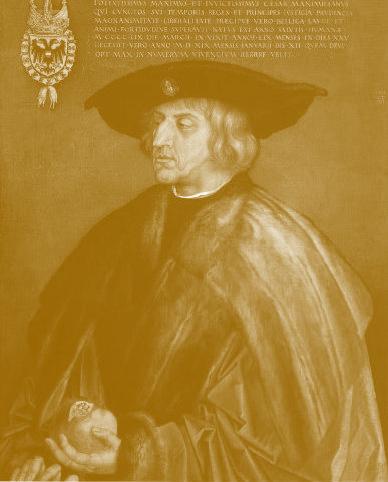
The Holy Roman Emperor Maximilian I |
|
|
|
 |
|
|
 |
|
|
In a way, Kaiser Maximilian I could be called the most successful family man in Europe. He set an example that was to become a trend throughout the history of the honored Hapsburg Dynasty: expansion through marriage rather than warfare. Maximilian I also embodied an important aspect of the Catholic character, which was devotion to the idea of a united Christendom rather than the advancement of any particular nation or country. He considered himself a Christian first and put any national attachments second. He was Holy Roman Emperor before he was the ruler of any particular country inside it.
Maximilian von Hapsburg became the thirty-first Holy Roman Emperor in 1493. This came as a result of the election of Rudolf I in 1273, who was the first Hapsburg to be so honored. The Hapsburgs would supply the Christian Emperors continuously from 1483 until 1918. Although Maximilian might not have been as great as his grandson, Emperor Charles V, it was he who set the stage, who established the House of Hapsburg as the greatest in Europe and provided a foundation for his descendants to build on. |
|
|
|
|
Soon after coming to power, Maximilian won the Netherlands and Burgundy in a war with King Louis XI of France, but later returned Burgundy in order to solidify his position in the Low Countries. His first wife Mary died in 1482 and a year after his coronation Maximilian married Bianca, Duchess of Milan. In further conflicts he lost several territories in Italy to the French and was obliged to grant independence to Switzerland after a suuccessful revolt there. |
|
|
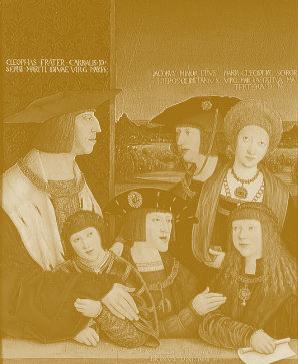
Frustrated in the traditional tactic of warfare, the Emperor proved much more successful in expansion through marriage and dynastic ties. He arranged for his son, Philip the Handsome, to marry Princess Juana of Castile, daughter of the famous Catholic monarchs and co-founders of Spain, King Ferdinand and Queen Isabella. Although Philip and Juana both proved to be disappointments, they did produce the future Emperor and champion of Christendom Charles V.
Emperor Maximilian also arranged for the marriage of two of his grandchildren into the royal families of Bohemia and Hungary, giving the House of Hapsburg its first foothold into Eastern Europe. Some have been critical of Maximilian for "neglecting" Germany, long considered to be the most important part of the Holy Roman Empire. The Emperor, however, looked to Christendom, beyond Germany to the big picture. By the time of his death in 1519, Kaiser Maximilian I's match making had made the House of Hapsburg the single most powerful family in Europe. |
|
|
|
 |
|
|
|
|
|
|
|