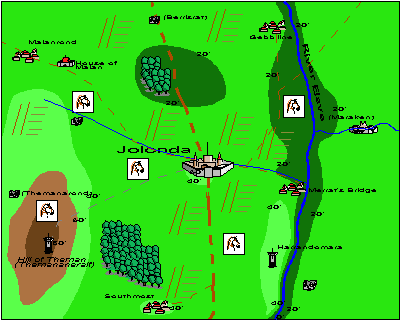
The first games of the campaign were at Jolonda. For that reason, I wanted to know the city in a bit more detail. This is what I came up with.
There has been a village at the site of Jolonda for an unknowably long time. The strategic position of the rocky hill near the river has guaranteed this.
When the Thearaddans conquered the area, there was a small farming village at the site. This was taken over, and the name Jolonda (after the wife of the first Thearaddan ruler of the area) was bestowed on the village. The area was ruled from Maraken, a larger settlement on the east side of the Elave. Jolonda had an uneventful history for the next 350 years, despite occasional changes of ownership.
Jolonda's real history begins with the Forbidding, 1100 years ago. At this time, the swamps of Quastaria were created, and all Thearaddans were forced by their gods to leave the east side of the Elave. The wave of refugees instantly turned Jolonda—up until then a sleepy farm village of 400 people—into a seething city. Many of the refugees came from the abandoned city of Maraken, others from the sudden swamps to the south.
The newly minted city faced dangers. The restless undead of Wastar spread out in waves from the swamp. The sentient monsters of the Helgars saw their chance and came forth on missions of plunder and rapine. The flood of refugees threatened to overturn law and order throughout the region.
The early history of Jolonda the city is a roll call of battles, some fought in the streets and tent towns that made up the city at that time. Almost all were victories for the defneders; some were temporary setbacks. Finally, 55 years after the Forbidding, the last battle was fought, and Jolonda was established as a free city, at the time controlling some 1,500 square miles of surrounding territory.
The passage of time was not kind to the city. When things settled down, Jolonda found itself at the end of the road, backed up against Quastaria and Helgar. The city's main export was its well-trained army, whose services as mercenaries were the largest source of revenue. Unfortunately, a series of incompetent political and military leaders destroyed the effectiveness of the army.
As the centuries passed, Jolonda threatened to fade from history. What saved it was the occupation of the area by the rising Empire of Relarion, 500 years ago. At the time, Jolonda was a sleepy burg of 2,000 souls, almost all peasant farmers, occasionally aroused from slumber by an incursion from Quastaria and Helgar—but never aroused very far. The Empire was determined to tame Quastaria and contain Helgar. As a start, Jolonda was turned into a fortress and base for an active, roaming army. Then, the first road through the Narrows was built, with Jolonda the northern terminus (and the already-bustling city of Chelmarrond the southern end).
The Empire's intentions regarding Quastaria were not realized, but the boost the effort gave to Jolonda remained. The army was retained in the city, and a large watchtower and barracks were built on the high hill of Theman, a few miles to the southwest.
Jolonda's status was confirmed when it became the administrative center for the region which would now be called the southern Wet Towns (the term "Wet Towns" came into use only after the Song), and the base of the army protecting the road. Jolonda began to look somewhat like the city of today—providing services for merchants and people traveling through. It was at this time, 450 years ago, that the first horse-breeding efforts were begun, with stock imported from the eastern cities (what are now called the Dry Towns).
The pattern remained unchanged until the Song of Woe. At that time, of course, the order of the world was overthrown. The Helgars suddenly became an incredibly dangerous place to be near. The Mindlost, people and creatures driven insane by the overwhelming burden of the Song, began roaming the land. Once again, Jolonda was turned into an armed camp—along with every other city, town and village. During this time, almost all of the villages around Jolonda were abandoned. Some have since been reoccupied; others wait until there are enough people to return them to life.
Again, battles were occasionally fought in the streets of the city. Again, Jolonda won clear of the chaos. And again, the city became a backwater in danger of extinction. This time, the Road through the Narrows has in itself saved Jolonda. One hundred and forty years after the Song, Chelond I of Chelmarrond re-constructed the Road (which now bears his name). The trade with the Wet Towns began, and, as the last town before the Narrows (or the first town after the Narrows, if you prefer), Jolonda became a popular way station. This, in turn, encouraged the revival of the horse-breeding industry.
Now, over three hundred years after the Song of Woe, Jolonda is a prosperous yet quiet town. The threats from Helgar and Quastaria are at an all time low. Wealth is increasing slowly. Politically, the town is stable. Overall, Jolonda now has good, but not great, prospects. It will not become the next Chelmarrond, but neither will it sink into obscurity.
Within the area that makes up the realm of Jolonda (extending from twenty to thirty miles in all directions except the south), there are no more than 10 small villages, with populations ranging from 40 to 500. Virtually all of these villagers are farmers. Features of the area map of Jolonda (an area 20 by 16 miles, centered on the city) include the following:
There are a few individual homesteads. Except for the horse breeders, these are all to the north and west of Jolonda. The five major breeders all have farms within ten miles of the city (these are marked on the map with horse symbols). The total population of the realm is roughly 22,000. The area of the realm is just less than 1,000 square miles.
The population of the city of Jolonda is roughly 18,000. This includes about
1,500 half-elves, 900 halflings, and a handful of other non-humans. All of
the humans are of the Thearaddan race. As in almost all towns and cities,
the vast majority of people in the small realm of Jolonda are farmers. There
is still a tendency to cluster in the city, and walk the two to five miles
necessary to reach the fields—a legacy of the terrors of the Song of
Woe.
The population breaks down as follows:
This leaves over 13,000 farmers, both free peasants and tenant farmers, and families.
At the top of the social scale, of course, are the nobility. These are the ancestors of men and woman who have distinguished themselves enough to be elevated to the topmost class. These days, it is very tough to be so elevated—it has happened once in the last twenty-five years. To be removed from the nobility, one has to commit a heinous act such as treason, killing a person through magic, or offending a god. Even then, it takes a majority vote in the High Council of Jolonda (see below, Government) to effect the expulsion.
The merchants and traders resell items bought from producers, whether local or foreign. They are the lifeblood of Jolonda's economy. Most of the money that comes into Jolonda from the outside arrives in the form of traveling traders, taking Wet Town goods to market at Chelmarrond. Since Jolonda is the last city before the wild Narrows, most caravans stop for an extended period in the city in order to complete provisioning and repairs. The provisions are in the form of food, grown around Jolonda and sold to merchants, who resell it in the Jolonda market to the foreign traders and caravans.
As in any Thearaddan city or land, the priests are an important and influential part of the community. Jolonda, like other of the Wet Towns, is pious, and the people obey the commands and requests of the gods with alacrity. In Jolonda, the premier god is Malan, the (neutral good) god of agriculture. The high priest of Malan, Eggewish (hm CL 10), is the current dean of Jolondan clerics (due to his high level). The high priest of Malan, as well as the high priest of Donoran (the city god—lawful good), are entitled to seats on the High Council. The current priest of Donoran is Mardan (hm CL 8).
The peasant class is the foundation of the city. Peasants (about two-thirds in ownership of their own land; the other third working for noble landowners; there are no serfs in the Wet Towns) provide the food for the city, form much of the “middle class” (roughly 2000 of the more prosperous peasants may be placed in this category), and make up most of the army (as explained below, Jolonda has universal military training).
As noted above, the noble class of Jolonda supplies most of the government of the city. The overall ruler is the High Lord; he/she is elected by the High Council for life, with provision for removal (extremely difficult). The High Lord executes, and to a certain extent makes, the law for the city. He/she has a great deal of latitude ruling the city; the High Council sits mostly in an advisory capacity. The current High Lord is Meneldun (hm F/CL 3/2).
The High Council makes law for the city (subject to the veto of the High Lord), advises the High Lord, selects a new High Lord upon the death or retirement of the previous High Lord, and, under special circumstances, can remove a High Lord (though Jolonda has suffered two short civil wars in the last 300 years as the Council has sought to enforce such a decision).
The government of Jolonda, like most of the Wet Towns, generally takes a “hands-off” approach to its citizens, leaving them with a fairly large amount of personal freedom. Tolls are levied on passing caravans, a monetary tax is collected from the merchants and horse breeders, and a tax in kind is levied on the free peasants (a small amount which does not endanger the existence of the free peasantry). No taxes are assessed on nobility who participate in the government or the military.
As to foreign affairs, there are little to speak of. Jolonda's main contact with the outside world is through the Principality of Chelmarrond. The city is a key point in the view of that realm, as it guards the northern end of the Road through which Chelmarrond's prosperity flows. The princes take great care to maintain the friendship of the High Lord of Jolonda, while the Jolondans are aware of the consequences of stepping too far out of line. It would not be easy for Chelmarrond to take and hold Jolonda—but they would certainly make the attempt, if they thought that the Road was in danger. Jolonda's relationship with the rest of the Wet Towns is distant, and the city little affects what happens in its northern neighbors; they have equally small effect on Jolonda. As long as the city holds open the northern end of the Road through the Narrows, and provides a friendly stopover point, the rest of the Wet Towns will not concern themselves with Jolonda.
The one thing the High Lord does not absolutely control is the army. With its small population, Jolonda cannot afford to maintain a large standing army. Furthermore, the threats the city faces are not constant, but can be troublesome when they do rear their head. The solution: universal military training. All male Jolondans, upon reaching the age of 16, are required to spend 4 months in the army (June-July and December-January). Then, each year afterward (until age 45), a month during the summer is required. The citizenry are divided into four groups, and each group spends the same month each year in service, thereby spreading the service period over four months. For females and halflings, military service (either permanent or summer) is voluntary. The permanent standing army consists of 400 men and women. Of these, 50 are light cavalry, trained for scouting and raiding (and mounted on fine Jolondan horses, of course!), and 325 are light infantry, trained with short bow and short sword. The remainder are an elite force of swamp rangers. Their duty is to scout the swamps of Quastaria and find out what is going on there, in order to protect Jolonda from any danger the swamp might throw at the city. This force is called the Jolondan Watchers. They call themselves the Swamp Rats.
Further protection is afforded by Jolonda's stone wall: thirty feet wide, twenty feet high, and well maintained.
The army has four bases:
Nerian (hef F6) is the commander of the army. Under her skilled and dogged leadership, the army has become more professional and more effective, and the Jolondan Watchers have doubled in size. Nerian's ultimate, long-term objective is to create a bigger army by reviving an old, old tradition—Jolondan mercenary service.
Jolonda is a fantasy example of a “service” economy—most of the wealth of the town is dumped in by travelers. As the last city before the Narrows, almost every caravan, individual, or ship traveling from the Wet Towns stops in the city before tackling the dangers to be found to the south. Here they rest, re-provision, and generally prepare for the southward journey. From Jolonda to the city of Chelmarrond is over 130 miles. This journey will take between 7 and 15 days. Therefore, it is important to stock up on supplies, as well as perfect the condition of equipment, in Jolonda. The main time of the year for the southward journey is May and June. Conversely, many travelers emerging from the Narrows, northbound from the Princedom, seek rest and refurbishing in Jolonda before continuing to their home cities. Most of the returning merchants pass north through Jolonda in September.
The other main factor in the Jolonda economy is horses. For hundreds of years, various Jolondans have maintained extensive horse farms, where the second-finest horses in Sacawisha are raised (the finest are raised around Uratt, in the Dry Towns). While Uratt horses are better by a small margin, the difficulties (the distance to Uratt, the different, somewhat bigoted culture which rules there, and the consequentially high prices) persuade most 'Tweeners to buy their best horses from the Jolondan farms.
As a result of these two factors, the mainstays of the Jolondan economy may be summed up by the following list, in order of importance: