| Cam Shafts - Valve Lift, Duration and inconsistency |
| To a fair extent you can grade performance cams by their duration although valve lift is also very important. The first grade of performance road cam is usually around the 270/275 degree duration mark with up to 10% more lift than standard. It should be worth about 4% to 7% extra power with some loss of tractability under 1500 rpm.
Of course, this is largely dependant upon the original Cam: The 96 does not have a performance cam profile and therefore tangible gains can be made. If you are starting with a performance cam or a cam that has already been modded then the gains become less significant. To this end, it is very difficult to put a percentage power increase on a modded cam without considering what else has been done to the engine. For a wealth of information, see what David Baker has to say at Puma Racing - he knows his stuff. |
| The next step up in road cams is those with durations in the high 270s to high 280s degrees region and should have up to 20% more lift than standard. Ideally these cams want to be used with cylinder heads modified to flow well at these higher valve lifts. Simply bolting in a performance cam with un-modded head will loose bottom end power without the gains at the top end. High lift cams make best use of larger valves and ported airways to maximize flow. Lifting the valve significantly above stock without allowing more airflow through the head will significantly decrease the power all around.
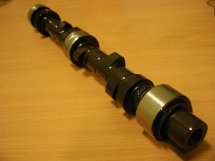
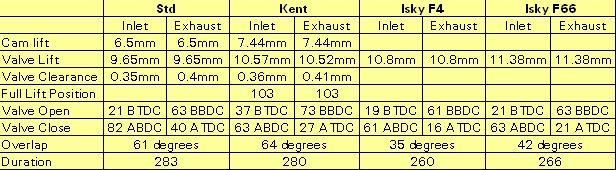
Valve Lift In terms of lift, maximum results are yielded at a valve lift of � the diameter of the valves. I have put in larger (42.1mm) inlet valves and machined the valve throats to 2mm narrower diameter (e.g. a 1mm valve seat) of 40.1mm � this gives me in a maximum potential valve lift of 10.5mm. The reason is, lifting the valve any higher does not allow more gas flow through the valve throat as the throat then becomes the limiting factor: Valve throat cross section area = radius x radius x pi = 20.05mm.x 20.05mm x3.141 = 1262.7 mm2 The size of the �gateway� that allows gas out and around the valve can be worked out as the circumference of the valve x maximum valve lift = diameter x pi x height = 40.1mm x 3.141 x 10.5mm = 1322.5 mm2 As you see, the valve throat is the limiting factor, regardless how high you lift the cams. When trying to choose between cams go for the highest lift you can find without exceeding the duration that will give you the tractability you are after. The longer the cam duration the more low end power you will sacrifice. 275 is a good benchmark for a road car that is going to be used regularly � that said, Kent Cams modded mine to 280 as it is what they have done to other 96 owners cams! I await to see what the results will be! Another problem is that different cam companies quote durations measured in different ways and thinks makes comparing cam specs fairly academic. My first initiation in this was when I discovered that the Haines Manual quotes the standard duration at 283 degrees � pretty wild for a road cam and confusing as Kent had extended my cam to 280 degrees! What is happening here? |
| The Isky Cam profiles are a popular US modification but look at the duration: 260 degree. Well, that is just awkward. So. Comparison of different durations is tricky but valve lift mods translate pretty easily.
Saab Rally cams Back in the day, Saab made their own performance cams for their Rally projects. They were named: 7.2, 7.6 and 8.6. Catchy names. As I understand it (correct me if I am wrong) they relate to the cam lift, e.g. The difference between the lowest point on the cam lobe and the highest. The V4 has a rocker ratio of 1:147, e.g. every 1mm cam lift produces 1.47mm of valve lift. With this in mind, I translate the following specs to be: Cam Lift Valve Lift Std. 6.5mm 9.5mm 7.2mm 10.5mm 7.6mm 11.2mm 8.6mm 12.6mm. Blimey. Fitting a new Cam The life expectancy of a new cam is almost exclusively defined by the first few moments of its useage. To start with the reassembly is viatally important. The cam bearings have oil ports which much pe propoerly alighed to the oil channels that feed the. If they are misaligned, oil will not get to the cam bearing journals. Instant death. To this end, replacing cam beaings is a machine shop job. If you are replacing the cam yourself, be sure to check as best you can, that the bearings have not been moved during the cam removal. When refitting your cam - be it old or new - you MUST use a liberal dose of Cam Assembly Lube. This is often included with new cams but can be purchased from motor factors. Coat the cam and the cam follwers in the stuff. If you are refitting an old cam, you MUST replace the Cam follwers in their exact locations. Over time they will have bedded in to the cam lobe they are in contact with. Mixing up old cam follwers with an old cam will severly shorten the life of the cam. If you are fitting a new cam, you MUST replace the old cam follwers with new ones. Again, with a liberal coating of Cam Assembly Lube. Running in; The first few moments of a Cams life are absolutlely critical. You MUST run the cam in at about 2500rpm for about 20 minutes (a long time sitting on the driveway with your foot on the accelerator!) to work harden the cam lobes. Idling a new cam is a certain road to ruin. I am trying to resolve the paradox I have which is to run the cam in, set the timing, tune the carb and fill the coolant - all at the same time without dropping below 2000 rpm. Hmmmm...when I resolve it I will let you know! For more information, visit the Puma Racing site for more information than you could possibly imagine! |
 |
 |
 |
 |