Tens or thousands of years before the coming of the first European settlers, ancestors of Canada's Native People migrated across a frozen icepack linking Asia to North America. Over many centuries they spread across the continent. forming a rich tapestry of cultural and linguistic groupings. Approximately 500 years ago, European settlers arrived in what would eventually be called Canada. First came French colonists who created homes along the St.Lawrence. They were followed by settlers from France and Britain who gradually established competeing colonial posts in the Maritime provinces. The 18th century victory of British arms at Qu�bec, followed by the British defeat in the american revolution sent loyalists northward to British North America(Canada, B.C) in search of new homes.
During most of the next century and a half immigration continued. Settlers came mainly form Britian, including English, Scots and Irish. Some were drawn to the oppurtunities of a new world. Others, such as Scots and Irish famine immigrants, escaped the grinding poverty and starvation which was followed by crop failures or eviction from their lands. Americans also immigrated here. Many were lured north to Canada by Canadian land agents. Some came alone, while others came in famalies. Some succeded in finding a new place while others reaped only misery.
While most of the early immigrants came to Canada from Britain or the United States, other nationalities also came, including non-whites. Many immigrants from continental Europe were drawn to Canada by its economic promise, or as an escape from religious and political threats. In years before the American Civil war, the europeans were joined by thousands of black slaves who escaped by following the Underground Railway northward into Canada. After Canadian Confederation in 1867, thousands of Irish, Chinese and Indian labourers were imported as workers to build the Canadian Pacific Railway. On the Pacific coast other Chinese joined the rush of fortune hunters from all over the world who trekked into British Columbia and later the Yukon interior after the discovery of gold(The Canadian Gold Rush).
After the turn of the century, hundreds of thousands of American farmers moved northward into the Canadian praires in search of farm lands. At the same time, many from central and eastern Europe, seeking land, were recruited by Canadian Immigration agents anxious to fill the west with farmers.
While Canada's easter lands filled with settlers, other newcomers laboured away in Canada's expanding lumber, mining and railway, manufacturing and construction industries. Some planned to stay and become Canadians;other wished only to save money and then return to their famalies. Meanwhile, the money these journers sent home helped support those who didnt come to Canada. But whatever thier motives were for coming to Canada and whether or not they ended up staying permanently, each newcomer played a role in the builind of Canada.(All the above information was gotten from www.pch.gc.ca/csp-pec/english/about/multi.com)
ImmigrationIn The Modern Era
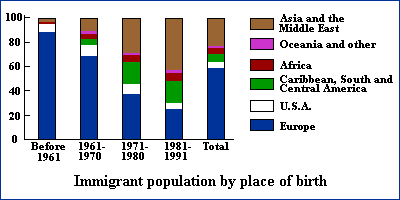
With the end of WW2, the Canadian economy was booming. The economy grew so large that there werent enough workers in Canada to meet the demand. Afraid that the economy might stall Canad lifted its restrictions on immigration to bring in tens of thousands of worker and their famalies from Europe. While the preference ws given to the people from Britian and western Europe, the need for workers was so great that they opened the door to other European countries. Immigrants from souther Europe and refugess from the then-Soviet occupied Europe arrived. Unlik earlier waves of immigrants, most who came after the WW2 settled in cities instead of farms and mining cities. Most were trained and well educated professionals.
In the years that followed, Canada became home to waves of refugees fleeing fom behind the Iron Curtain--from Hungary(1956), Czechsolvakia(1968) and Poland(1982-85). Canadian attitudes towards immigrants become a lot more welcoming. The Canadians supported efforts to end Racism and discrimintion in Canadian law, the last racial and ethnic barriers to Canadian Imimgrants were finally removed in 1967. The result was a dramatic change in the source of the immigrants. Non-Europeans, especially immigrants from Asia and the Caribbean, arrived in increasing numbers. Today, immigrants and refugees from the developing world and from other non-European sources outnumber European immigrants by a ratio of 3:1. Immigrants from all over the world are now allowed to enter Canada through something called a point system. Points are given to immigrants and if they have enough they are allowed to enter Canada. Canada now allows in about 200,000 immigrants a year.(All the above infromation was take from www.pch.gc.ca/csp-pec/english/about/multi.com)
multi_cultural_199/asi.html
_1999