| Research |
Term Paper for His. 135-a
Pro. Kenez
Medieval Russia
Final Draft
Tom Wheat
10/9/01
 The
English traders of the 16th century and particularly those dealing with
northern and eastern euro-Asian trade, when they stumbled on Russia, naturally proposed that they discovered
the country. Until the 15th century Russia was firmly believed to be under the
sole dominion and control of Tatar chiefs. Since the Tatars were feared
all throughout Europe, i.e., the historical memory of Mongol
riders was enough for them to associate Russia with being part of the chain of barbarism
and cruelty. Hence the writings of Giles
Fletcher, are the writings of an Orientalist,
who in his approach to Russia, emphasized themes of innate autocracy
and despotism as arising naturally out of the harsh Russian landscape
and so in despite the success of scholarly objectivity, for that time
period, certain racial notions and prejudices were reinforced by this
work as well. The
English traders of the 16th century and particularly those dealing with
northern and eastern euro-Asian trade, when they stumbled on Russia, naturally proposed that they discovered
the country. Until the 15th century Russia was firmly believed to be under the
sole dominion and control of Tatar chiefs. Since the Tatars were feared
all throughout Europe, i.e., the historical memory of Mongol
riders was enough for them to associate Russia with being part of the chain of barbarism
and cruelty. Hence the writings of Giles
Fletcher, are the writings of an Orientalist,
who in his approach to Russia, emphasized themes of innate autocracy
and despotism as arising naturally out of the harsh Russian landscape
and so in despite the success of scholarly objectivity, for that time
period, certain racial notions and prejudices were reinforced by this
work as well.
Now this of course
was naturally not the intention of Giles, since he was merely writing
from the bourgeoisie standpoint of a western European. However, there
was a long-standing view that Russia's evolution to statehood was retarded
by two reasons: 1. The imposition of foreign
Turkic-Mongol raids and rule, and 2.) Being cut off from the Catholic
civilization, Westward. The result of this cause and effect scenario
was the push by Russian merchants and traders to develop Sino Turkic
Mongolian trade ties and expand their own share of the eastern China trade.
However, to say that
the Russians were not expanding heavily in the 16th century or actively
engaging in alliances and trade pacts with their eastern neighbors would
utterly miss the point. Even Giles is amazed at the flow of wealth in
the tsar court. The Tsar court itself had been actively involved since
the 15th of century of negotiating military alliances and opening up
trade in Russia both from the East and West. This
of course was what led to formation of the Russian state with Moscow as supreme, --geographically and politically
at the center of the Russian realm.
Historical Overview
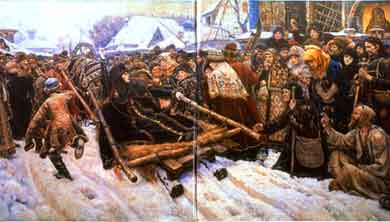
In the 15th century the Byzantine Empire was essentially reduced to the walled city of Constantinople. By 1453 the city fell to Mehemed
II and the Ottoman Turks. Tsar Ivan III, father of Ivan Grozny
had already arranged for himself to be married to the niece of the last
Byzantine Emperor. Coincidently, with the fall of the city, a short
time later, Moscow declared itself as the "Third
Rome."
|
Now
Moscow was forced to look west were it once looked south
to Constantinople. The seizure of the city by the Turks, made it necessary
for traders all over to search for a northeast passage to china
through Russia. 
|
Historically, Russia had a very long trading history with Tatars, Persians
and Mongols and had managed to develop a number of spurious
far-flung vast trade networks throughout central Asia and the Caucuses.
|
As a result of cultural and
economic contact with the East, the Russians borrowed many Asiatic
customs, such as kowtowing, and the divinely sanctioned supreme
authority of the monarch. So while Russia was a Christian country, to other Christian countries,
she was viewed as the barbarism exotica of the Northern frontiers.
However, Russia was undergoing a period of consolidation and centralization
during this period.
During the 15th and 16th century
as the Moscow princes managed to exert firmer control over the
feudal appenages, the liberty afforded towards centralized consolidation
of revenues, and land ownership made trade expansion possible.
With Trade expansion, came many western foreign traders, many
of who left in their writings accounts of their travels. The
most famous of these accounts is the account by the German ambassador
Sigisimund
von Herberstein. This work constituted
all of the known information westerners possessed on Russia as a whole. These merchant traveler accounts form
the basis for primary sources on Russian government and society
during those centuries of Russian-proto-state formation and
trade expansion.
Giles Fletcher no doubt read
the writings of Heberstein. However,
the English Elizabethian crown wanted to have its own unique sources
and intelligence on the newly expanding Russian proto-state.
As mentioned earlier Russia was important to England because it was believed that she had a Northeast Passage to China. Many explorers such as Sebastian
Cabot openly talked of finding a North East passage in Russia-how else could they avoid trade with the middleman
Turks. Under the reign of Ivan Grozny,
English explorers were trading all throughout Russia.
|
Ivan IV's reign was marked by many military and economic
expansionary campaigns. To the west he had to fight the western border
trade embargo imposed on the Russian state by the Poles, Swedes, Lithuanians,
and German tectonic knights. To the East and South he fought with the
various Tatar khanates, Astrakhan and Khazan that still challenged his
authority, eventually incorporating these into the Moscow orbit.
The Russian court warmly welcomed the arrival of the English and
their desire of direct western investment and trade in Russia. The British
promptly set up the joint stock Moscow Trading Company. Hence Ivan was
able to stave off the Baltic blockade, with the arrival of the English.
The Moscow trading company essentially became the blue print
for all joint stock companies that followed from the English
crown. (7) Ivan IV granted the English a trading monopoly and
exempted the Moscow Company from customs and other excises on
goods that were sold. During this time it was found that a Northeast
Passage to
china was not economically feasible. However a land route to
the Middle East was found and trade opened up quickly in what was
once the vacuum of the conquered Byzantine state. During this
time Moscow annexed all of the tributaries of the Volga River and essentially made it the central artery of trade in Russia.
However, the Anglo-Russian
treaty began to suffer a number of setbacks. The Russian court
began to fear the monopoly of the English on the Northeastern
trade routes. The queen of England first dispatches Thomas Randolph to renegotiate the
trade treaty. The Russians later reaffirmed the treaty with
England, and Tsar was able to supervise the company's actions
with his newly formed Secret police, the Oprichnina.
Secretly though, Ivan hoped for a military alliance with England. However, Ivan died in 1584, and now the puppet Fedor, and his enforcer, Boris
Godiunov, ruled Russia.
Now the English court called
on the services of Giles Fletcher. He was already a veteran
of both the English parliament and treasury and had his own
ideas on how commerce was supposed to operate between to nations-not
necessarily equal ones.
|
However, these are
tumultuous times all throughout Europe. Fletcher is virtually shunned, much to his indignation,
when he arrives in Moscow. Russian intelligence had already known of the Spanish
armada that had been fitted for sail against the power of England. The Moscow court had also been actively pursuing talks with
Germany and Spain over the possibility of a mutual alliance against
Ottoman hegemony.
Elizabeth defeats king Phillip of Spain in 1588. With fortune blowing in the wind, in April
of that year Fletcher had a new trade agreement signed by Moscow. The English withdrew their monopoly and conversely
won exemption from collective responsibility regarding individual
merchant debt.
Giles account
of Russia
Fletcher
Giles published his book, "Russe Commonwealth" in 1591. The Moscow Company vigorously tried to suppress the
book. The book was targeted as being seditionary
nature. The essential summary of Russian statecraft personality
of the 16th century, according to the English and Fletcher could
be summarized as autocrat and autocracy, rule by military decree.
On the Orientalist
note, somewhat common in colonial sources, was also the depiction
of the “other”, and although Russia had good relations withEngland
at this time, her knowledge about Russia was framed by the stereotype of the despot, and mind
numbingly poor exploited peasant. This part was very true though
Karimzin agrees that Fletcher’s account of Russian life
was fairly accurate.
Fletcher’s book became more
risqué when it was revealed that certain passages in the book
about Godinov portrayed him as the
autocrat and Fedor as the puppet.
In further passages there is also the account of the alleged
unlawful succession of Fedor to the
throne and that overall the rulers of Russia were innately tyrannous autocrats, as opposed to
the (English gentleman autocrat).
The Book was essentially divided
into three sections, geography, state institutional structure,
(this being the most lengthy part of his analysis), and finally
an account of Russian customs and manners. The largest part
of the book is devoted to the operations of the state itself,
from the nobility and officials to the judiciary and military
apparatuses of the Moscow state. Most of his other source information comes
from his companion Hosey, who provided
him with a rich descriptive account of the Siberian Tatars.
Overall, the book was a watershed in Russian political history.
It was the first systematic analysis of Russian politics and
society ever undertaken.
For Fletcher, the importance of his work lay in addressing the
relationships between autocracy and how the government functioned
and retained its power. Thus, Autocracy for Giles was a political
necessity in Russia given her violent past. He poignantly pointed out
the differences between the English and Russian crowns defining
the English government as a "community of interest."(28).
This involved the balance of power, and authority being shared
by the English king and his nobles, pursuant to the Magna Carta
precedent that established the English parliament. In Ivan's
time, there is no Veche or parliament.
Fletcher views the tax-exempt
church as being totally disconnected from the peasantry. He
says the Russian manner is crude, and the regime is responsible
for the stunted evolution of the commoner. He is obviously sympathetic
towards these people and blamed the government. Essentially
he summed up the reason for the backwardness of the peasantry.
1. Rigidity of the social structure,
and 2.) Lawlessness and anarchy in the countryside.
(35) Fletcher knew that the thin veil of social order would
not last long and accurately predicted
that a civil war would soon follow. 15 years later, so began
the "Time of troubles." To Fletcher, England was antithetical to Russia. Two countries with related royal
houses, and totally different economic and political fortunes.
The individual nobles and
lords functioned as tyrant landholding manorial serf systems
as well. The Grozny state mutually reinforced, the quick succession of
noble classes, through inherited Byzantine Court intrigue, as diplomacy @ home through purge of the Boyar, and diplomacy
abroad as military expansion, and consolidation, of the Moscow
state, through trade with England and military expansion of
border, periphery states, that precipitated, polish-Lithuanian
encroachment. Among the nobility and gentry, the specter of
the divided houses, as often purge, by Ivan’s paranoia, and
an inherited disintegration of sanity with the death of anaststasia
romanaov busmanov,
made the life of the Boyar, a good one if he never crossed Grozny’s
path. For after the death of his wife, Anastasia is when the
autocracy fully emerged.
as diplomacy @ home through purge of the Boyar, and diplomacy
abroad as military expansion, and consolidation, of the Moscow
state, through trade with England and military expansion of
border, periphery states, that precipitated, polish-Lithuanian
encroachment. Among the nobility and gentry, the specter of
the divided houses, as often purge, by Ivan’s paranoia, and
an inherited disintegration of sanity with the death of anaststasia
romanaov busmanov,
made the life of the Boyar, a good one if he never crossed Grozny’s
path. For after the death of his wife, Anastasia is when the
autocracy fully emerged.
In terms of historical relevancy,
this period was regarded as how Moscow was to expand, and centralize
control with the rate of expansion, i.e., Boyar Purge = Transfer
of Votchina,
to Pomestie. The crown becomes
the major landholding entity along with the church. In Giles
view it was in the Slavic tradition, the tragedy making the
tyrant. Hence Fedor’s puppet role
was a doomed- somewhat, a hapless tragedy, and a point in which
Moscow is still controlled by Ivan’s generals.
Muscovy endured two False Dimitry’s
claiming kinship to the royal throne of Ivan Grozny.
Some where supported by the resurgent Poles and Lithuanians,
however, both reigns were short towards exile for one and execution
for state (church-Judicial) heresy, on the other. Eventually,
the election of Michael Romanov, by the Boyar Duma, as
Tsar, transformed the face of Russian History. Michael
was the grandson of Anastasia, and Grand Father, to Peter the
Great.
Conclusion
Centralization in Russia required an autocrat, and a strong ruler who could
unite the military and bring boyar feudalism in line with state
control. The institutional framework, i.e., state taxing structure
was already in place as a result of former Mongol rule. With
the resumption of the East west trade and the end of the pax
mongolica, western trade, diplomatically
sought ways around the ottoman black sea blockade. The English
began to heavily invest in Russia. This investment already complemented the internal
political politics of succession of Moscow, the vestiges of Mongol absolutism, i.e., taxation
structure and borrowed military structure.
Key to the character of the
proto Russian state was the inherited notion that Political
crises in Russia tended to create a phenomenon in which the state
had to be increasingly militarized. This was the states classic
response to border instability, which tended to create rule
by a single autocrat, and his generals. Border defense and land
registration, were tasks that only the state and its emerging
military bureaucracy could provide. For centralization to occur
the ruler had to command obedience from his nobles. The history
of the fractious nobles had made foreign invasion possible.
So Russia As a country had faced numerous raids from nomadic
tribes and the Baltic Alliance,
throughout its history and this led to the necessity for strong
central control, if it was to remain a nation. The military
was the only institutional structure capable of unifying the
Russian land.
Fletcher was never able to
really profit from his book. He died in 1611. His book was banned
for a while and finally re-released in 1643. The Russian historian
Karamzin found Fletcher's work to
be quite accurate for the time.
In all, the author of, “"Russe Commonwealth,"” Giles, attempted to describe in 150 pages,
a testimonial of Russia during a period in which she was undergoing a period
of massive land consolidation, under the authority of centralizing
Muscovy state. Moscow centralization was essentially Russia's response to incessant Mongol and Tatar raids. After
the fall of the Mongol Russian Suzerain state, the Russian princes
had fallen into decay and princely infighting.
In conclusion, the autocracy
that the English were viewing in Russia as part of their economic
and political intelligence gathering in Russia, in terms of
historical understanding of russian political custom, had to be viewed in the context
of the necessity for political stability in Russia, as she began
the process of modernization, and in the English eyes, the gradual
evolution into westphalian statehood.
|
Usefull Links for Online Research
THE OXFORD HISTORY OF MEDIEVAL EUROPE (online
edition)
Top
|
|