Gnosticisim and the hypocrisy of Arian US corporate Christianity
part 2 News Networks
Gnostic Origins of Alfred Rosenberg's Thought
The Cult of Muscovy
by Tom Wheat
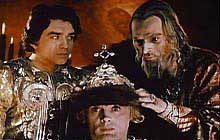
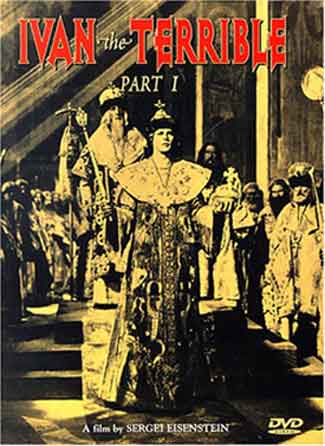
Recommended Viewing: [1943mr:Sergei Eisenstein's famous movie "Ivan the Terrible"]
The Cult of Muscovy
 The
historian Robert O' Crummey in his book, "Formation of Muscovy,"
outlines the evolving bureaucratic structure of Moscow, and the culmination
of autocracy under the reign of Ivan Grozny. The ways he argues this unfolding
process is to outline features of Ivan's personality, and how his personality
affected his decision-making ability. Furthermore, Crummey also argues
that the sources describing life and autocracy in Russia, come mainly
from foreign visitors to the Moscow court and generally they refer to
the brutality of his oprichnina campaign. This program became self destructive,
and according to Crummey, indicative of Ivan's stress with having to deal
with the feuding Boyar clans, some of them family members at court. He
also had to explain his early military failures with Tatar tribes and
diplomatic failures with Western Europe. Military failures abroad meant
that the Oprichnina office was used to purge the military, often, of effective
leadership, as well as the dilettante Boyars. The key reform under Ivan's
reign was his establishment of a centralized, professional, Russian Land
army, and this facet alone established the foundations for autocracy in
Russia, and that autocracy, and imperial centralized administration in
Russia was the process in which it would eventually evolve into a state.
The
historian Robert O' Crummey in his book, "Formation of Muscovy,"
outlines the evolving bureaucratic structure of Moscow, and the culmination
of autocracy under the reign of Ivan Grozny. The ways he argues this unfolding
process is to outline features of Ivan's personality, and how his personality
affected his decision-making ability. Furthermore, Crummey also argues
that the sources describing life and autocracy in Russia, come mainly
from foreign visitors to the Moscow court and generally they refer to
the brutality of his oprichnina campaign. This program became self destructive,
and according to Crummey, indicative of Ivan's stress with having to deal
with the feuding Boyar clans, some of them family members at court. He
also had to explain his early military failures with Tatar tribes and
diplomatic failures with Western Europe. Military failures abroad meant
that the Oprichnina office was used to purge the military, often, of effective
leadership, as well as the dilettante Boyars. The key reform under Ivan's
reign was his establishment of a centralized, professional, Russian Land
army, and this facet alone established the foundations for autocracy in
Russia, and that autocracy, and imperial centralized administration in
Russia was the process in which it would eventually evolve into a state.
 Overall, I
would characterize the book as lacking the necessary, exculpatory evidence
into the actual psychological dispositions of Ivan, inferred through the
"letters of Prince Kurbiskii," and through actual admissions
in which I have cited Crummey. Rather that the author's reliance on this
piece of evidence requires him to shift the focus of the chapter dealing
with Ivan's reign as a chapter that merely underlines Ivan's foreign policies
and uses those policies to explain his actions in the domestic arena.
Overall, I
would characterize the book as lacking the necessary, exculpatory evidence
into the actual psychological dispositions of Ivan, inferred through the
"letters of Prince Kurbiskii," and through actual admissions
in which I have cited Crummey. Rather that the author's reliance on this
piece of evidence requires him to shift the focus of the chapter dealing
with Ivan's reign as a chapter that merely underlines Ivan's foreign policies
and uses those policies to explain his actions in the domestic arena.
 With
Control of a standing army, Crummey maintains that Ivan could consolidate
his realm, conquer the Tatar tribes, and used the first Draft of Service
Act, to move all Boyars toward mandatory service in the military, in which
they were under his direct authority. The key failure according to Crummey,
was that Ivan failed to leave a suitable replacement and this created
a power vacuum. The wars that Ivan waged had also drained the treasury
and this was what led to the end of stable rule for some 25 years of strife
that followed his death. However, Crummey also maintains that Ivan's reforms
leave an enduring legacy---, that his structure of government, remained
unchanged until Peter the Great. This establishes a weak link toward the
progression of united, Imperial Russia. However, much more had to be done,
and in fact the emergence of Imperial Russia, some 100 years later, the
act of having dissolved Ivan's administrative policies and the forms of
muscovite bureaucracy, tends to show that centralized unity and actual
state formation happened under Imperial Tsar, Peter the Great, and not
Ivan Grozny.
With
Control of a standing army, Crummey maintains that Ivan could consolidate
his realm, conquer the Tatar tribes, and used the first Draft of Service
Act, to move all Boyars toward mandatory service in the military, in which
they were under his direct authority. The key failure according to Crummey,
was that Ivan failed to leave a suitable replacement and this created
a power vacuum. The wars that Ivan waged had also drained the treasury
and this was what led to the end of stable rule for some 25 years of strife
that followed his death. However, Crummey also maintains that Ivan's reforms
leave an enduring legacy---, that his structure of government, remained
unchanged until Peter the Great. This establishes a weak link toward the
progression of united, Imperial Russia. However, much more had to be done,
and in fact the emergence of Imperial Russia, some 100 years later, the
act of having dissolved Ivan's administrative policies and the forms of
muscovite bureaucracy, tends to show that centralized unity and actual
state formation happened under Imperial Tsar, Peter the Great, and not
Ivan Grozny.
There are no contradictions if one accepts that the formation of the Moscow
state did not proceed an in upward linear progression. Rather it was kind
of a Boom-Bust" cycle of fluid political, and economic power, revolving
around the status of international trade agreements abroad. That this
made early Russia's borders somewhat fluid, and difficult to define in
terms of Ivan's political realism and paranoia misses the point, that
his absolute decrees, and the manifestation of his power, the treasury,
was subject international prices, and tariff agreements and to Ivan made
the western conquest of Livonia-(Sweden, Poland-Vladimirvolynia), necessary,
despite the 20 year old war's effect on his domestic economy, and the
resulting inflation, indenturing the peasant to the land. That trade authority
for Russia was somewhat subverted to the supreme authority of the institution
of Tsar, by his military mobilization and consolidation of domestic, and
popular power. Moreover, his authority was more challenged when the economics
of inflation and natural disasters coupled with the economic, and military
failures of engagements abroad, showed his lack of control over international
events and their overall effects on the domestic scene. This is in stark
contrast with the dominant historiography that has created an atmosphere
of pedagogical definitions that correspond to linear definition, in defining
the evolution of statehood, by precisely de-emphasizing the effects that
international trade has on the development of a Westphalian- nation-state.
I argue that Crummey's analysis of Ivan's reign marks the way in which
he describes the evolution of Moscow, and how the tsar influenced that
evolution. However, the sources which Crummey entertains in his book,
come entirely from foreign sources in specific regards to Ivan's personality,
and why Ivan acted or reacted a certain way or interpreted events as attacks
to his personal power. Crummey maintains that he can explain this away
because the argument against ascertaining I van's actual policy prerogatives,
is a circular argument, in which debate and dialogue are made impossible.
So without any policy prerogatives much of what he argues about Ivan's
personality, his drunken rages, and the murder of his son, is not clearly
substantiated by logic rather inferred first with a physical autopsy performed
on Ivan Grozny's body in the early twentieth century, in which mercurial
trace substances were found, and that he also had a deformed spine. This
does not explain to me Ivan's personality, rather the events are inferentially
substantiated to me by the mention of Ivan's political realism with his
family of Boyar nobles. Crummey acknowledges this fact as well, but both
of us are drawing circumstantial inferences not fully substantiated into
the larger picture. Thus, the problem of defining Ivan's bureaucratic
methods should involve more by Crummey's logic, and by the design of his
book, and the chapter dealing with the reign of Ivan Grozny, as one in
which, the sources can be satisfactorily derived from foreign accounts,
because Ivan was actively engaging and trading with the West.
The Western Intelligentsia at Ivan's court had a chance to view the intrigue
of royal succession, meschestnitzva, and rites. That hearsay on their
part is acceptable as evidence because that hearsay was written down as
opposed to oral history demonstrates the bias of Western history. However,
I would argue that probably a majority of the sources are accurate however,
Crummey's reliance on hearsay for the sake of historical simplicity in
crafting his narrative introduces a feature in which he will only rely
on hearsay when it is convenient. "Accounts of his reign are filled
with tales about his sadistic cruelty. The English visitor Sir Jerome
Hosey described him as a man full of ready wisdom as well as cruel, bloody
and merciless."(Crummey, 145)
 I
argue that the state of Moscow's foreign policy relationship with the
West was one of England as a trading partner and the rest of the West
as mutual adversaries, and that Ivan depended on that adversarial relationship
to maximize his power at home, by military force abroad, genealogy and
land consolidation at home. This also involved the subjugation of the
various Khanates still competing for power and influence in Russia. Ivan
conquered most of them, but not all of them. That he was engaged in a
two front war at all times, either the hegemonic West, or with the unruly
Boyars, and if not them then he also had to contend with Russia's legacy
of repeated harassment, by nomadic tribes that formed the earliest of
Russia's political climate. Thus, when he died the Crimean Khanate once
again sacked Moscow and Civil War in Russia ensued, and foreign powers
once again manipulated the throne of Moscow. What did survive and what
constituted Ivan's legacy, was his development of Russia's first standing
army.
I
argue that the state of Moscow's foreign policy relationship with the
West was one of England as a trading partner and the rest of the West
as mutual adversaries, and that Ivan depended on that adversarial relationship
to maximize his power at home, by military force abroad, genealogy and
land consolidation at home. This also involved the subjugation of the
various Khanates still competing for power and influence in Russia. Ivan
conquered most of them, but not all of them. That he was engaged in a
two front war at all times, either the hegemonic West, or with the unruly
Boyars, and if not them then he also had to contend with Russia's legacy
of repeated harassment, by nomadic tribes that formed the earliest of
Russia's political climate. Thus, when he died the Crimean Khanate once
again sacked Moscow and Civil War in Russia ensued, and foreign powers
once again manipulated the throne of Moscow. What did survive and what
constituted Ivan's legacy, was his development of Russia's first standing
army.
Historiagraphical Analysis
The Historiography of Mongol rule in Kievan Rus has been chronicled by
two methods in explaining Mongol victory and the subsequent end of the
Kievan period. The first method as one of great destruction under the
Tatar yoke and the other, recording the period of princely rule as if
nothing had changed by obscuring the authority and vestige the Mongols
exercised over the Princes. The tale of the Life of Prince Alexander Nevsky
 as
well as those of, "The Life and Death of Grand Prince Dimitry Ivanovish
and St. Sergius illustrate these two points. All three documents are propaganda
pieces intending to portray the sovereign authority of Russia as unchanging
during the period of Mongol conquest and its subsequent period of decline.
as
well as those of, "The Life and Death of Grand Prince Dimitry Ivanovish
and St. Sergius illustrate these two points. All three documents are propaganda
pieces intending to portray the sovereign authority of Russia as unchanging
during the period of Mongol conquest and its subsequent period of decline.
The writers of these documents would have us believe that the Mongols
never invaded Russia, i.e., state and ecclesiastical, "ideology of
silence,"-let alone establish a conquest upon Russian land. Rather
the view is presented that these Mongols are merely peripheral, periodic
raiders, with no real overall impact, --oh and by the way Dimitry of Moscow
finally, defeated the Mongols at Kilikavo, and the Swedes at the Don,
in 1380 AD-fishy! Mongol authority over the succession of the princes,
specifically its power to award and take away the title of grand prince
is never mentioned in the chronicles.
Overall, the writers of the period never accepted the legitimacy of Mongol
rule ever having in fact occurred as well as their misrepresentation of
actual Mongol government policy. This in part was due to the fact that
the Mongols did not maintain an active presence in Russia, rather ruling
Russia as a peripherary,--- tribute and territorial consolidation being
their chief objective. Furthermore, the writers from the early Muscovite
period embellish accounts of historical events that one would believe
that the fall of Kievan Rus, simultaneously occurred with the rise of
Moscow.
In fact it was the Mongols who originally favored Moscow as a counterweight to Kiev and Novgorodian aspirations, and only when they failed to check the city before it maximized its control, did Mongol authority cease to possess significance. An expository on these Primary sources and evaluation of Crummey's analysis will now follow.
Crummey is somewhat of a revisionist on his reliance on the letters of
Prince Kurbskii, since history has proved them to be forgeries, in most
circles, accept his. The letters he argues offers a detailed window into
Ivan's world and that there status is still justifiably disputed, all
the same. (Crummey, 144) Kennan his main detractor, and whose argument
he seeks to debunk, by calling the letters as disputed, rather than as
"actual" forgeries, on the part of Crummey's analysis does not
explain why Crummey continues to use the letters as primary source material
concerning the personality and motivations, of Ivan grozny. By analyzing
his footnotes, I found that he was referring to the author of a book,
"Apocrypha," by Kennan. Crummey states that, "Both Kennan's
supporters and his many opponents can present strong arguments in their
favor. Moreover, both camps seem to depend, to some extent, on a closed
circle of arguments so that dialogue between them is virtually impossible."(Crummey,
176)
He does have an encompassing literary theme though in all of this, in
stressing his premise that the evolution of muscovy, involved centralized
authority, this required an autocratic ruler, when Russia had a strong
ruler she was able to defeat the Mongols, and that the Civil war after
Ivan IV's reign was a minor setback in the overall evolution of Muscovy.
To this point I would agree, autocracy was politically expedient for Russian
centralization. Nonetheless, Crummey maintains that the side effects of
autocratic centralization in Russia increased serfdom of the peasantry.
However, a key point that Crummey overlooks is the definition of feudalism.
That the fact that decentralization and feudalism are a linked phenomena,
when one is trying to describe serfdom, and that the definition of the
word serf, is also syntactically a western European word and connotes
a definition antitheses, and invokes a contradiction when Crummey is referring
to the phenomenon of centralized feudalism in Russia.
This furnishes an incomplete picture and does not explain why Ivan acted
the way he did. Rather what does explain his actions were the actual people
he executed and their relationship to royal authority via the hereditary
elite conflict with the new emerging elite classes. This also stemmed
from his ideological conflict with the church, and whether secular government
under a divine tsar was a divinely sanctioned authority over the church.
Crummey also maintains that the church would unite with the landed aristocracy
and attempt to thwart Ivan's plans for centralization. The church itself,
which is interesting to note, initially created the office of Tsar so
as to better control the state from one solitary source. The church instituted
the seeds for its eventual subjugation to central authority, i.e., Ivan
Grozny, by crowning him a nominal figurehead while still a teenager, by
giving him broad, ideological powers in defining him, the Emperor, of
Christian Russia.
Finally, that this process of centralization in Russia stemmed from its relationship to the other powers of Europe and patterns of international trade, and that these factors alone governed how Ivan ruled Russia, , not entirely the arbitrary rule of one man, as it is convenient to define the first Tsar of Russia. That in fact, the state of the country at his death led to civil war, and the purges of the Boyars had created a mercenary force in Russia, the Oprichnina, and that some its members were recruited from other countries. That the sources that Crummey uses to describe, Oprichnina also exclusively come from western sources, or from Soviet historians, who interpreted travelers' logs. (please see footnote #1) Crummey siding with the historian, V.B. Kobrin, states that, "In short as V.B. Kobrin has convincingly argued,...was the presence in oprichnina of a scattering of foreign adventurers, several of whom left accounts of their adventures."(Crummey, 163)
Crummey also fails to mention that the oprichnina both enhanced Ivan's power, but also produced the largest threat to his power, through its ability to dissolve the dominant social order at the will of the Tsar, and now the Tsar claimed to represent popular opinion as well. Rather, Crummey maintains that Ivan was mentally unstable when he was at the height of his power and began to scale down the Oprichina program.. Crummey states, "All of these statements and gestures suggest that, at the height of Oprichnina, Ivan suffered from acute delusions of persecution."
So that when we consider that after purging the Boyars he created a new threat to his power,---in its place, and deprived the bureaucracy of effective leadership through his sometimes arbitrary purges. That this scenario set the stage for later civil war is inherent to autocratic regimes, however it is not mutually exclusive to the actions of a delusional paranoid, rather the actions of a political realist. Thus, Crummey's evolutionary hypothesis is somewhat problematic, and upon further scrutiny installs a rather cyclical nature to the emerging Muscovite state--something Ivan never intended, nor could help. That Moscow had periods of regression, first with Ivan's death then visa via civil war after the death of Boris Godinov, and the appearance of the False Dimitry, and then finally the election of an autocrat, by the Veche, Michael Romanov.
Moscow's evolution was a circular process in forming, it began under the Mongols, then autocratically under Ivan's military power, and ended under the establishment of the dynasty of Peter the Great. In this process the Russian state evolved into a dynastic bureaucracy, by autarchic means, and the bureaucracy experienced the same rate of parallel growth. Crummey simplifies the narrative to a standard linear progression of events, and that hearsay is accepted to simplify the narrative, and thus he can gloss over the "Time of Troubles," and other impracticalities it raises concerning his evolutionary hypothesis: That Russia's march toward statehood was an upward march of progress not marred by bureacratic failings inherent to the bureacratic culture of leadership, --which is erroneous, because his sources are limited by ideology. Because Russia at this time was activly defining its borders while still defining its conception of statehood at the same time. Europe, of course, was engaging in defining 'nation' and 'statehood' at the same time, and one remembers that the dominant mode of historical thought centers on the notion that autocratic monarchy in Europe was created by the Treaty of Westphalia when its provisions were enacted by all of the european powers. This treaty outlined the modern definition of the nation-state.
I argue that Ivan was still consolidating his realm into a proto-state. This made the military reforms neccessary, because through them, and through war he and other leaders soon found that they could increase their power over the domestic population. With the decomissioning of local militia leaders, and govenors of local authority, peasants now only owed allegiance to god and the Tsar, as opposed to tacking on the Noble title tithe as well. Ivan mobilized a base of popular support through emergency protocals, awarded only to a commander and chief who is secular head of state.Thus, the ever present state of emergency in Russia, gave him more authority to create military mobilization and institutionalization of government through purges of the army and aristocracy on charges of disloyalty. The authority of the military as Russia's first form of centralized bureacracy and what made it a proto-state, was that its authority was centralized, under Ivan. This was how he could extend his authority over the Boyars
This military mobilization created the institutional framework for the Russian administrative precedent, Oprichnina, which Crummey fails to mention. What he does mention is the historian S.F. Platanov's analysis of the Oprichnina as the final evolution of his autocratic institutional reform package for the unruly, centripedal, Boyar elites. In summarizing Platonov's stance, he states, "In their opinion, the core of the Tsar's domestic policy after 1564 was a systematic attempt to strengthen his authority by destroying the power of the aristocratic clans whose members dominated his court and administration."(Crummey, 163)
With the boyars under his authority, coupled with their yearly requirement to demonstrate loyalty through military service, the Church also subverted to his authority since it was proved that it had collussions with those centripedal forces forces in Russia that Ivan found a device, a tool for state formation. He found this in the military, the ability in which he could circumvent geanology, hereditary decision-making ability and replace it in spirit with qualified or less corrupt administrators, who adhered to his vision of a unified Russia. This reflected his overall policy regarding the shifting of wealth from hereditary estate to seignorial estate, as a means in which he could control the flow of domestic wealth in his lands. The personality of Ivan the administrator is less important to gauge when one consider the effects that his administrative policing had as a whole on the evolution and formation of Russian Statehood.
Bibliography
Crummey, Robert O. "Formation of muscovy 1304-1613,"Longman group, UK Limited 1987.