


Nu Beta's history began about October 11th, 1909, when a group of men convened at 43 Winants Hall and formed an organization called the Rutgers Silver Fox Club. One month later, its formal constitution was written, and the club was headed by president Fred Glender. In 1910, the name of the group was changed to Scarlet Society Club. In 1911, the new club leased a house at 524 George St., and began to consider joining Phi Gamma Delta. The members then adopted the motto "Phi Gamma Delta or NOTHING." Between the period of 1912 to 1917, the group went through the tasks of becoming a chapter and was granted its charter on December 29th, 1917. At that time, Nu Beta had 54 members. However, the onset of World War I brought the chapter's activities to a standstill until 1919, as students were participating in army corps training.
In 1920, Nu Beta held its first Pig Dinner and in 1922, the chapter moved to 586 George St., where Clothier residence hall now stands. This location is directly across the street from our new house. Nu Beta remained at this house until 1943, when Sigma Alpha Mu rented it. Later, in 1945, the house was destroyed as the result of a fire. In 1946, the chapter house moved to 15 Union St., but this was only a temporary home for the Phi Gams, as it was too small.
In 1949, the fraternity bought the property at 78 Easton Avenue for $40,000. This would be the chapter's home for 40 years. The fraternity saw many great years on Easton Ave. In 1957, Nu Beta won the Cheney Cup and in its long, proud history, won the Keller Cup competition 29 times (more than any other fraternity at Rutgers). On June 18th, 1990, the house at 78 Easton Ave. was tragically the victim of arson, and thankfully nobody was injured. The house was gutted by the fire and torn down in September.
The loss of the fraternity's home was devastating to both the graduates and undergraduates. Plans were continually reviewed either to rebuild on the property or relocate to another location. The high cost of building a new structure, estimated at over one million dollars, and the lack of another appropriate house, forced Nu Beta undergraduates to maintain the chapter in off-campus facilities. Morale and membership hit an all-time low and a brotherhood review of the chapter was instituted.
In 1991, a core group of undergraduates, led by the chapter president Jason Clark-Christie and Purple Legionnaire Sheldon Thorpe began the task of rebuilding the chapter and recruiting new members. In 1994, undergraduate president Glenn Jenkins and Purple Legionnaire Bill Parker signed a five-year lease for the fraternity house at 40 Union St., formerly owned by Delta Sigma Phi. The undergraduate chapter slowly built back its membership reputation, and relationship with the grated this past year. Accordingly, Phi Gamma Delta was voted the most improved chapter at Rutgers University, and received numerous other awards for programming excellence.
In March 1998, with our Union St. lease termination in only 15 months, the Alumni Association became aware of Sigma Phi Epsilon's intent to sell their chapter house due to financial and undergraduate problems. The Alumni Association convened for a special meeting on March 25th, 1998 to review this opportunity, and voted unanimously to purchase the Sig Ep house. On April 25th, 1998, a purchase contract was signed for $845,000 and the Nu Beta Alumni Association took the title to the property on August 5th, 1998. Beginning on August 23rd, 1998, Nu Beta brothers have lived in our great new home.









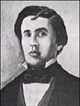
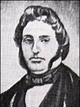
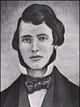
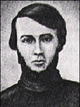
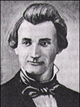
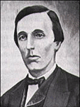
Crofts McCarty Gregg Wilson
The second meeting held on May 1, 1848, which is the date adopted and celebrated as the anniversary of our founding. At that time, the Constituion drafted by Samuel Beatty WIlson and James Elliott Jr. was ratified and steps were taken to investigate the feasibility of establishing "foreign chatpers."
Early in June of 1848, the second chapter was installed at nearby Washington College; Wilson served as Legate or installer of this new chapter. Likewise, new members were soon taken into the mother chapter of the "Delta Association," thirteen others being admitted before Commencement Day in 1848. In keeping with a strict policy of secrecy, it was not until Commencement that the existence of the new Greek-letter society was made public to the college - and only then by the sudden apperance of the black diamonds on a score of lapels. All of the founders graduated in 1848 except for Naaman Fletcher, who was elected President fot eh succeeding year, and the chapter adjourned until the fall.
The early activites of the Fraternity were shrouded in the darkest secrecy, every move being jealousy guarded. It was many years before undergraduate brothers wore their badges in public. While many of the first meetings were held in McCarty's and Fletcher's rooms, the brothers also met at night in an old Seceder Church about a mile from the campus and in Tillie Hutchinson's underground springhouse.
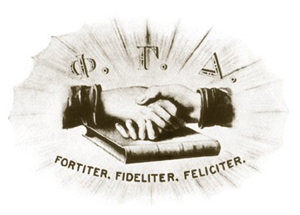
The Seal of the Fraternity is designated with two clasped hands. The hands rest upon a closed book. Rays of light radiate from the background to provide the oval shape of the Seal. The greek letters are appropriately displayed along with three greek words.
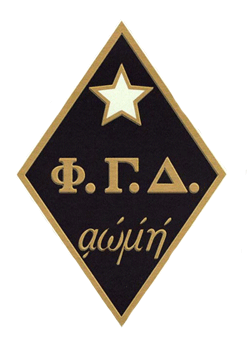
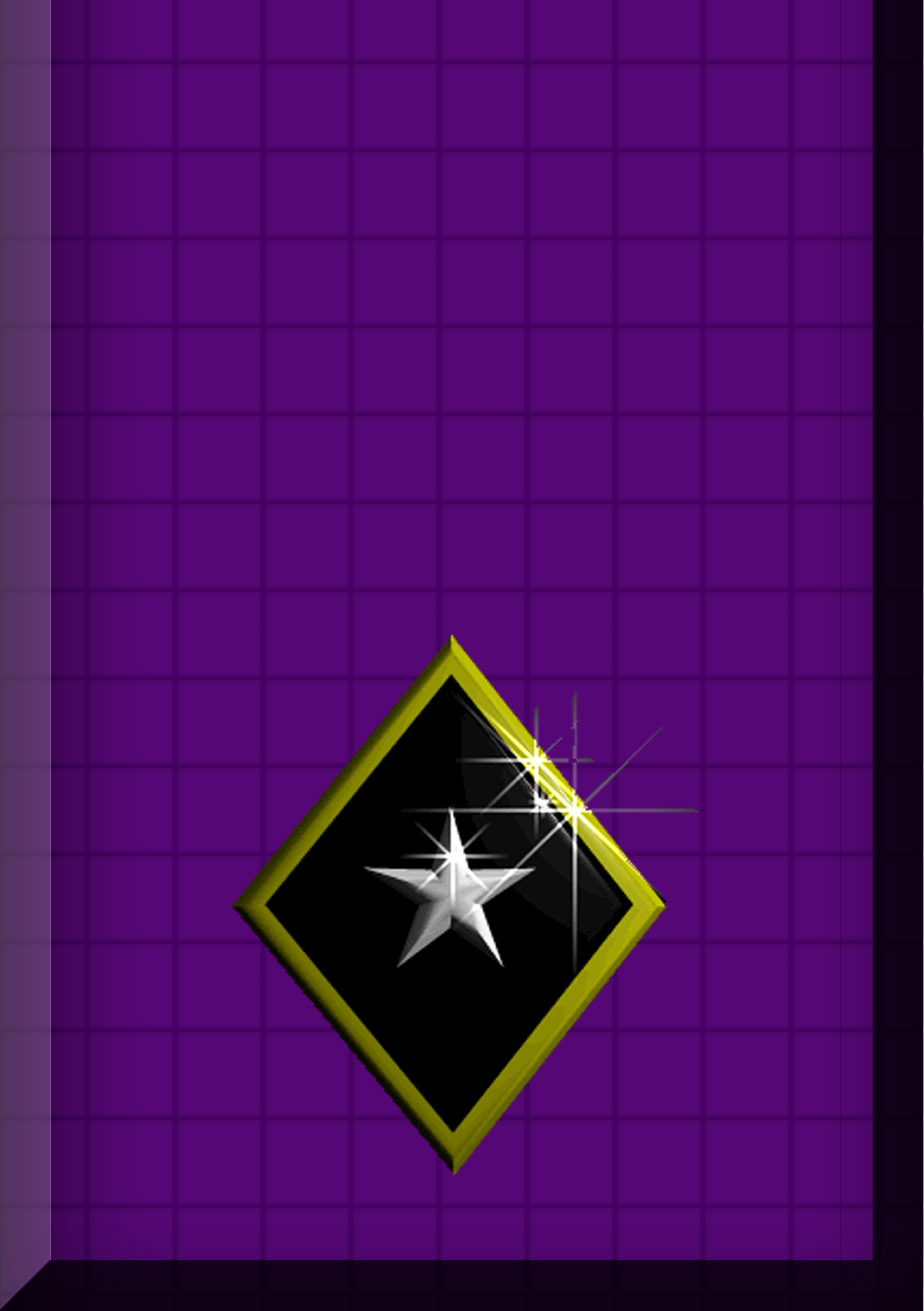
The cherished badge of Phi Gamma Delta has undergone many changes in size and ornamentation, but the basic design of the Founders - a white star and the Greek letters in gold on the black field of the diamond - has always been adhered to. The badge was first designed by Founder McCarty and its manufacture was first overseen by Founder Elliott. Seventy-five years later, by unanimous vote of the Pittsburgh Ekklesia of 1923, the badge of our Founders was officially restored as the official emblem of Fraternity membership. No variation of this plain but beautiful design is permitted, partially on the grounds that jeweled pins can not be afforded by all and that all brothers are equal.
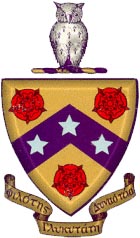
In 1879, Phi Gamma Delta became on of the first fraternities to adopt an official coat of arms. Major Frank Keck (City College 1872, Columbia 1875) and John Sherman Battell (City College 1873) were largely responsible for its creation. They submitted it for adoption at the 1879 Convention, and it featured: coat of arms - a gold shield, bearing three red roses, crossed by a purple chevron bearing three silver stars; crest - an owl; open motto - in Greek. This is essentially design in use today.
The Greek letters of Phi Gamma Delta may never appear on stationary, clothing, or jewelery other than an official college ring. A discriminating fraternity man is never guilty of cheapening himself or his fraternity by displaying the Greek letters on textbooks, raincoats, lavatory walls (nor even "Fiji" in this case), or the windshield of an automobile. Phi Gamma Delta allows only seven places where the Greek letters may be displayed:
1. officeial badge 5. memorials to members 2. official seal 6. certificate of membership
3. official flag 7. official college ring
4. chapter house marker
GAMMA
DELTA

The Fraternity's mascot is a snowy white owl nicknamed "Gamma." The great snowy owl is indigenous to the Allegheny Mountains of western Pennsylvania. According to legend, it was an unitiated visitor to some of the secret, midnight meetings of the "Delta Association".