CREATION CASCADE--SAIVA
Origin of Universe--Saiva view
The universe and beings originate from the Unmanifest (Avyakta) Mula Bhuta or Para Vastu (Supreme Substance or Essence second to none). There are three factors or entities: Janman, Janaka, and Janya. Janman means production or generation; Janaka is substrate, cause, generator; Janya is substance, the generated or the effect. Vikrita is change, modification or transformation. Paravastu undergoes transformation and produces Maha Tattva (Great Principle) which is made of three Gunas, Sattva, Rajas and Tamas, and Antahkarana. Maha Tattva generates three kinds of Ahamkara, colored by Sattva, Rajas, and Tamas. Avyakta, Mula Bhuta, Paravastu, Prakrti, Sabda Brahman, Bindu are synonyms. Prakrti by process of Vikrita (transformation) becomes Vikrti (changed product) that is Maha Tattva; therefore, Maha Tattva or Vikrti (the product) is Pratibimba of Prakrti or Para Vastu. (reflection of Prakrti). (Vikrti = Maha Tattva) Every object has qualities and so Vikriti, the product of Prakrti, is colored by three qualities; Vikrti or Mahatattva generates eight products: Mahat1 (Intuition or Buddhi), Ahamkara2 (ego), Manas3 (mind), Akasa4 (Ether), Vayu5 (air), Tejas6 (Fire), Apas7 (water), and Kshiti8 (Earth). Mahat, Ahamkara, Manas, Akasa, Vayu, Tejas, Apas, Kshiti.
Guna: quality
Antah-karana: Internal-organ, the seat of thought and feeling, mind, the thinking faculty, the heart, the conscience, the soul. ref: Monier Williams.
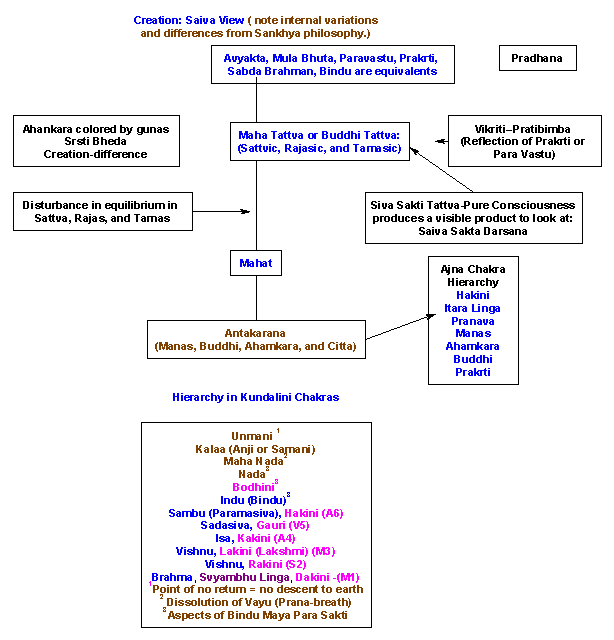
The transformed Prakrti (Vikrti) and the eight
elements that are its progeny are the primary and secondary causes of the
universe. (In Tantra Sastra, all powers are of equal importance, while in Vaidic
sastras, Purusa is the spirit and Prakrti is matter.) The nine centers, powers,
Chakras or Conscious Powers are the eight Padmas or Lotuses: 1)
Sahasrara, 2) Nada, 3) Bindu, 4) Ajna, 5) Visuddha, 6) Anahata, 7) Manipura, 8)
Svadhisthana, and 9) Muladhara. Sahasrara Padma or Lotus is the seat of
universal power which generated Nada and Bindu, Sound and Light. From Nada
Sakti, the universe of beings and matter emanated. The lower six chakras contain
fifty petals with 50 Sanskrit letters inscribed on them, attesting to the fact
that the universe originates from Sound. The first three centers form the basis
of Saiva Siddhanta philosophy. They are the Conscious Centers, the brain and the
know-how behind creation, having the
Creation—Linga
(Tamasa) Purana
In Linga Purana, Siva is the dominant God, as Visnu is the dominant God in Visnu Purana. He was androgynous (Ardhanari), right half male, and left half female. Ardhanari represents fusion of male and female principles in One and forms the basis for passion and lust. Man is genetically XY, meaning he is half female and half male, while woman is XX, meaning that she is homozygous for the X chromosome. The prevailing conjecture is that hermaphroditism was the order of the day before the species, subjected to many factors and stresses, differentiated into male and female. In Biblical terms, Adam's rib is the X chromosome (haploid, single), which became diploid (double)--that is XX in Eve. If you can stretch your imagination, Adam donated his X chromosome which underwent equal division in genetic terms, resulting in diploid XX. Where do you go to harvest the life-giving cells, needed by a leukemic patient? BMT (Bone marrow Transplantation) is the answer; of course stem cell is not far off. After ablation of recipient's marrow, a marrow transplantation from a male donor to a female recipient will result in chimeric cell population (both XX and XY) in the recipient, a genetic Ardhanari.
The halves of the Lord split; the male impregnates the female; this creative
energy is Brahma himself; Vishnu is the product. Thus, Ardhanari form of the
Lord is both efficient and material, paternal and maternal cause of the universe. The Cosmic
Egg comes into existence in the womb of Visnu, when the seed of Siva enters it,
and remained in the
|
Linga Purana (Siva) |
Bhagavata Purana |
|
Rudraloka |
GOLOKA |
|
Skanda and Uma loka
|
Vaikuntha |
|
Visnuloka |
Brahmaloka |
|
Satyaloka |
Satyaloka |
|
Taparloka |
Taparloka |
|
Janarloka |
Janarloka |
|
Maharloka |
Maharloka |
|
Svarloka |
Svarloka |
|
Bhuvarloka |
Bhuvarloka |
|
Bhurloka ---Earth plane |
Bhurloka |
|
Atāla
|
Atāla |
|
Vitāla
|
Vitāla |
|
Sutāla
|
Sutāla |
|
Talatāla
|
Talatāla |
|
Rasatāla
|
Rasatāla |
|
Mahatāla
|
Mahatāla |
|
Patāla
|
Patāla |
Table points to the difference in the worlds, according to the dominant God.
Matter
(Prakrti) consists of 24 elements made of unevolved Primordial Prakrti
(Pradhana), intellect (Mahat), ego, Pada (five subtle elements or Tanmatras),
Matra (five organs of action, Karmendriyas, or motor organs),
The intellect, ego,
consciousness, and the mind form a unit called Kaladvara. These are insentient
and cannot come together to a life-form without the participating
Jiva, the 25th entity, is the knower of the Primordial, undifferentiated, unevolved, and undeveloped Prakrti (Pradhana), the precursor of all 23 insentient elements. Pradhana is the 24th entity. Purusa, the 26th entity, ontologically placed higher, is the knower and the passive witness of Jiva and Pradhana. The preceding knowing entities have an adjunct status to the Supreme Soul, Siva or Mahadeva, the 27th entity, because only Mahadeva can give grace. He is Mahesvara because he transcends gunas, Sattva, Rajas, and Tamas (Virtue, passion, and darkness).
Mahesvara manifests himself in three ways: Saptadah (seven forms), Sodasadha (16 forms), and 26 forms. It is a progressive form, going from subtle elements to gross elements to consciousness and to life itself, and ends in the creation of Brahma. Pradhana is the central column of support, around which these forms come into existence, resulting in Linga whose ends and glory are unfathomable. Only Mahesvara (the 27th entity) with 26 forms has the exclusive ability to grant Ananda (grace, beatitude).
|
|
|
|
|
|
|
27 elements |
7 forms |
16 forms |
26 forms |
Mahesvara |
|
Intellect (Buddhi) (1) |
Yes |
|
Yes |
Yes |
|
Ego (Ahamkara) (2) |
Yes |
|
Yes |
Yes |
|
Subtle elements (Tanmatras (3-7) |
Yes |
|
Yes |
Yes |
|
Five organs of action (8-12) |
|
Yes |
Yes |
Yes |
|
Five organs of sense (13-17) |
|
Yes |
Yes |
Yes |
|
Five gross elements (18-22) |
|
Yes |
Yes |
Yes |
|
Mind (23) |
|
Yes |
Yes |
Yes |
|
Pradhana (24) |
|
|
Yes |
Yes |
|
Jiva (25) |
|
|
Yes |
Yes |
|
Purusa (26) |
|
|
Yes |
Yes |
|
Mahesvara (27) Bliss (Saptavimsaka) |
|
|
|
Yes |
|
|
|
|
|
|
Mahesvara, the Ultimate Supreme Principle, is Prabuddha, the Supreme Intelligence, Wisdom, All-awareness, the Awakened, All-enlightenment, expanded Consciousness, and the Supreme Pervader. Purusa, one step below Mahesvara is All-awareness and the Awakened. Jiva is Buddhiman with less awareness and awakening, compared to Purusa. In his male form, he is whole without attributes (Niskala); in his female form he is parts with attributes (Sakala): (Brahma with Rajas and) creative power, (Vishnu with Sattva and) sustaining power, and (Rudra with Tamas and) destructive power. Niskala form is Brahman and transcendent and Sakala form is manifest Brahman and phenomenal.
Linga is the Universe of beings and matter. It is the skambha (pillar) or Axis Mundi around which all elements, sentient and insentient are supported. Brahma is at the base of the shaft, engaged in creation; Vishnu is at the middle of the shaft, engaged in sustenance; and Rudra is at the top, engaged in destruction at the appointed time. All three functions are equipotent which is necessary for balance and smooth running of the universe. Supreme Siva pervades Linga and provides the fillip for its functions.
Creation consists of
primary, secondary, and tertiary phases. In the primary phase, the building blocks, 24
elements, are formed; in the secondary phase, elements gain functions and
bodies with or without life under the aegis of the Lord, with the creation of
mobiles, immobiles, insentient objects, living things, animals, humans and
gods; and in the tertiary phase, which is a combination of primary and
secondary phases, Brahma creates his mind-born sons. The mind-born sons went
against the will of Brahma and practiced celibacy. As buds would erupt from the
stem, eleven sons erupted from the body of Brahma and blossomed out into
full-grown sons. Please go to “Creation part three”
Creation and Dissolution for details. Brahma assumes
an androgynous status and divides into male and female halves; the male half
separates and grows into fully formed man, Manu; the female half grows into a
fully formed woman, Satarupa. Manu and Satarupa obey the will of Brahma and
help augment the population of the world.
There are some similarities among religions on the appearance of the
first man and the first woman. Adam’s
rib became the woman. According to Koran
4:1, God created a single soul from which he created its mate and through them
countless men and women. In ancient Egypt, Hapi was the androgynous god of the
marshes with pendulous breasts, flooding the
The three qualities of the insentient and the sentient, Sattva, Rajas and Tamas assume an ontological status in Brahma, Vishnu, and Rudra under the aegis of Mahesvara for creation, sustenance, and dissolution of the universe. Mahesvara pervades them all, and in their roles, they are called Alinga, Linga, and Lingalinga. He is Pradhana (primordial unmanifested matter), Bija (the seed), and Yoni (the womb). Prakrti, the unmanifest matter, wakes up to become manifest and fecund upon the glance of the Lord Mahesvara. This potentially nubile and fecund Aja (the unborn Prakrti) of red, white and black complexion (Rajas, Sattva and Tamas) enjoys the advances of Purusa when it comes of age and gives birth to this universe and beings. This gestation goes through several stages. The gunas of Aja undergo agitation and Mahat springs forth. This creative cascade, starting from Mahat, in a downstream fashion, results in ego (ahamkara) with three colors or gunas: Sattvika (white) ahamkara, Rajasic (red) ahamkara, and Tamasic (black) ahamkara. The Sattvika ahamkara gives rise to the mind and the presiding deities of the senses; the Rajasic ahamkara gives rise to the sensory and motor organs; the Tamasika ahamkara gives rise to the subtle elements like sound, touch, color and vision, taste, and odor.
The five subtle elements, upon combination, starting from sound give rise to gross elements with cumulative qualities.
|
Element––––––––––> |
Resulting product–––> |
Cumulative & Special Quality |
|
Sound––––––-> |
Ether–>All-pervasive |
Sound |
|
Ether –––––––> |
Air––––––––––> |
Sound and touch |
|
Air and Ether–––> |
Fire–––––––––-> |
Sound, touch, and color or form |
|
Air and Fire–––-> |
Water––––––––-> |
Sound, touch, color, and taste |
|
Water and Fire––> |
Earth–––––––––> |
Sound, touch, color, taste, and odor |
From the polychromatic ego develop 11 senses: Five organs of sense, five organs of action and the mind: (ears) hearing, (skin) touching, (eyes) seeing, (tongue) tasting, and (nose) smelling; (voice box) speech, (hands) prehension or grasping, (feet) ambulation or movement, (anus) excretion, and (genitalia) generation; and the mind.
The building blocks (from Mahat and ending in indispensable and distinct elements -Visesha/bhutas) make the Cosmic Egg from which Brahma comes forth. This egg is surrounded in layers by water, fire, air, ether, ego, intellect, and Pradhana—seven in all. There are zillions and zillions of these Cosmic Eggs strewn all over this limitless space. In each Cosmic Egg, there reside four-faced Brahma, Vishnu and Rudra. Mahesvara’s transformational seed and seeing of Pradhana brought about these Cosmic Eggs. Mahesvara uses Rajas for creation, Sattva for sustenance, and Tamas for destruction; and the entire cycle is repeated in an endless fashion. Mahesvara is all in One: Brahma, Vishnu, Siva, Sadasiva, and Bhava.
The Lord, through his surrogate god, Brahma, brings about creation during day and dissolution during night--they are long days and nights measured in millions of years.
Much of the information on kalpas is omitted to avoid repetition and only new material is mentioned here.
The night of Brahma is graced by 28 crores (1 crore = 10 million) of gods whose transport is airborne chariot. Their population explodes to 392 crores during daytime of Brahma. Pradhana and Purusa come to a halt and the gunas come to equilibrium, an inert status, when the universe is in the state of dissolution. There is only one Mahesvara, but there are as many Brahmas and Vishnus as there are kalpas and cosmic eggs—numbers beyond human imagination. At nightfall, the worlds of Bhur, Bhuvah, Svar and Mahar meet destruction and the worlds above them escape dissolution. The universe is a watery grave in which sleeps Brahma in the form of Vishnu/Narayana. At the beginning of kalpa, Brahma wakes up, assumes the form of a boar and lifts the earth from the Ekarnava (nothing but one ocean, all oceans and waters joined to form one ocean) Ocean. Vishnu restores all features on the earth (as before destruction), mountains, hills, plains, rivers, lakes, oceans.
Brahma, at the beginning of creation, was affected by five forms ignorance: Tamas, Moha, Mahamoha, Tamasira and Andhatamsira (darkness, delusion, great delusion, pitch-darkness, and extreme darkness). This ignorance resulted in the creation of the immovables, which are afflicted with the same ignorance. Brahma immersed himself in meditation and his vertical neck suddenly assumed a horizontal stance. This resulted in the emergence from his body of Tiryaksrotas, Udhavasrotas, Arvaksrotas, Anugraha, and bhutadi. (See part one for details, Creation and Dissolution.) First he created Mahat; second, Tanmatras; third, the sense organs; fourth, the immovables, fifth, animals; sixth, gods; seventh, men; eighth, emotions (anugraha); and ninth, Kaumaras (Sanadana, Sanaka and Sanatana). The Kaumaras dedicated themselves to yoga and refused to proliferate. Rbhu and Sanatkumara sublimated their sexual urges and did not take part in propagation of the race. From his (Brahma) body and mind he created nine sons: Marici, Bhrgu, Angiras, Pulastya, Pulaha, Kratau, Daksa, Atri, and Vasistha.
According to Linga Purana,
Brahma and Vishnu got into an argument and a fight about the superiority of one
over the other. Suddenly an effulgent Linga appeared before them. It was a
fiery column with no obvious beginning, middle, or end. Vishnu asked Brahma to find the top of the
column, while he went to find the base. Vishnu assumed the form of a black Boar,
and Brahma, the form of a swan; they moved at the speed of wind and mind for a
thousand years. Brahma could not find the top and came back to the starting
point, so also did Lord Visnu. Both of them paid their respects to Lord Siva; a
loud sound “AUM” came out of the column. The letter "A" appeared on
the right of the column; the letter "U" appeared on the left side;
and the letter "M" appeared in the middle. Vibrations rang forth from
the column, sounding the syllable
Vishnu saw the sun, the moon, and the refulgent fire; and on top of them, Siva appeared like a pristine crystal, which is devoid of any attributes. Siva proved to Vishnu and Brahma that he is superior to both of them. Since then, the sakti is the altar for the Linga. It is Linga because, at dissolution, all elements, universe, gods, and beings dissolve in it.
Creation according to Skanda Purana
The primordial Lord, Siva, created Brahma from right half of his body and Vishnu from left half. Brahma was infused with Raja Guna; Acyuta (Vishnu) was fortified with Sattva Guna. The first creative act of Brahma was mental; what he perceived in his mind materialized as full-grown Brahmana beginning with Marici. Beings broke out of his body; Daksa wriggled out of his thumb; Brahmanas poured forth from his mouth; Ksatriyas muscled their way out of his arms; Vaisyas emerged from his thighs; Sudras sauntered from his feet. Other beings of all kinds were created: swimmers and crawlers, two-footed and winged, four-footed, multiped serpentine walkers, Gandharvas, and Manu. All of them produced abundant progeny. Acyuta (Vishnu) married the lotus-residing Lakshmi, daughter of Bhrgu. Vishnu did not remember either Isvara (Siva) or his incarnation as fish. Here, memory means the remembrance of one's organic relationship with Siva. All beings are organically connected to Isvara Siva both in spirit and body. Skanda Purana states that Vishnu and Brahma became arrogant on account of their portfolio of sustenance and creation. Each one thought and insisted that he was the Lord of the universe forgetting Siva Isvara who was their creator.
Brahma speaks his mind
Brahma, the creator, felt immensely superior to Vishnu and advanced his reasons why he was superior to him. Brahma spoke as follows:
O Vishnu, I am the grandfather of all beings in this world. Cerumen-born
Asuras, Madhu and Kaitabha (born of your ear wax) were threatening me.
They came out of your ears and were threatening me, sitting on the lotus
sprouting from your navel. The ocean that you live in is my perspiration;
You were sinking in my perspiration; if it is not for the fig tree for your
support, you would have drowned. You caught hold of one of the many serpents in
the ocean created by me for your support, rest and Nidra (sleep). I am seated on
the lotus above you and within your reach. Out of fear, you ran away from
Daityas and found your refuge on a snake in the ocean, created by me.
Brahma's vituperation and harsh words drew mischievous smile from Vishnu, who was known for his easy-going congeniality.
Vishnu retorts and addresses Brahma thus.
You are caught up in the turbulence of emotion; you are an ostentatious braggart. You are born of me and you are still attached to and seated on the Lotus that springs from my navel. Because I killed Madhu and Kaitabha, you escaped with your life. You are demon-possessed by Raja Guna; you are all motion and passion; I am all Sattva Guna, all propitious and auspicious qualities. The Lotus that you sit on is my Sakti, without whose benign glance no being or universe will be existent. I am the Pervader of all things that you see. Time is in me; I am the Paramatman. Adityas, Vasus, Rudras, the Guardians of the Quarters and Manus are my body and spirit; the three worlds and Vedas depend on me. It is my Sakti that causes creation. How then is it possible that you are senior to me or my equal?
Chaos in the universe
Sage Nandikesvara, the bull-faced chief attendant and devotee of Siva, is the narrator of this story in Skanda Purana. As Brahma and Vishnu were arguing back and forth, time slid by. Normality of universe was deteriorating; the Sun and the Moon neither rose nor set; the stars became weak; there was neither wind, nor fire; the sky, the earth and the Quarters lost their effulgence. The oceans roiled; the mountains shook; medicinal herbs wilted and dried; the creatures became weak, and bleak in their outlook. The days and nights were haphazard; fortnights, months, seasons and other time elements were inchoate. The celestials thought that there was a premature ending of kalpa. All these regressive things happened because of the dispute between the creator Brahma and the sustainer Vishnu; all orderly movements of the universe were in chaos. Rta, the Cosmic Law and Order, that holds the universe in balance was tottering. Siva Nataraja's dance and beat sustain the balance of this universe.
Rutilant Column of Fire paints the universe red.
All living creature were crying for a remedy from this regression into Avidya
Maya (ignorance and delusion). Siva saw the cause of the problem in Brahma and Vishnu, whose delusion
took the universe into premature destruction. Siva decided to lift the Avidya
Maya from their system and thus restore order in the universe. Between these two
disputants rose a rutilant column (of fire) with no ends in sight. Rta was
restored; things
started to change; the oceans became calmer; the stars, the sun and the moon
resumed their usual behavior and reflected effulgence of the fiery column; the
mountains were swathed in red color from the splendor of fiery Lingam and vied
with Mars and rising sun in their
The four-faced Brahma and four-armed Vishnu paused and gave up their disputation and mutual animosity. Seeing the splendor, they did not know what to think of. Could this be the light that came through the earth from the jewels of Sesa Serpent? Could this be the twelve suns marking the end of the kalpa? Could this be falling fragments of lightning? Its refulgence bathing the universe is so powerful that the objects lost their contours. Though the Lingam was dazzlingly brilliant and many tongues of fire were leaping to and licking the firmament, there was no heat and there were no secondary fires. Brahma and Vishnu drenched in red light. Where does it come from? Where are its ends?
Vishnu wants to find its ends.
Vishnu smiled, looked at Brahma and told him, "I do not know one end from another. I do not see the ends. I do not know its origin. I am curious. This mass of Light is placed here to test us. He who finds its ends will be the Lord."
Brahma metamorphosed into a swan and declared, "I shall find the top." Vishnu transformed himself as a Boar with curved teeth and steely hair and dug the earth. Vishnu appeared as if he was falling prostrate at the fiery column. He was all fired up with enthusiasm and vigor. He dug and dug; he made grunts all the way to Patala so much that the sound reverberated; he looked for the lower end of the fiery column in Patala (Nether world); it appeared no different from what it looked at the beginning. The snakes were coming out of the ground bathed in the effulgent light of the column. They appeared like shoots sprouting out of the column. Vishnu noticed the tortoise looking like globular root of the Golden Mountain. He saw the Elephants of the quarters supporting the ankle of the earth and the frog holding the earth on its back . He saw the primordial Sakti, whose power energizes the supporting entities. He saw all the seven nether worlds. He even went past the city of Virocana (Bali King) and those of other Daityas. He was way below the ocean floors; the column had no change in appearance. The earth was gouged; the oceans were roaring; endless tsunamis were roiling the ocean and earth, and rose and touched the skies.
Vishnu's return journey
The Boar was a heap of pain and suffering: the hoofs were worn; the curved teeth showed signs of erosion and damage; his body was frozen stiff from muscle spasm, his snout broke from too much digging; the fatigue was terminal; he could not move even one muscle of his body; endogenous fatigue and exogenous effulgence blinded his eyes. He decided he had enough and had to get back where he started. Slowly he moved up from the Nether Worlds, went past the oceans and climbed up. The physical exertion induced so much sweat that he was drowning in it. He was hugging close to the column as he climbed and it appeared that the column somehow was pulling him upwards as if by a rope. He surmised that Brahma could not have found the top of the column. He decided to seek refuge in Siva. He realized that his delusion made him feel superior and that only Siva was superior to all. He shed his arrogance and reached the base where he started.
Brahma was soaring high on his wings, the fluttering of which violently scattered the nimbus clouds, which moaned, groaned and shed torrential tears. What a pitiful sight! He was traversing the sky so fast above the scattered clouds that he appeared like a flushed rocketing bird straight up to the heavens. He flew up beyond the bird's domain; he pierced through the clouds, reached the clear skies, the domain of aerial chariots (reminds me of modern air travel), and was shooting for the domain of the stars. He hugged close to the carmine column, whose effulgence was his guiding light. He flew higher and higher and the thin air made his wings weary and breathing labored. We flew past seven layers of wind and saw the rutilant column pierce Brahmanda, the quasi-spherical egg (Cosmic Egg). Brahma wondered about Vishnu, who, he thought, might have found the root of the column. He could not bear the thought of seeing Vishnu victoriously cocking his head in a show of superiority.
Brahma's mind was battered by a torrent of painful thoughts. How am I going to
face Vishnu? My vital airs have not been of any use to me. My pride and vow are
in tatters. What am I going to do? What is the right thing for me to do? Is
there any help that I can seek? I hate Vishnu. I must device a stratagem to
The talking leaf
The leaf was annoyed by the crushing claws of the bird; it felt like the vise of the talons. (Author conjectures that this is what the leaf told the bird: " I am a living leaf. Your clumsy claws abraded my epidermis. I may get dehydrated. You scraped off my cuticle and beautiful waxy shine, which is going to make me soaking wet, if it rains. You are choking my stomata (pores that allow breathing). Your claws gouged out the guard cells which open and shut my nostrils. You are blocking the sun shining on my palisade cells, that manufacture food. You are squishing my spongy cells that allow passage of gases, sugars, and water. Take a look at my vascular bundle with its beautiful xylem, phloem and other channels. You broke them all. Sap and gases are leaking out of me. You are killing me, you old fool.")
It was floating and flying all this time on the wings of the Lord of Air with no worry or weariness until the swan caught it in midair. The Ketaki leaf, bent out of shape by the claws, spoke thus: Why did you catch me. Let go of me. I have been flying for a hundred thousand years. I need rest.
Brahma's fatigue was rising and his spirits were falling. His vow was yet to be realized. He was the creator-god; he had a lot of pride but no prescience. What was he going to do? He mused and worried about his failure which he equated to unmanliness. His wings were shattering and could not give him the lift he needed; feathers were falling off; his shoulder muscles were failing. Effulgence of the column made him blind and fatigued. He was close to taking a nosedive. With every exhalation, his strength was draining. He even thought that he should curb his pride and rive rivalry with Vishnu from his consciousness. Brahma continued to entertain thoughts of despair and hopelessness. This column's breadth and width is greater than the space between earth and heavens. Its ends are out of sight and out of reach. Neither Vishnu nor I created this effulgent column. Ketaki leaf under his choking hold was croaking for relief. Brahma questioned the leaf, "Where are you from, O deciduous leaf?" Ketaki leaf replied, "I am originally adorned the head of Sambhu of the fiery column. I am on a visit to the terrestrial world." Brahma beseeched the leaf, "Please tell me the distance between here and the top of the column."
Brahma let the leaf have a little relief from his hold. His croak suddenly modulated into his usual rustling voice; he regained his vigor; he spoke like the rustling leaves in a wind-swept night and not knowing that Brahma was the Vedic Scholar of first order, uttered carefree flippant remarks to him, "O Fool, you have no idea. Who are you anyway? What world are you coming from? His fiery column is the stumbha (Axis Mundi or Pole) that lends support to zillions of Brahmandas (Cosmic Eggs). I have been falling from his head for ten thousand Mahayugas (1 Mahayuga is 4.32million years) and I am now at the middle of the column." Brahma, having heard such description of the column, paid respects to the leaf with joined palms; his pride was in tatters.
A nefarious plan and enlisting a perjurer
Brahma admitted his foolishness to Ketaki leaf and said that Vishnu and he became arrogant because they were given the portfolio of maintenance and creation by Siva.
Thus, Brahma led the leaf down the garden path. Ketaki fell for this plan, not knowing that this would be his fall from grace. Ketaki descended from his lofty heights along with Brahma as they were talking and brewing a plan, landed in front of Visnu and uttered every word in his rustling voice to Vishnu.
Vishnu played along.
Knowing Brahma from his past deeds, having rescued him from many ugly situations, and exercising his natural charm, wit, and politesse, Vishnu the Pervader and the Mayin of Mayins easily managed to summon an impish smile on his bow-shaped lustrous lips. (Mayin: artful skilled in cunning. Mayin is also applicable to Brahma and Siva.) Vishnu, the knower of minds of men and gods, knew that Brahma did not reach the top and conscripted the falling leaf to rustle up a lie and perjure himself.
Vishnu prays to Siva.
Gentle and reverent thoughts about Siva wafted into the mind of Vishnu. He thought as follows: 'Only the Lord of gods, Siva, is capable of forgiving and blessing us ( Brahma and Vishnu). My arrogance, vanity and pretensions vanished (like dew in the morning sun.) My devotion to Siva has welled up in my heart. My pride is supplanted with eulogy for Siva Mahesvara whose limbs were Brahma's and my origin. Siva has to remove Brahma's pride and replace it with reverence for him. By conscripting a false witness, Brahma is trying to deceive me (and Siva). Siva is my refuge, will set matters right, expose Brahma for his lie and dispel miseries. Let Siva offer benevolence, pardon, and refuge to Brahma who uttered a lie, and is disrespectful and malevolent towards his seniors (Vishnu and Siva).'
Vishnu sings eulogy to Siva
Victory to Lord Siva who is of the form of Water, Sun, Moon, Fire, Wind, Hotr (priest), and Ether. O Lord, you are beyond guna and Kala (Time and Death). You are the creator, maintainer, and annihilator of the universe and living beings. You are the most infinitesimal of all minute things. You are the greatest of all great things. You pervade the whole universe. You are transcendent and immanent in all beings and things. Nigamas are your breaths. You are the mountain; you are the peacock; you are the God of gods; there is nothing you are not. You are Yoga and the Yogins of yogins. You are the Supreme and Pure Consciousness. You are the beginning, the middle and the end of all things.
Siva makes his appearance.
The Lord of Pasus (Siva) broke through the column of Refulgence and appeared in front of Vishnu and Brahma. His entry was like that of the full moon breaking through vespertine clouds. He was sitting on a resplendent bull as white as the snow-clad peak of Kailas. His russet hair was matted; he sported a waxing moon on his head; he wore a garland of skulls of demons and Aaragh-vadha (Cassia Fistulosa). He had snakes as his earrings on all five heads; three eyes on each head were lustrous and the throats had dark blue stain on them from the poison he drank to save gods who were scorched and blackened by it during the churning of milk ocean. His faces radiated brilliance. His hands held accoutrements: a trident, a skull, a drum, a deer, an axe, a bow, Khatvangha (a club with skull above its collar), a sword and a serpent. His body was smeared with fragrant ash. Elephant hide that was stripped off the elephant sent by Rishis to destroy him, graced his upper body. Beautiful ornaments jiggled and jangled as he moved. Devas, hovering in the skies, were sending unending downpour of eulogies on him. Tiger skin, peeled by Siva from a tiger sent by Rishis to devour Siva because wandering mendicant Siva was the cynosure of Rishipatnis (wives of Rishis), graced his lower body.
Brahma lost his wits on seeing the lotus-eyed Siva with all divinity pulsating around him; in a state of confusion and paucity of understanding he danced wildly.
Siva's fury at Brahma and approval of Vishnu.
Siva smiled at Vishnu benignly and spoke with his eyes his approval (of Vishnu). Suddenly his eyes were spewing fire, he uttered Hum and lifted four-faced Brahma up by his arms. He was dangling like a ragged doll. Siva let loose a tirade: Both of you on account of your portfolio and authority became arrogant and vain. This is what happens to gods and people with power. Hari (Vishnu) is a quick study and became enlightened upon seeing my greatness. But you, Brahma, is suffused with deceit, vice, and deviant sexual behavior. I punished you many times; you do not learn. You laughed at me; you were punished. When you dallied with your own daughter, I punished you. This is your third offence. From now on, I proclaim that there should not be any place of worship reserved for you, Brahma. The perjurer, Ketaki Bunch, will never adorn my head. Siva Mahesvara turned to Vishnu and spoke words of approval and appreciation: "Do not be afraid. I am pleased with you. I like your devotion to me. You are born of me. You are sattvic (virtuous) and your devotion to me is unparalleled; you will attain salvation." Siva gave his blessings and grace to Vishnu whose pride vanished and devotion to Siva increased. On seeing Siva giving grace to Vishnu, Brahma became frightened.
Brahma eulogizes Siva.
Brahma watched Siva lavish his attention on Vishnu; knowing his precarious and
untenable condition, Brahma immediately resorted to piling praises on Siva: "You
are the consort of Parvati. You are Pati (Lord), while we are all Pasus
(animals) tied down with Pasas (bondage, ties). You rescue and liberate us from
the ocean of Samsara (birth and rebirth). You are Mahesvara controlling the 26
building blocks of the universe and beings. You are the Hunter with Agamas as
your hunting dogs bearing down and killing wild animals such as
Siva was pleased at the narrative eulogy from Brahma and addressed both of them: I am blessing both of you. Do your creation and maintenance well. Let all men who are within orbit of 3 Yojanas (36 kms) of this holy site be offered Sayujya Mukti (Click<<<Siva-Ashtamurthy>>>). Let my fiery column be transformed into a cool mountain, circumambulation of which will bring salvation to my devotees. After hearing this, Brahma and Vishnu took leave of Siva.
End