NATO was formed in 1949 to prevent the spread of communism from Eastern Europe into Western Europe. NATO originally had just 5 member states and has grown to 19 - Belgium, Canada, Czech Republic, Denmark, France, Germany, Greece, Hungary, Iceland, Italy, Luxembourg, Netherlands, Norway, Poland, Portugal, Spain, Turkey, United Kingdom and the United States. NATO is a collective security organisation. Its central idea is stated in Article 5: "An attack on one member is an attack on all." Although Russia is not a member of NATO it has agreed to have closer links with the organisation.
8. Arguments for retaining NATO
NATO has been successful in keeping peace in Europe for last 50 years (containing any conflict which may arise)
Although communism is no longer perceived to be a threat the 15 republics formed from the breakup of the former USSR are perceived to be unstable
Although the West of the USSR has agreed to dismantle nuclear warheads it could be argued NATO is still required as a deterrent -Ukraine has many missile sites inherited from former USSR
NATO is needed to protect Europe from terrorism
Reducing number of troops and weapons will damage the economy
9. Arguments against retaining NATO
No longer necessary - there has been no wars in Western Europe for 50 years
Money spent on armed forces and weapons could be used to improve health, housing and education. This is known as "The Peace Dividend"
Communism is no longer seen as a threat. Since the collapse of the USSR the Warsaw Pact has been disbanded
10. The main advantages of NATO membership
Shared defensive costs
Collective Security
For these reasons many astern European countries wish to join
11. Advantage of expanding NATO
the more members there are, the more secure the world will be
more opportunity for shared defence costs
more troops available for NATO forces
12. Disadvantages of expanding NATO
wide range of weapons and equipment - may not link well with each other
more difficult chains of command
wealthier members may have to subsidise poorer members
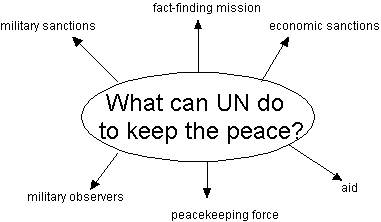
13. What can UN do to keep the peace?
Home 1 2 3
1 2 3 4