


|



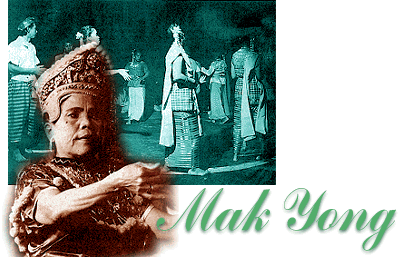
Until the beginning
of the present century a Mak Yong group only performed in the center
of the audienece hall of a Sultan or a royal family, never in public. The
sultan, his guests and family sat round three sides, leaning against the
walls. There were no scenery, wings or front curtain, nevertheless, royal
patrons provided costumes which were elaborate and often costly. The costumes
of the Hero (Pak Yong Muda) and the Raja (Pak Yong) were similar. Each wore
a stiff head-dress covered with velvet, rising to a peak above the center
of the forehead. It was held in position by two short projections which
jutted down in front of the ears. The velvet was usually liberally studded
with small jewels and had a gilded over the left ear. It was sewn on the
edge of the head dress just before the begining of the nights performance.
The head dress of the Raja was usually less elaborate. It was known in both
cases as mahkota (crown).
The music of the Mak Yong consists mainly of solo singing, always accompanied by the rebab. Before a performance begins the orchestra often plays an overture which may continue for half an hour, and only ends when the actresses have made their way to the stage. If it is the first night of a new play the leading actress then sings Mengadap Rebab, a opening song with short choral passages from the other actresses. Some of the other tunes are Pandan Wangi, Timang-Timang, Buloh Seruas, Cagak Manis, Lagu Mengulit (lullaby) and Lagu Mengambur, a song of grief. The stories which were recorded were: Dewa Muda, Anak Raja Gondang, Bongsu Sakti, Raja Tangkai Hati, Indera Dewa-Dewa Indera, Puteri Timun Muda, traja Muda laleng, Raja Muda Lembik, Gading Bertimang, and Raja Dua Serupa. Anak Raja Gondang is the most popular story of the Mak Yong genre. The story revolves around a young queen, the daughter of the Sea Dragon King but married to a Malay ruler, bears as her first born, atriton shell and is driven out of palace in disgrace. some days later, while the queen is out cultivating some vegetables, on the edge of the forest, atiny boy emerges from the triton shell and quickly grow to the size of a boy of sixteen. He goes to play with children from the court, on a grassy plain, and is taken to the Raja, who does not know who is he. The boy is given a room in a palace and a delicious meal, but he rejects both and sends an insulting message to the Raja. The Raja orders the boy to be executed by firing him from a cannon into the sea. There he is rescued by his maternal grandfather, the Sea Dragon King, taken to dry land and left in the care of an ogre. Fearing that the ogre may eat him, the boy takes an apeskin which enables the wearer to fly, and magic wand, from the ogres cave and flies to another kingdom. He meets and falls in love with the youngest of the seven daughters of the Raja, but because he continues to wear the apeskin, the Raja refuses to agree to the marriage. Later the Raja changes his mind, under pressure from his favourite daughter, but he tries to find an excuse to kill his apelike son-in-law. The Shell Princeounters all plots to kill him using the magic which he obtained from the ogre, and finally removes the apeskin and is installed with the youngest princess, as the Rulers heir. He then goes to find his mother, and with the help of his magic wand and the animals of the forest, he persuades his father to remarry his mother and receive her back to the palace. This is one of the longest of the Mak Yong plays and continues to play for an average five nights. Mak Yong performance nowadays is shown for the public particularly during cultural festival. Itصs certainly part of the priceless heritage of Kelantan people. Mak Yong is a traditional Malay dance drama which until the beginning of the 20th century, was performed only for Sultans and aristocrats. It was the favourite entertainment of the palace courtyard of Kelantan and Patani for more than three hundred years. It is a unique form of dramatic entertainment which combines acting, singing, dancing, drama, romance and broad comedy in a single nights performance. Its stories, music, dances and the costumes are recognizably different from those to be seen and heard in Indonesia, Thailand and old Cambodia. Mak Yong, in its original form probably existed long before the coming of Islam to this country, and a performance may have been offered to some spirits whose help or goodwill was needed. Nevertheless, with the strong of presence of Islamic values preserved in the community, the offerings nowadays are done just for the sake of cultural performance rather than a ritual rites. Mak Yong stories, music and songs have been handed down for centuries by word of mouth. They have never been written down and a few people except Mak Yong actresses , musicians and comedians knew them from the beegiining to end. There were 12 principal stories in which the young hero, Pak Yong Mud, his father, Pak Yong, his mother, Mak Yong and the heroine, Puteri Mak Yong; were constant. The characters were given different names in different plays, but they always wore the particular costume which accompanied that role. A Mak Yong group usuallly consisted of four leading actresses - who played the parts of Raja, the Hero, the Queen and the Heroine. There were also younger women who took the part of their attendants (dayang), and five men - a Bomoh and four comedians. The Bomoh had nothing to do, once he had performed the opening ceremony, but was available in case of an emergency. Two of the other men were leading comedians, the others supported them. They act as the court jesters. The men also appeared as Genie, Ogres, Giants and as an occasional elephant. The quality of the buffoonery of the best comedians, who were known as Peran, was of a very high order. The men seldom sang or danced. but if they did, the actresses withdrew from the stage while they did so. There were four musicians. The leader played the rebab, two other men played gendang and another man played tetawak, which were hung facing each other. 

|