Sinter Klaas Comes to New York
How Santa Claus Came to Be

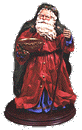 A long time ago, a
bishop named Nicholas lived in what is now the country of Turkey. No one
knows much about him. But there are stories that he often helped children
who were in need.
A long time ago, a
bishop named Nicholas lived in what is now the country of Turkey. No one
knows much about him. But there are stories that he often helped children
who were in need.
Many years after his death, Nicholas was made a Saint. In time, he became
the patron saint of children. Today, the date of his death, December 6, is
an important date in some countries in Europe.
On the night before, children put out their shoes and hang up their stockings. Early next morning, they rush to see what gifts Saint Nicholas left them.
Saint Nicholas visits towns and
cities, leads parades, talks to children, and often hands out small gifts.
He is dressed as a bishop, of course, wearing a red or white robe and a
tall, pointed hat.
 St. Nicholas's
scary helper
St. Nicholas's
scary helper
Saint Nicholas always has a helper. In the Netherlands, this helper is
called Black Peter. In Germany,
he's Knecht Ruprecht. In parts of France,
he's Pere Fouettard. And in Luxenbourg, he's known as Hoesecker.
Of course, all the
children love Saint Nicholas. But they're quite afraid of his helper. For it
is the helper who keeps track of who was good and who was naughty. Naughty
children may get only switches, with which their parents can spank them!
They may even be carried away in the helper's bag until they learn to be
good!
helper. For it
is the helper who keeps track of who was good and who was naughty. Naughty
children may get only switches, with which their parents can spank them!
They may even be carried away in the helper's bag until they learn to be
good!
Dutch settlers in America
continued to celebrate this feast day. Their name for Saint Nicholas was
Sinterklaas. And in English, this became Santa Claus.
 As Christmas evolved in the United States,
new customs were adopted and many old ones were reworked. The legend of
Santa Claus, for example, had origins in Europe and was brought by Dutch
settlers to New York
in the early 18th century. Traditionally, Santa Claus�from the Dutch
Sinter Klaas�was depicted as a tall, dignified, religious figure riding
a white horse through the air. Known as Saint Nicholas in Germany, he was
usually accompanied by Black Peter, an elf who punished disobedient
children. In North America he eventually developed into a fat, jolly old
gentleman who had neither the religious attributes of Saint Nicholas nor the
strict disciplinarian character of Black Peter.
As Christmas evolved in the United States,
new customs were adopted and many old ones were reworked. The legend of
Santa Claus, for example, had origins in Europe and was brought by Dutch
settlers to New York
in the early 18th century. Traditionally, Santa Claus�from the Dutch
Sinter Klaas�was depicted as a tall, dignified, religious figure riding
a white horse through the air. Known as Saint Nicholas in Germany, he was
usually accompanied by Black Peter, an elf who punished disobedient
children. In North America he eventually developed into a fat, jolly old
gentleman who had neither the religious attributes of Saint Nicholas nor the
strict disciplinarian character of Black Peter.
Santa�s transformation
began in 1823, when a New York
newspaper published the poem �A Visit from Saint Nicholas,� which Clement
Clark Moore had written to amuse his daughter. The poem introduced many
Americans to the story of a kindly saint who flew over housetops in a
reindeer�drawn sleigh. Portraits and drawings of Santa Claus by American
illustrator Thomas Nast further strengthened the legend during the second
half of the 19th century. Living at the North Pole and assisted by elves,
the modern Santa produced and delivered toys to all good children. By the
late 19th century he had become such a prominent figure of American folklore
that in 1897, when Virginia O�Hanlon wrote to the New York Sun
newspaper asking if Santa were real, she received a direct answer: �Yes,
Virginia, there is a Santa Claus.�
elves,
the modern Santa produced and delivered toys to all good children. By the
late 19th century he had become such a prominent figure of American folklore
that in 1897, when Virginia O�Hanlon wrote to the New York Sun
newspaper asking if Santa were real, she received a direct answer: �Yes,
Virginia, there is a Santa Claus.�