
While Santa Claus became increasingly familiar to Americans, the German
Christmas tree also acquired popularity in North America. As early as the
17th century, Germans had transformed this pagan symbol of fertility into a
Christian symbol of rebirth. According to legend, the Christmas tree
tradition began with the founder of German Protestantism, Martin Luther.
While walking through the forest on Christmas Eve, Luther was so moved by
the beauty of the starlit fir trees that he brought one indoors and
decorated it with candles to remind his children of God�s creation. In 1841
Prince Albert of Germany gave his wife, Queen Victoria of England, a gift of
a Christmas tree. This was reputedly the first Christmas tree in England,
but the custom spread quickly. German immigrants took the Christmas tree to
other parts of Europe and to the United States and Canada, where it soon
became a popular traditio n.
Blown-glass ornaments, tin angels, paper chains, candles, cornucopias filled
with sugarplums, and other decorations made the simple evergreen tree into a
beautiful parlor centerpiece at Christmastime.
n.
Blown-glass ornaments, tin angels, paper chains, candles, cornucopias filled
with sugarplums, and other decorations made the simple evergreen tree into a
beautiful parlor centerpiece at Christmastime.
The Christmas Tree probably developed in part from the ``Paradise Tree." This tree was an evergreen decorated with apples used in a popular play about Adam and Eve held on December 24 in medieval Germany. By 1605, some Germans decorated their homes with evergreens for Christmas. They trimmed the trees with fruits, nuts, lighted candles, and paper roses. Later decorations included painted eggshells, cookies, and candies.
The first Christmas trees in the United States were used in the early 1800's by German settlers in Pennsylvania. During the mid-1800's, the custom of trimming Christmas trees spread rapidly throughout the world. Today, some form of Christmas tree is part of every Christmas celebration. Decorations include tinsel, bright ornaments, and candy canes. A star is mounted on top of many Christmas trees and other Christmas displays. It represents the star that led the wise men to the stable in Bethlehem where Jesus was born.
The practice of exchanging Christmas cards also became a widespread custom
in the 19th century. Europeans had distributed wood prints
 of
religious themes for Christmas during the Middle Ages (5th century to 15th
century). In
1843 English illustrator John Callcott Horsley created the first modern
Christmas card. The card depicted a family celebration and its caption read,
�A Merry Christmas and a Happy New Year to You.� In the
United States,
German-born printer Louis Prang made advances in color lithography that
enabled him to mass-produce a colorful Christmas card in 1875. The card sold
extremely well, and soon the custom of exchanging Christmas cards spread
throughout the country.
of
religious themes for Christmas during the Middle Ages (5th century to 15th
century). In
1843 English illustrator John Callcott Horsley created the first modern
Christmas card. The card depicted a family celebration and its caption read,
�A Merry Christmas and a Happy New Year to You.� In the
United States,
German-born printer Louis Prang made advances in color lithography that
enabled him to mass-produce a colorful Christmas card in 1875. The card sold
extremely well, and soon the custom of exchanging Christmas cards spread
throughout the country.
Th e
traditional colors of Christmas are green and red. Green represents the
continuance of life through the winter and the Christian belief in eternal
life through Christ. Red symbolizes the
blood that Jesus shed
at His Crucifixion. Christmas decorations that feature these colors include
the Christmas tree, the Christmas wreath, holly, and mistletoe.
e
traditional colors of Christmas are green and red. Green represents the
continuance of life through the winter and the Christian belief in eternal
life through Christ. Red symbolizes the
blood that Jesus shed
at His Crucifixion. Christmas decorations that feature these colors include
the Christmas tree, the Christmas wreath, holly, and mistletoe.
The Christmas wreath, like the evergreens used as Christmas trees, symbolizes the strength of life overcoming the forces of winter. In ancient Rome, people used decorative wreaths as a sign of victory and celebration. The custom of hanging a Christmas wreath on the front door of the home probably came from this practice.
Holly is an evergreen tree with sharply pointed, glossy leaves and red berries. It is used in making Christmas wreaths and other decorations. The needlelike points of the leaves were thought to resemble the crown of thorns that Jesus wore when He was crucified. The red berries symbolized the drops of blood He shed.
Mistletoe is an evergreen plant with dark leaves and shiny white berries. Ancient Celtic priests considered the plant sacred and gave people sprigs of it to use as charms. The custom of decorating homes with mistletoe probably came from its use as a ceremonial plant by early Europeans. In many countries, a person standing under a sprig of mistletoe may be kissed.
The word carol
came from a Greek dance called a choraulein, which
was
 accompanied
by flute music. The dance later spread throughout
Europe
and became especially
popular with the French, who replaced the flute music with singing. People
originally performed carols on several occasions during the year. By the 1600's,
car
accompanied
by flute music. The dance later spread throughout
Europe
and became especially
popular with the French, who replaced the flute music with singing. People
originally performed carols on several occasions during the year. By the 1600's,
car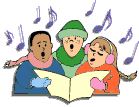 ols
involved
singing only,
and Christmas had become the main holiday for these songs.
ols
involved
singing only,
and Christmas had become the main holiday for these songs.
Most of the carols
sung today were originally composed in the 1700's and 1800's. They include
``O Little Town of Bethlehem" and ``Hark! The Herald Angels Sing." The words
of the famous carol ``Silent Night" were written on Christmas Eve in 1818 b
y Joseph Mohr, an Austrian priest. Franz Gruber, the organist of Mohr's
church, composed the music that same night, and the carol was sung at
midnight Mass. ``O
Holy Night" was introduced at
midnight
Mass in 1847. Adolphe Adam, a French composer, wrote the music. Popular
nonreligious carols include ``Jingle Bells" and ``White Christmas."
The
year-end festivities of ancient European peoples included huge feasts, many
of which lasted for several days. The preparation of special foods later
became an important part of the Christmas celebration throughout the world.
 At the first Christmas feasts, people roasted boars, pigs, and peacocks over
large open fires. Today, roast turkey is the most popular main course in the
United States, Canada, Australia,
and New Zealand. In the British Isles, people serve roast goose. Fish is the
feature of Christmas Eve dinner in a number of countries. For example,
Austrians eat baked carp and Norwegians dine on lutefisk (dried cod).
Vegetables, relishes, hot breads, and a variety of other dishes accompany
the main course of the Christmas feast everywhere.
At the first Christmas feasts, people roasted boars, pigs, and peacocks over
large open fires. Today, roast turkey is the most popular main course in the
United States, Canada, Australia,
and New Zealand. In the British Isles, people serve roast goose. Fish is the
feature of Christmas Eve dinner in a number of countries. For example,
Austrians eat baked carp and Norwegians dine on lutefisk (dried cod).
Vegetables, relishes, hot breads, and a variety of other dishes accompany
the main course of the Christmas feast everywhere.
Popular beverages served
especially at Christmastime include eggnog in the United States and hot,
spicy wassail in England. Many people in Sweden drink glogg, a hot punch
made with spices, liquors, raisins, and nuts.
Favorite Christmas desserts in
the United States include fruitcake, mince pie, and pumpkin pie. Plum
pudding is traditional in Canada and the British Isles. The French serve a
Christmas cake called buche de Noel, which looks like a miniature log.
Italians finish their meal with torrone, a candy made of egg whites, honey,
and nuts. Fruit-filled breads called stollen are favorites in Germany. In
Mexico and other Latin-American countries, thin, round pastries called
bunuelos are usually eaten with cinnamon and sugar.
In some countries, especially Britain, France, and the Scandinavian nations,
many families burned a Yule log at Christmastime. The log was a large piece
of a tree trunk, and people kept an unburned part of it to light the next
year's log. Early Europeans believed the unburned wood had magic powers. It
was thought that bad luck would follow if the Yule log fire went out. Today,
these fires are confined to large public fireplaces, such as those in ski
resorts.
thought that bad luck would follow if the Yule log fire went out. Today,
these fires are confined to large public fireplaces, such as those in ski
resorts.
Large numbers of people enjoy reading
Christmas stories and poems during the holiday season. For example, A
Christmas Carol (1843) by the English novelist Charles Dickens ranks as
one of the most famous tales ever written. The poem ``A Visit from St.
Nicholas" (1823), popularly known by its first line, ``'Twas the Night
Before Christmas," is read aloud in many homes on Christmas Eve. Clement
Moore, an American scholar, supposedly wrote this poem as a Christmas
present for his children. Several musical productions are also Christmas
traditions. They include The Nutcracker, a ballet by Peter Ilich
Tchaikovsky of Russia, and Amahl and the Night Visitors, an opera by
Gian Carlo Menotti of Italy.