Studying Abroad in Ireland
So you want to attend James Joyce's school?
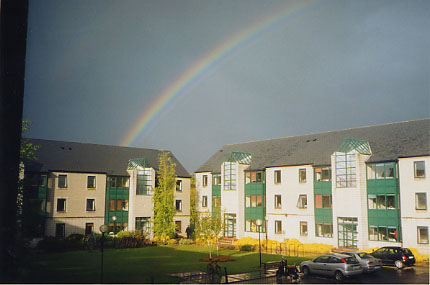 Ireland reveals its (double) rainbows
over Belgrove Student Village
Introduction & Disclaimer
I am an undergrad at Amherst College, located in the western portion of Massachusetts, and decided to take advantage of the opportunity to study abroad generously provided by my home school. I don't know the exact numbers, but I believe that upwards of one third of the Junior class of Amherst studies abroad each year. These kinds of numbers can't be wrong! Studying abroad is a wonderful experience and shouldn't be missed if you are interested in learning about other places and in new ways.
So why study in Ireland? Of course, for literary buffs, Ireland is a sacred place. For its size, Ireland has been the motherland of an overwhelming number of extremely talented writers, poets, and dramatists including W.B. Yeats, James Joyce, John Millington Synge, Oscar Wilde, and George Bernard Shaw. The opportunity to learn about the culture and places that inspired and shaped these linguistic masters is priceless; to learn about them from native professors is even better. The same goes for artists such as Paul Henry, Jack B. Yeats (brother to W.B.), and Mainie Jellett. This does not even include outstanding political and revolutionary leaders like James O'Connell, musicians, pundits, and the list continues. Additionally, there are many museums, monuments, and birthplaces devoted to and upkept for the purpose of dispersing knowledge on these late greats, as well as surviving talents. For more information on these sites, see the portion of my Dublin page on Literature and Artistic Exploits, Cultural Centres, and Historic Places.
Disclaimer! I don't profess to be an expert or to have all the answers, nor do I argue that studying abroad is for everyone. It's essential to be openminded and flexible, and above all, to want to explore, and to want to make the best of every situation that comes your way. Not everything goes as planned, and it can be quite daunting when you're thousands of miles away and things gang agley, as both mice and men well know! Things are different, and this is neither inherently good nor inherently bad: it's what you make of it. If you get freaked out when you don't get answers right away, or if "they do things differently here" and it pisses you off, you may need to reconsider your attitude towards studying abroad. This sounds like high-and-mighty nagging, but it's true! If you're not willing to consider alternatives and to make things happen, then you won't have as much fun or learn as many things as you'd like to, and then you're just gypping yourself.
Doing research before you go (nay, before you sign up, even!) is a good idea--nostalgic/romanticized visions aside, you need to be able to survive in this place. What is the educational system like? Will your credits transfer? Will you go with a program sponsored by your school, another school, or by yourself? Check your school's Study Abroad Office or see Amherst's for a more complete list of questions you should be addressing. For the purposes of this page, I intend to outline what it's like to study in Ireland, specifically at the National University Ireland, University College Dublin.
Scholastic Links
The School
The National University of Ireland is, obviously, the public college system of the Republic of Ireland. It has several branches, including ones in Cork, Galway, and of course, Dublin, as you can see in the links above. Each branch has its own unique flavor, as does the area in which it is situated. I'd recommend looking into the place's offerings before deciding which institution to attend. Also, keep in mind that "public college" for Ireland means that if you're an Irish citizen, you don't have to pay tuition, though there are fees. International students, however, do have to pay tuition and fees, though they are far less than most American institutions.
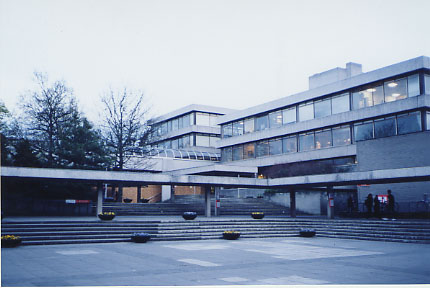 Arts Bloc: As far as Dublin is concerned, this lack of high tuition costs means that the school is simply huge. Portions of it exist off the main campus, little oases of Medicine, Architecture, etc. in the wild & wooly world of Dublin. The main campus is about 4 miles from the city center (let's call that O'Connell Bridge). The student population is approximately 17,000. This is a huge difference from my home institution's attendance of 1600, but for many of you reading this, this is nothing new. The main campus itself has a circumference of about 6 km, and you'll often see joggers trail by your first-floor windows on their daily route. This specific building is the Arts building, where I spent most of my scholastic time. It is home to what we in the States would call the "Liberal Arts". Also, in it is a little coffee shop, Finnegan's Break (witty), two computer labs, and a tunnel to the Library. Also, like other academic buildings, there are lots of places for students to hang out & sit--benches line many walls, and little alcoves are set off from the hall. Be aware that smoking is allowed in public buildings in Ireland, so you're sure to catch a whiff of cigarette smoke as you pass these student havens.
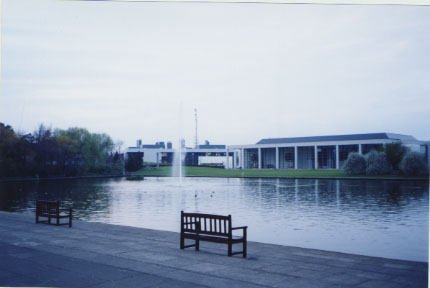 The Lake: The school is fairly modern, with a good deal of concrete, steel, and glass; though it's not as pretty as Queen's College in Belfast or Trinity College in Dublin, the architects made a conscious effort to make buildings both functional and aesthetically interesting. The grounds are extensive, with a manmade lake (complete with ducks and other waterfowl), plenty of landscaping, and covered walkways for those predictable rainy days.
Be aware that facilities are not generally open on Sundays, except certain ones for constricted hours, and that closing hours, even for computer/internet labs, are quite early.
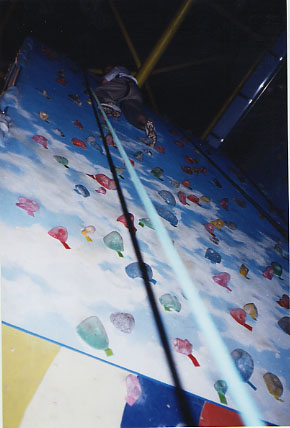
 Climbing Gym: also, because this is such a "modern" campus, there are many wonderful facilities, including the climbing wall in the gym. This is me, at the top of a 20' wall! The gym itself is owned and run by a private company, so you have to buy a membership to use the equipment, although the Climbing Club has free climbing nights.
Classes, Professors, and Exams
I must begin by saying that, unless otherwise stated, I cannot speak for any departments but English and Art. As compared to Amherst, UCDublin courses were much less rigorous. Part of this is the format of classes: most courses were held in a lecture format (around 100-200 students for English and about 50 for Art), with little professor-student interaction. Seminars (20 students or so), at least in the English department, were far more demanding in this regard, on a level with Amherst's. To compensate departments have instituted tutorials, which meet weekly for several weeks; unfortunately, because of their limited scope they cannot cover all questions, and as they are seldom in time with the course while still requiring their own out-of-class work, felt at times like more of a hindrance than a help.
It should be noted that the Irish school system will seem less organized, less informed as to procedure, and less quick to resolve issues. That doesn't mean that they don't do it--it just means that it'll take a bit more legwork on your part, and a bit more patience. The school runs, like the buses and shops, on "Irish time", even in as large a city as Dublin.
The professors of course varied in quality and availability. On average, they were somewhat slow in returning emails and phonecalls. The best thing to do is to find out their office hours and harass them then. They frequently have so many students in each lecture that unless you make yourself known you will not be noticed or helped. Another option is to try the tutorial instructor for that course. All professors seemed to welcome individual viewpoints and encouraged independent research.
The lecture courses were just that: the professor would read from a previously prepared paper or outline. Most would not entertain questions during their lecture. The "bad" ones would just read from a prepared paper without regard for the difficulty of taking notes or the cohesiveness and comprehensiveness of their argument. Some, however, encouraged in-class participation and included film clips, readings, and notes on the overhead projector. The constant is that you have to take lecture courses.
The seminar course I had (on a novel) was engaging and more interactive with regular discussions and outside sources and information brought in. The professor was extremely knowledgeable, open to opinions, and available for outside discussion.
No foreign languages are necessary; everything is in both English and Irish. An Amherst education, or a comparable one in any respectable American institution, is more than adequate; just be prepared to view things from alternative perspectives. Third year courses are more difficult than second year, but not excessively so for a Junior.
There is little to no continual assessment. Essays or exams were required by some professors for the tutorials, and for all courses (two for each of my art courses and one for each of my English). The length of essays depended on the year/level (first, second, or third) of the course; average was 1500 words. Papers in Ireland are graded according to the theory of human
fallibility; UCD begins at 40 (the equivalent of a C) and adds on when you
don't suck. 70% is a "First", meaning you can't really do much better than
that, and is the equivalent of an A. Some professors took and counted attendance towards the final grade. All classwork and attendance only counted minimally, however; the majority of the grade was based on a final exam. This is why the library is impossibly full both in the month preceding and during the month of exams!
Exams were an average of two hours and were essays; they stretched out for a month, but even then there were occasional scheduling clashes (which required a lot of footwork and phonework by both the student and the professors in question to fix with the Exam Office). Professors do not write OR grade exams, and thus cannot tell you exactly what you should be studying (provided you wish to focus on several topics, which is a preferred method), though they can give some indication. Overall the examiners are somewhat "lenient", though they do expect a good amount of detail and outside research and personal opinions/conclusions. In this way, the classes become challenging: you do as well as you prepare yourself for--the amount of external work (reading criticism on a novel for English, visiting the art museum for a firsthand look at a painting for an essay...) and the direction it takes is up to you.
The Student Body and Enrollment
There were Irish, American, and International students in all of my courses, with a majority of Irish. Some courses, those that covered a broad local subject, such as Irish Artists, for instance, had a slightly larger number of International students. This is not because there were fewer Irish interested in this course, as the system only allows a few options per year and the number of Irish students seldom varied, but because a greater number of International students took the course. The number of Americans versus European Union students also varied; in courses such as American Literature there was (predictably) a larger number of EU students than Americans. Smaller seminar courses only reserved a seat or two for international students. Have choices lined up beforehand or make your decision quickly because most enrollment operates on a department-by-department, first-come-first-served basis. That is, you register with the school, and then you enroll for courses with the department.
Clubs were everywhere and many were very active on campus. I met some very nice people in the Sci-Fi/Fantasy Club with similar interests and Buffy fixations. Even though I was only there for a semester, I signed up for several clubs and participated in various events. It's a great way to meet the aforementioned student body, and is great craic to boot. (Irishism: "craic" means "fun" in Irish.)
Also, many events and lectures were held throughout the semester on varying topics. I went to a lecture entitled "The Opening of the Sixth Seal: Medieval
Apocalypticism in Modern Fantasy Fiction". It was quite interesting,
though the author that the lecturer was focussing on, Robert
Jordan, is not one I've read (his increasingly ill-named trilogy is now up
to 10 volumes, each quite extensively long; you know how hard it is to read
fun stuff when at school). The lecturer interwove elements of popular
culture, "pulp" fiction (no, not Pulp Fiction), literary
criticism (including critical snobbery in snubbing such works of fiction),
medieval studies, and historical theory in an overwhelmingly
interdisciplinary seminar. Somewhat limited appeal for myself, in the end,
because a good deal pre-required some knowledge of Jordan, but the general
information was more widely applicable, and she even went on to interrelate
Jordan with Tolkien and his legacy. I particularly liked her
treatment of the role of the author who takes pains to research for
accuracy's sake, and that of the reader who alters what s/he has read by
his/her previous reading. And, in the great Amherst tradition, it was
indirectly related to what my Anglo-Irish literature class had highlighted
in our last lecture: precisely, the flow of history, its blanks, and the
impossibility of a "objective" perspective. Everything's connected, man!
On-Campus Housing and Cost of Living
Just so's you're aware, postal codes in Dublin are organized according to their relation to the River Liffey, even numbers reside on the northern, and odds on the southern. I lived in Dublin 4.
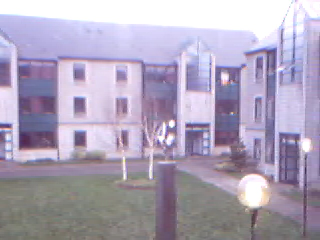
Spacechicken: outside the dorms. Here you can see images of the suites of Belgrove Student Residences. Arcadia CEA made all living arrangements, and attempts to place you with people with similar living habits. They had an agreement with UCDublin for a certain number of spaces on campus. Some students in the program lived in the Village, either with all Americans or with a mixture of Americans and Irish students. You can see that the housing, too, is very modern-looking. Each of these buildings have two suites per floor, and three floors. Each grouping within the village had its own parking, green, and trees. Kids often went outside to do homework, play frisbee, or chat. The "space chicken" is one of many public sculptures erected in the student housing; I don't know what its name or artist really is, but it reminded me of a sculpture in the Sims called Space Chicken. Perhaps this sculpture is why we had two ducks that habitually chilled out in our quad: fellow fowl, and all that. ;)
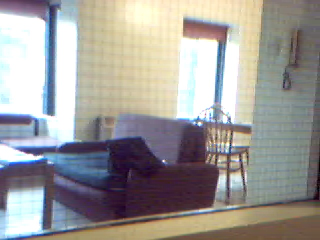
Kitchen/livingroom from the hallway. Each coed suite consisted of 3 small (big enough for a bed, shelves, and desk, and not much else) singles, a kitchen/livingroom, a bathroom, and a shower room. The housing was fairly clean, quiet, and well-kept, albeit plain, though loud music and people outside were definately audible. Laundry machines are located within the Village. I enjoyed living on campus; you didn't have to pay for the bus to get to & from the school, it took only 10 minutes to walk to class, and you were surrounded by other students. We also had a lot of fun personalizing both our private and public spaces.
My roommates were cool, and we all did a healthy mix of "our own
things" as well as quality roommate group time. One of them (Jess) met a guy in a bar and was telling me all about how wonderful he was...very humerous, she's
so sweet and a little quirky. The other (Corinne) won 10th place out of 32
in a national (Ireland) climbing competition in Galway this past weekend. I
guess that I use a lot of big words in normal conversation, because Jess
says that I'm a walking SAT vocab prep book. I assume this is a good thing.
It's refreshing to be with such different people (not that I didn't miss my Amherst and home friends all terribly, such that it gives me physical pain and keeping me lying awake at night)--they don't like all the stuff I like, they don't know all my lame stories, so it's like being a *gasp* freshman again. And they're very accepting of my various states of random weirdness. We went and got posters to decorate, because we were all getting suicidal looking at plain creme walls all day. So, we got the black & white photo of those construction guys sitting on the beam (Corinne's contribution), a poster of different kinds of vodka (Jess's doing), and a large art print of a Klimt, "The Kiss" (my
presentation). I also got a Monty Python poster, and a Red Dwarf poster for my room. Cool!
The rest of the program shared coed furnished garden apartments halfway into town with other CEA students, and each apartment has a combo washer-dryer. They were medium-sized apartments, cozy, and homey. I'd imagine that they are a good halfway point between living with a family and living on campus.
There is no meal plan at UCD. A decently priced restaurant/cafeteria, several sandwich and coffee shops, and a student union shop are on campus (where you can buy office supplies, newspapers, school memorabilia, and sandwiches and snacks), and open to varying hours, though none are open past 9-ish. Grocery stores are situated fairly nearby both the campus and the Leeson Street apartments--accessible by either bus or walking--and a small catch-all shop is in the Village. Tesco has the best prices. You will also be responsible for buying paper, dishwashing, cleaning, and bathroom products.
Things are slightly more expensive than in the States due to the "recent" conversion from Irish pounds to euro, and due to the fluctuating exchange rates. If you cook for yourself, the average weekly food budget is Euro 30, less if you share groceries with others, about Euro 20-25. Laundry is about Eu 3-4 per load. Paper and bathroom products roughly Eu 5 every other week. Sheets and towels are fairly expensive at Eu 30 and up for sheets and blankets, and Eu 15 up for towels. Haircuts for women run around Eu 25-30, and for men, Eu 10-15. Books are very expensive; most Irish students don't buy books, although the library is unreliable. Sharing books may be the best bet. As for entertainment, movies are an average of Eu 8, while a pint of beer will run you Eu 3-5. For more exact numbers, see the UCDublin webpage.
The benefits of studying with a program should be obvious by what I've said. In addition to organizing housing, Arcadia CEA arranged an orientation (several days, including housing, food, information sessions...see Culture Shock for more info about traveling with a program), a homestay with a family for a weekend, several dinners, and several group trips (some of which required a minimal fee). The orientation was pretty helpful, and provided an opportunity to ask last-minute questions. I am not sure whether official counseling was available, but the staff were very approachable. It was very reassuring to have liasons helping to orchestrate home school-abroad school interactions. Additionally, the Americans employed by Arcadia have spent considerable time in Ireland, and they also employ Irish citizens, so these people know what they're talking about. If they did not know something, they would find out for you.
Return Home