Dubliners: Touring and Culture
Dublin, the hub of the green isle
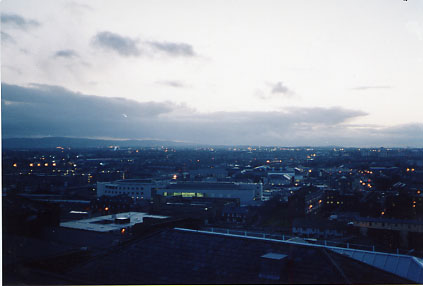 Evening falls on Dublin: View of Dublin from the Gravity Bar, Guinness Brewery. More often than not, the weather in Dublin was fabulous, sunny and for the most part temperate. In fact, it was unseasonably nice here until the beginning of May�the Irish students I talked with say that it had been the mildest, driest spring they could remember. Usually, and I�m sure your impressions corroborate this, Ireland has a tendency of being somewhat damp and chilly. They wear a lot of wool for a reason. And everyone wears a scarf until mid-April at the least. (To be cool, get a striped or brightly-colored scarf, fold it in half, wrap the doubled scarf around your neck, and pull the ends through the loop formed by the fold and down toward your chest, not behind you.) And I must admit that the winter was around a solid 3-10 degrees Celsius, but that�s better than 0, right? And there were hardy flowers blooming on campus since mid-February. All in all, perfect weather for adventures, no? :) Being located in such a large city has its advantages; being in the largest city in a country focused on tourism and becoming a strong member of the European Union is a godsend. The favorable weather, coupled with a plethora of places and activities of interest, allowed me to see and do a great deal, which I�ll relate here.
Some of these activities are best appreciated alone, while others are more fun with friends. Unlike my Belfast trip page, I am able to organize this according to subheadings of Dublin joy:
Places to Eat
Leo Burdock�s Fish & Chips: we got the fish & chips take away (take out) and headed over to enjoy the food and scenery at St. Stephen�s Green. It was starting to get gray but the weather held out, the flowers were in full bloom, and the pigeons were voracious (as were we--and luckily the portions were Hungry Man-sized). The special of the day was hake, an ugly-looking but quite delicious fish. I got take-away here twice, and both times it was well worth the wait.
If you like chocolate, check out Butler's Chocolates on Grafton. They sell quality (read: expensive but yummy) chocolates, coffee, and hot cocoa, as well as gift packages of the lovely stuff.
Kitty's Kaboodle: good food, decent prices, and paper and crayons to draw with! Very unusual, and not a children's/family restaurant per se. It has pics up all over the walls drawn by patrons from all over the world. Very neat.
Saffron: possibly the best Indian food I've ever had. A nice little establishment with polite waiters and a slightly "mood lit" ambience.
Haagen-Dazs: yum, quality ice cream in a sit-down establishment.
Artistic Exploits
 Stone faces: located on the side of a building in downtown Dublin, these stone faces are influenced by similar ones used to decorate bridges at the turn of the century. This sense of art in everyday life completely pervades Ireland, even in a city as bustling and modern as Dublin. In fact, one of the last things I saw while riding the bus downtown was the plaque on the facade of yet another Dublin brick house, identifying it as Mainie Jellett's residence (some of her work is shown in the NGI).
 Powerscourt Townhouse Shopping Center: converted into a high-end shopping center, this is one of the younger townhouses in the Georgian style; the interior is decorated in both Rococo and Neo-classical stuccowork. If you sit on the staircase (careful, the security guard will yell at you for this) and look up, the view of delicately tinctured stucco is breathtaking. Oh, and the expensive jewelry, bridal, bansai tree and other shops and food kiosks are neat too. ;)
 Parliament House: now the Bank of Ireland, houses the former House of Lords, the fa�ade is in an imposing Classical style (not Neo-classical, that came about a century later in Ireland) with an interior of elaborate diaperwork plaster and richly stained wood-panelled walls.
National Concert Hall: one day I would like to actually attend a concert here...and maybe go inside.... But the outside fits with the rest of downtown Dublin, in a curving Classical format.
Millennium Child Statue: a cute little chunky geometric bronze statue of kids cavorting and holding hands, next to one of those secret grottoes you can find so many of. As this is a big city, however, do be on the lookout for the homeless and pickpockets.
Chester Beatty Library: near St. Patrick�s Cathedral, the library is hidden away from the public eye but is quite famous for its extensive and rare collections of Asian artifacts. Their displays of bookmaking and calligraphy, and their collection of the Koran, are particularly amazing and well-presented.
 National Gallery of Ireland: I've been several times, and it just keeps getting better & better. It's difficult to see all of the art in one sitting, and they have regularly-changing special exhibits. A particularly interesting one was on Paul Henry, whose images of western Ireland were used on tourism posters during the past century. A lot of people have called his work "chocolate box" art because so much of it is seemingly similar, but in the exhibit there was a
definate sense of growth and range. Also, some of the works were just
downright crap. But some of them were almost transcendentally beautiful!
Goes to show that not even the best artists have good days every day. The gift shop has the requisite art books and postcards for sale, and the cafe, though charming, is overpriced. Like most art museums, they don't allow photography (camera flashes damage paintings, plus there's a question of copyright), but I took one anyways. Hehe. This depicts the receding doorways of the Irish wing, with Grotesque-modelled wooden doorframes and flanking Irish portraits of some old dead guys by some old dead guys. You'd think, for someone who studied Irish art, I could be more descriptive, but there you go.
National Gallery of Ireland: I've been several times, and it just keeps getting better & better. It's difficult to see all of the art in one sitting, and they have regularly-changing special exhibits. A particularly interesting one was on Paul Henry, whose images of western Ireland were used on tourism posters during the past century. A lot of people have called his work "chocolate box" art because so much of it is seemingly similar, but in the exhibit there was a
definate sense of growth and range. Also, some of the works were just
downright crap. But some of them were almost transcendentally beautiful!
Goes to show that not even the best artists have good days every day. The gift shop has the requisite art books and postcards for sale, and the cafe, though charming, is overpriced. Like most art museums, they don't allow photography (camera flashes damage paintings, plus there's a question of copyright), but I took one anyways. Hehe. This depicts the receding doorways of the Irish wing, with Grotesque-modelled wooden doorframes and flanking Irish portraits of some old dead guys by some old dead guys. You'd think, for someone who studied Irish art, I could be more descriptive, but there you go.
Belvedere College: tour of more Dublin stuccowork with my Grammar of Ornament class; you need an appointment. The stucco was done in the Neo-classical style by native craftsmen using molds and based on the etchings of various Continental artists and especially those of the British Adams brothers. Dublin Neo-classical stucco is unique in the world in that it stubbornly maintains acanthus leafwork throughout the Classical, Baroque, Rococo, and Neo-classical styles, a fact that I�m certain all of you feel better for knowing.... ;)

 Newman House: The first of these images is of Apollo himself, modelled after the Apollo Belvedere (see my Cork page, or Apollo himself), surrounded by a shell frame and with flanking Grotesque acanthus fronds and swags of flora. The rest of the room contains the Muses, elegantly done. The second is of a stuccoed coved ceiling in the upstairs parlour, depicting different mythical couples in losenges with playful putti. Both of these rooms and several in the rest of the house are sculpted by the amazingly talented Lafranchini brothers, who were enticed to Ireland from the European continent by Irish patrons well versed in European taste and style.


 Royal Hospital Kilmainham: a lying-in hospital
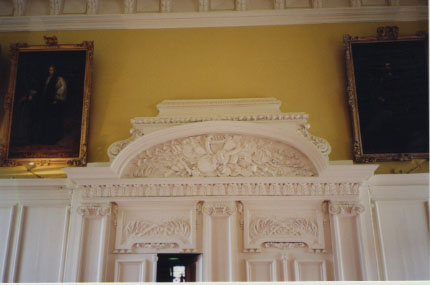
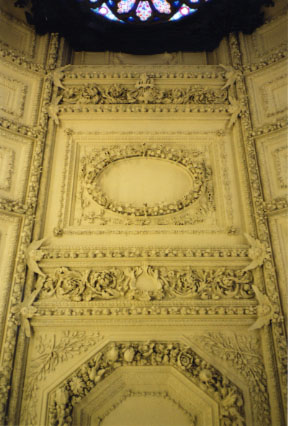
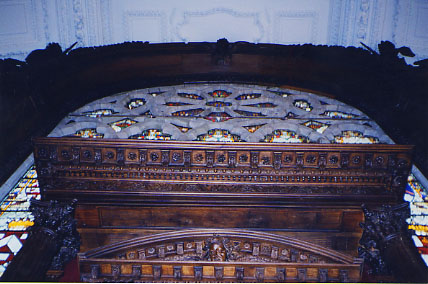
for retired soldiers, built as a square with inner courtyard and palisades on the Italian model. It has been since renovated to be the Irish Museum of Modern Art (one of several in the city, might I add). The building itself was not so cool. The crowning glory of the building, for me, was the Chapel. It is decorated with the only example of Baroque interior in all of Ireland, if not all of the British Isles. The odd part is that the stuccowork is of English influence and the woodcarvings of French origin. The first image shows the stuccoworked overdoor at the entrance to the Chapel, with musical instruments and two flanking portraits. The second shows the stuccoed ceiling, designed in the Baroque style of extreme decorative detail and overwhelming magnificence. Flowers, fruit, garlands, and winged angels stand out in great relief. The third image depicts the altar, carved out of wood to match the stuccoed ceiling and without question a piece of art in its own right. Also, behind it is the mullioned stained-glass rose window, which bathes the interior in dazzling colorful light. They don't normally let people in to see the chapel, as it is used as a banquet/business hall and the doors are unlocked for people interested in renting it; however, if you ask nicely, and show some knowledge of the stucco interior, the receptionist might pull a few strings and get the guards to let you in. Call ahead.
Royal Hospital Kilmainham: a lying-in hospital
for retired soldiers, built as a square with inner courtyard and palisades on the Italian model. It has been since renovated to be the Irish Museum of Modern Art (one of several in the city, might I add). The building itself was not so cool. The crowning glory of the building, for me, was the Chapel. It is decorated with the only example of Baroque interior in all of Ireland, if not all of the British Isles. The odd part is that the stuccowork is of English influence and the woodcarvings of French origin. The first image shows the stuccoworked overdoor at the entrance to the Chapel, with musical instruments and two flanking portraits. The second shows the stuccoed ceiling, designed in the Baroque style of extreme decorative detail and overwhelming magnificence. Flowers, fruit, garlands, and winged angels stand out in great relief. The third image depicts the altar, carved out of wood to match the stuccoed ceiling and without question a piece of art in its own right. Also, behind it is the mullioned stained-glass rose window, which bathes the interior in dazzling colorful light. They don't normally let people in to see the chapel, as it is used as a banquet/business hall and the doors are unlocked for people interested in renting it; however, if you ask nicely, and show some knowledge of the stucco interior, the receptionist might pull a few strings and get the guards to let you in. Call ahead.

 Rotunda Hospital Chapel: the first image shows the character Justice with her scales and blindfold, sculptured by Bartholomew Cramillion fully in the round and independent of the wall; around her are attenuated angel terms with garlands and banners and putti angel faces. Also, significantly, you can see the rocaille work that indicates this as of the Rococo period and style. The second photo is of the Altar, also modelled by Cramillion, with the Lamb of God and adoring angels, with the character of Charity above it. Unlike most stucco, these sculptures were meant to be (and obviously continue to be) brightly polychromed. Standing inside and looking up, one cannot help but be entranced by the multitude of figures, some of which stare uncannily back.
National Museum of Decorative Arts and History: located in a former barracks a ways west on the quays. I got through like one quarter of it in 2 hours, before they closed. :( But that means there's more to see! I
saw Dublin costume/dress tradition for the last 200 years, as well as
several eclectic collections of "old stuff". Very nice, but not a place for little children.
Follow the Footsteps of a Writer
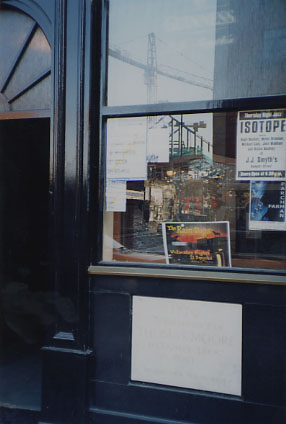
 Thomas Moore�s birthplace: Thomas Moore (1746-1820) was a poet and composer. His birthplace was converted into a pub in good ol' Irish fashion. ;)
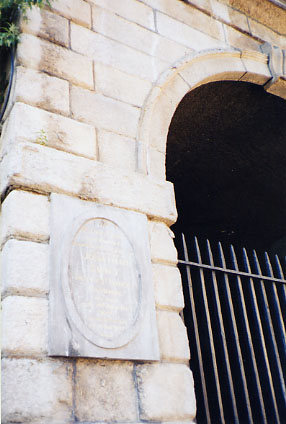
 Jonathan Swift�s birthplace: you should know who Jonathan Swift is. ; p Remember the guy who wrote that the best way to deal with the Irish famine "situation" was to have the Irish eat their children? Yeah, that's him, the master of satire. What you may not know is that he was the president of Trinity for a time, and that his death mask is on display in St. Patrick�s Cathedral.
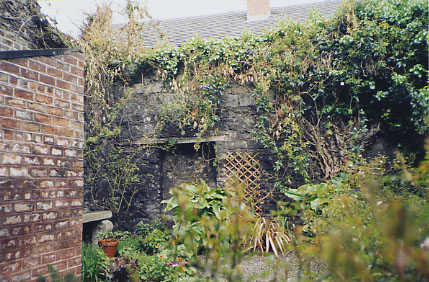
 George Bernhard Shaw Birthplace: This is an image of the garden in back of Shaw's childhood home. Not a very cheery place, with its high stone walls.
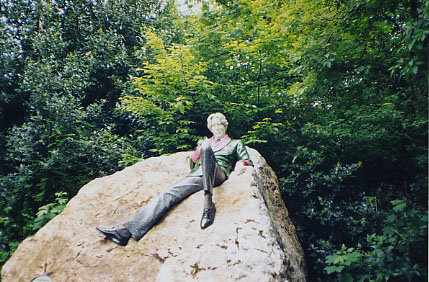
 Oscar Wilde Memorial, Merrion Square: made of polychrome stone, this piece captures both the writer's self-amused smirk and his extravagant public facade. You can also see more private parts of his life by visiting the Oscar Wilde Birthplace and Oscar Wilde Residence, though they are more difficult to find.
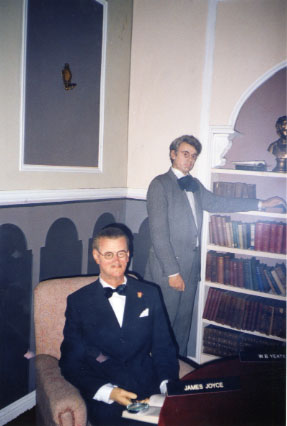
 James Joyce and W.B. Yeats, Dublin Wax Museum: this is about as close as you're going to get to the (formerly) living, breathing writers. The display isn't grand, but the men look nearly alive. They even went to the trouble of including Joyce's coke-bottle glasses. It would have been nice if the two figures were interacting, although based on their historical opinions of each other, I doubt that the conversation would have been altogether friendly. They shared very different views of what Ireland should be like, and how their writing would go about achieving that end.
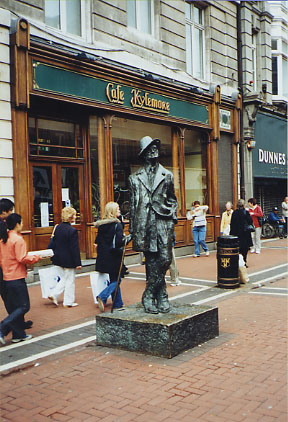
 James Joyce Statue: a.k.a. �The Prick with the Stick�, Joyce is modeled in rough bronze, holding a cane and wearing his telltale round glasses, hat, and mustache. The thing is always covered with tourists (no, not surrounded by, covered by--they hang all over it to get photos).


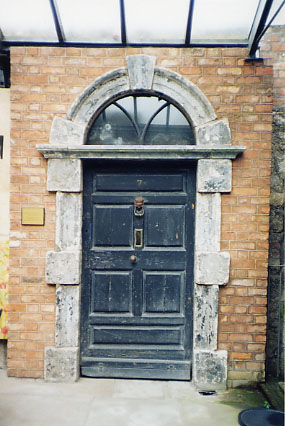
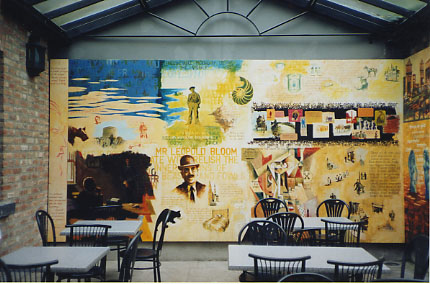
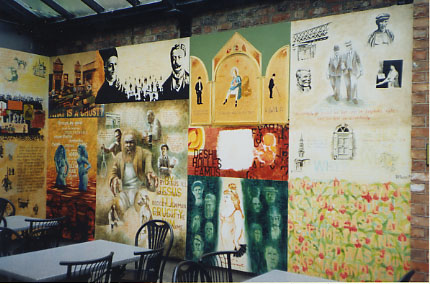
 James Joyce Center: located off Parnell, if I remember correctly, the JJC had quite a bit of memorabilia of Joyce's private writings and life, as well as things from his public writing and art inspired by it. Shown first is the door to No. 7 Eccles street, the home of the fictional character Leopold Bloom from Ulysses. The next two images are of murals done by an artist for each chapter of Ulysses. They also offer guided tours of "Joycean Dublin" for a moderate fee, and bring you to some of the places mentioned in his books and where he visited or lived. You can try to duplicate a similar walk on your own (any tourist shop worth its salt will be selling maps), reproducing Bloom and Dedalus' tour of the city on that day in 1904.

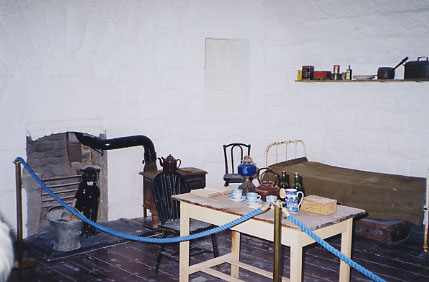
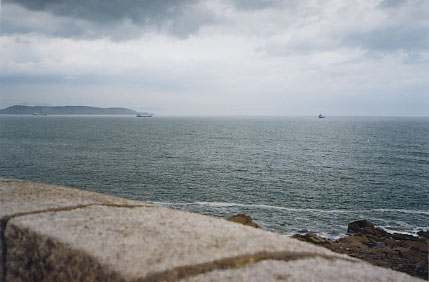
 James Joyce Tower, Sandycove: the James Joyce tower is located in Sandycove, a charming little suburb of Dublin about 20 minutes south of town center via the Dart. It is one of several towers dotting the coastline, built against an invasion by Napoleon that never came--so make certain you are visiting the right one! You have to pay a fee to enter, though you can get a combo ticket at either the tower, the James Joyce Center, or the Writer's Museum for two or three of these sites, which will definately save money in the long run if you intend to fully explore the literary history of Dublin. The tower itself is three storeys, with displays of memorabilia and writing on the first floor (with a small gift shop). On the second floor, after ascending a narrow winding staircase (be aware, it's very steep), is a reproduction of the situation of the room that Joyce lived in briefly with several friends, and which was the site of the opening chapter of Ulysses. They even have a panther! (first photo) On the third floor (achieved by rounding another set of narrow twisting wet stairs) the tower opens up, so that you can see both the gun turret and a lovely view of the surrounding area, both land and sea. (second photo)
Churches, Museums, and Cultural Centers
Book of Kells: located in the old Trinity College Library, which is itself quite breathtaking (the Long Gallery was the inspiration behind a scene in Star Wars: Episode I. There is an entrance fee, moderate for students, and completely worth it. The exhibit includes a whole display about how the books were made, the history of the area (religious, social, and political), etc., all of it very involving, with lots of blown-up photos of illuminated pages. Very lovely. I actually got to see two of the four books (there are four, not one like most people think; lettered, painted, and bound in the 8th century, is a copy of the Gospel according to someone-or-other), one turned to a page of illuminated text (lovely calligraphy...so jealous!), and one turned to a portrait of St. John, I think...er...ok, so I wasn't paying attention to the religious stuff. The books were mostly just for show anyway, so said the display--there are a lot of errors, and a majority of the time, effort, and interest went into making them look good. Anyways, those dudes must have been using magnifying glasses to have done knotwork that small! The details
were hard to see with the naked eye, they were so delicate and minute. Breathtaking. The colors haven't faded much--still vibrant green, lapis
blue, lead white, orange, red, purple, yellow--a veritable rainbow of
colors, all bold and well-preserved, done without the aid of modern
tinctures. The Book of Kells was definately one of the most amazing human
creations I have ever seen. Ever. Couldn't take photos, but bought postcards
of the pages I saw. Cool!
National Museum of Archaeology and History: You've never been to a museum until you've seen a bog body, I tell you. I would highly recommend reading Seamus Heaney's North before looking for bog bodies of your own, though. The bog has a preservative power, and the Irish archaeologists (and some turf cutters in the right place at the right time) have found all sorts of things preserved in the bogs, from butter to hidden stashes of gold and Bronze Age weapons, to human bodies which they have decided are ritual sacrifices. This particular one was not very well-preserved, mostly like a mummy, and was found with a noose around his neck. A very creepy find for the poor turf cutter, I am certain. I know I'm not doing the discoveries or the victims justice. Just read Heaney. The rest of the museum is also well worth your time, with a large old boat the size of a room, a collection of Irish golden artifacts, and a section devoted to the history of religious texts in Ireland.

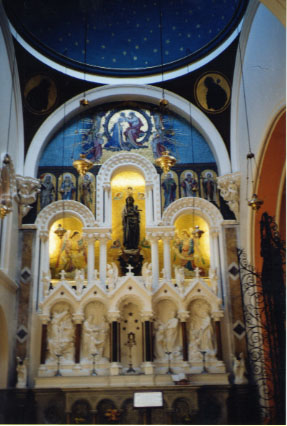
 Whitefriar Carmelite Church: a lovely little church still in use, I�ve been twice and it gets prettier every time. The carved bog oak Mary of Dublin is set off by colorful mosaics. This picture does not do justice to how breathtakingly beautiful (and ever so slightly garish) the interior of the church is, with many, many statues of saints and martyrs, and candles everywhere. There is even a statue of St. Pius X, the patron saint of the church across the street from my home in NH. Also housed in Whitefriar's is the relic of St. Valentine, which resides in a wooden chest behind glass.
St. Werburgh�s: the history of this church is largely unknown, but its fa�ade is as grand as any of the churches in Dublin.

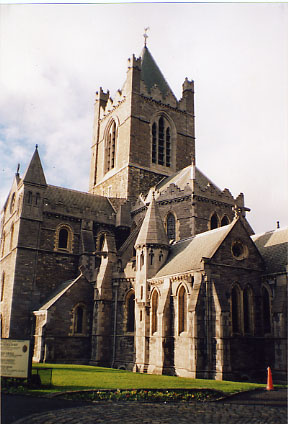
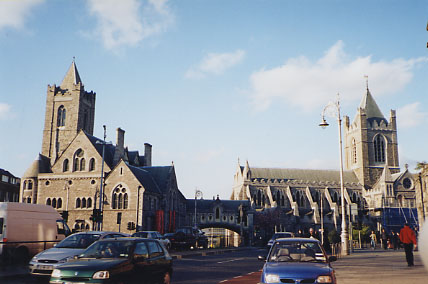
 Christ Church Cathedral is huge and beautiful. An annex of it is across the street, connected to the main portion by an elegantly arched footbridge. The main building was rebuilt in stone under Strongbow�s reign. Flying buttresses and high towers create an airy feeling. I did not actually go in, as there is an entrance fee for both this and St. Patrick's (which I had already seen), but supposedly you can get a special deal if you also buy a rather pricy ticket for Dublinia, an interactive museum of medieval Dublin, located in the annex and surrounding buildings.
St. Aodoen�s: a pretty little medieval church with pointed arches along the pathway leading up to it. You can only enter during certain hours, but it's still nice to look around when it's closed.
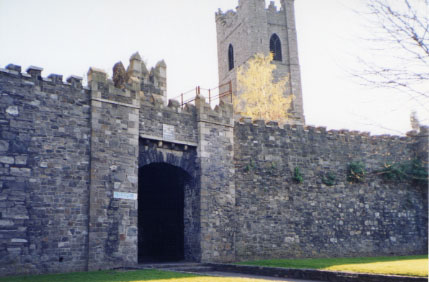
 St. Aodoen�s Gate and the Old City Walls: the only surviving portion of the city gates and wall that surrounded the much smaller medieval Dublin, built in 1240. How�s that for old? Behind them you can see the tower of St. Aodoen's.
Franciscan Friary: small and pretty. Sensing a trend here?
Abbey Theatre: one of Arcadia CEA's first stops in the orientation, we saw Sean O'Casey's The Plough and the Stars at this famous theatre. The stage is fairly large, and the theatre offers many local and international dramas with their very own Abbey Players.
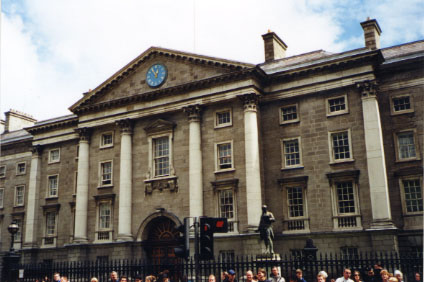
 Trinity College: TCD from the outside, specifically the West Front, is not that majestic, although the doors in remind one of a medieval foyer. The statues outside have recently had unfortunate encounters with birds. =P The college itself was built specifically for the education of talented Protestant Irishmen (and eventually, women). Before this, the Irish were forced to travel to England to attend school; there were many detractors of the college, one saying that it was a grave mistake to provide a place of higher learning for the "corner boys who spit in the Liffey". Not a nice thing to say, and it's too bad I don't remember who said it to more completely despise him.
Temple Bar: the �cultural center� of Dublin, it is more devoted to student culture (i.e., bars, pubs, clubs, and expensive touristy restaurants). The streets are narrow and ruled by pedestrians, and seem to wind around the buildings rather than the buildings being built around them. :)
Natural History Museum: as with the National Museum of Fine Art, one visit is not enough if you intend to spend quality time with all the dead animals. In fact, I decided to rename the place the �Museum of Dead Stuff�. It's in the traditional Victorian style with stuffed heads growling and birds flying and fish swimming. The first floor is devoted to Irish fauna and the upper floors to a mixture of Irish and international animals. I identified more of the loud birds outside my window. The first lecture was delivered here by the elusive Dr. Livingstone (I presume). Here can also see what hake looks like, and thanked the stuffed fish for a wonderful lunch at Leo Burdock's.
Heraldic Museum--very little explanation about the elements of a coat-of-arms, and quite small, but interesting and well-situated (or is it the other way around?) near some shops that sell heraldic merchandise. Photo of crest of Cardinal McCabe, carved into wood on a leather-bound book (my grandfather was a McCabe), and found and bought a pin with the O'Toole crest (my grandmother was an O'Toole). Yeah, finding out family history, in a lame artificial kind of way. :) Though you're not likely to find out too much about your actual bloodline, this was a great place to understand how the heraldry system works.
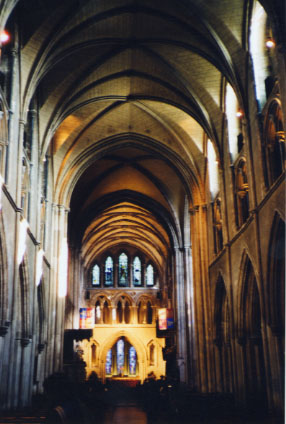
 St. Patrick's Cathedral: Amazing architecture, with very high arched ceilings. Lots of tombs; 2 major kinds: 1, where the figure of the deceased is carved in repose on the stone of the lid in full relief, and another, where the deceased is carved in wood or some other medium as in life with other family members and religious figures and angels praying. Very old, very cool. Also, I saw there the carved stone plate found over the supposed site of St. Patrick's holy well, rumored for its healing powers. Glorious stained-glass windows everywhere.
Scenic and Historic Spaces and Places
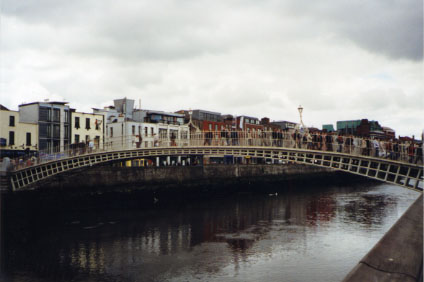
 Ha�penny Bridge: named such because pedestrians used to be charged a ha�penny toll to cross, it rises up and over the �unremarkable� river Liffey. One bridge west of the O�Connell Bridge. Gas lamps (converted to electric but in the same style) along its length light the way at night.
O�Connell Monument: guess. Also located on O�Connell St.
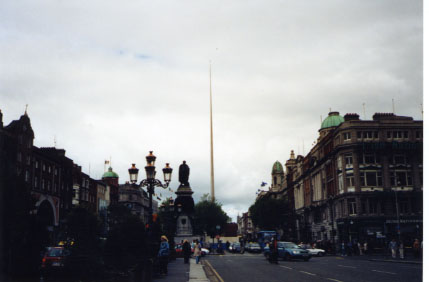
 Millennium Spire: also called the Monument of Light and located on O�Connell St., it is more like a big pointless metal spike with a light on the top. Even the Irish think it�s ridiculous! On the radio I once heard a woman berating the designer and town planners for perpetuating male phallocentrism. Hmm...anyways, in this photo you can see both the Millennium Spire and the statue at the foot of the street, as well as O'Connell Bridge.
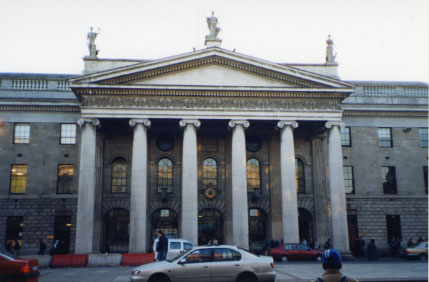
 General Post Office: the site of some of the fiercest fighting during the Easter 1916 uprising, the Irish Republicans took the GPO from the British for a bit before it was almost completely ruined by shelling and burning. Nowadays, it�s still used, and the interior resembles an old bank with teller booths and paintings on the walls. To either side of it are shops from newsstands to American fast food chains.
City Hall and the Government Buildings (the Government bldgs. being the �home� of the Taoiseach (pronounced `Tee-shock), Ireland�s prime minister), are all located near Merrion Square and the national museums.
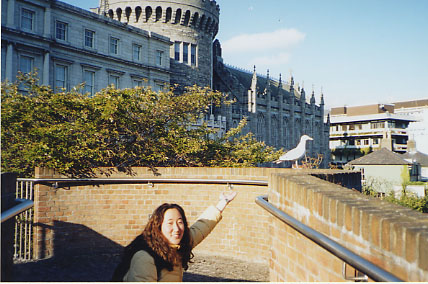
 Dublin Castle: built in 1204, it looks like a hodgepodge of different styles and pieces, with the oldest appearing to be the traditional �Irish� (Norman) round tower, which you can see in the center. Some of it has been painted various bright colors, from green to blue, red, and yellow, though why I don�t know. There are little cobbled alleys all around it, and somewhat secreted grottoes and a lawn with a large Celtic knot done in brick in the grass. The castle itself wasn�t spectacular, but we (my friend and guest, Joanne (pictured here), and I) kept finding little hidden parks and grottoes filled with flowers, statues, and fountains all over the city, in places I didn�t know existed. One such was surrounded by tall brick and ivy walls and filled with shrubs and foliage, with an open wrought-iron gate which reminded both of us of the �Secret Garden�. It'd be a nice place for a picnic lunch.
Brazen Head Inn: the oldest pub in Dublin, I think, founded in 1668. Not really much to see.
Four Courts: also designed by Gandon (responsible for both the Custom House and Parliament building), it is a sprawling behemoth with a central rotunda and four radial buildings that is still used as a place of law. The statues on the top, of Justice and others, I assume, are quite imposing.

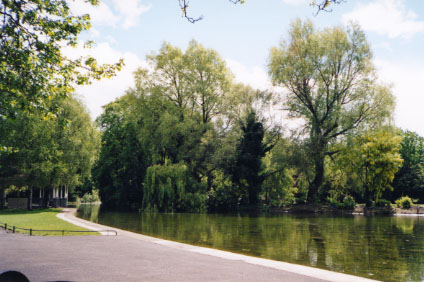
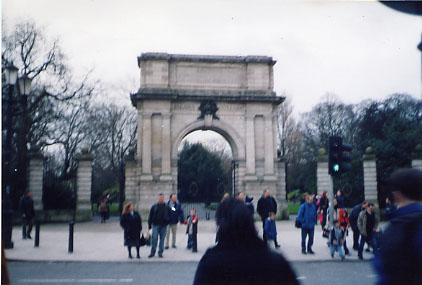
 Saint Stephen's Green and Dublin Fusiliers Arch: St. Stephen's Green is a lovely and fairly large park, with a lake and abundant waterfowl, plenty of flowers, and places to sit, talk, eat, or sleep, whatever your pleasure. It was also the site of some of the bloodiest fighting during the Easter Uprising of 1916.
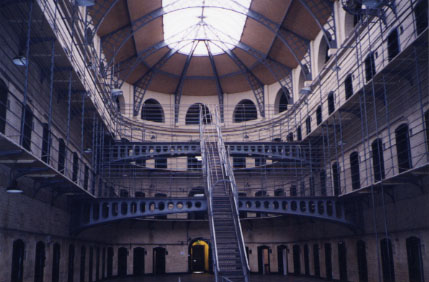
 Kilmainham Gaol: 2 km from Dublin center, in Kilmainham, along the Liffey. The gaol may not change, but the guides do, and each has interestng and different information in addition to the set speech, making any duplicate visit an educational one and not merely a repeat. Houses a quaint cafe upstairs. It was in operation until 1924. The old west wing was built in the 1700s and at the time had barred windows open to the elements, which most certainly made for very cold inmates. Ouch. The newer east wing, built in Victorian times, was designed on the Panopticon system, such that a guard could stand on the ground floor and look around the room to see all of the prisoners. Those crazy Victorians and their "all-seeing eye" theory. For more info, read Michel Foucault's Discipline and Punish. In this gaol, the political prisoners from the 1916 Easter Uprising and the
Invincibles were imprisoned and executed here, including James Connolly.
Kilmainham Gaol: 2 km from Dublin center, in Kilmainham, along the Liffey. The gaol may not change, but the guides do, and each has interestng and different information in addition to the set speech, making any duplicate visit an educational one and not merely a repeat. Houses a quaint cafe upstairs. It was in operation until 1924. The old west wing was built in the 1700s and at the time had barred windows open to the elements, which most certainly made for very cold inmates. Ouch. The newer east wing, built in Victorian times, was designed on the Panopticon system, such that a guard could stand on the ground floor and look around the room to see all of the prisoners. Those crazy Victorians and their "all-seeing eye" theory. For more info, read Michel Foucault's Discipline and Punish. In this gaol, the political prisoners from the 1916 Easter Uprising and the
Invincibles were imprisoned and executed here, including James Connolly.
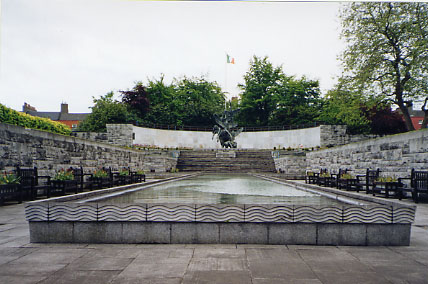
 Garden of Remembrance and The Children of Lir: located on the block next to the Writers' Museum, most of the Garden is actually concrete, and recessed below ground level, though the central pool is both cross-shaped and interesting. Flowers and flowering bushes parade around the edges, and at the very head of the cross pool is the bronze statue of the Children of Lir, turning into swans as the myth states.

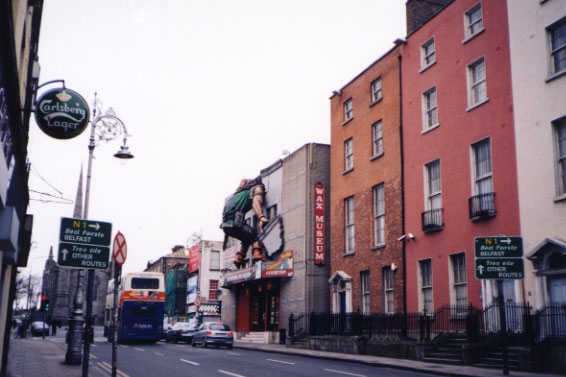
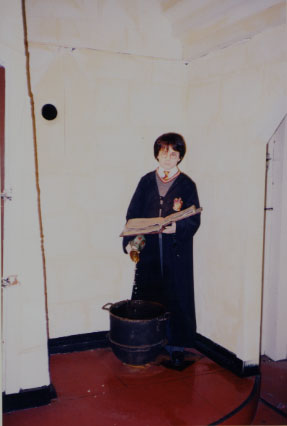
 Dublin Wax Museum: the first image is particularly interesting because it shows several subtle facets of Dublin/Irish life and culture: first, the signs are in both Irish (no, not Gaelic, Irish) and English; second, you can see a double decker bus; third, there's a sign for one of the more popular beers, Carlsberg lager (try some! if you're of age!); and fourth, there's a typical (and unique to) Dublin streetlamp with the wrought iron vine & shamrock motif. The second pic is for all you Harry Potter fans out there. Not really worth the EUR 5 I paid to get in, but moderately entertaining. Most of the figures didn't actually look real, they just looked like wax. Some of the "House of Horrors" members good, though--I had my picture taken with a very realistic (and angry) Hannibal Lecter.
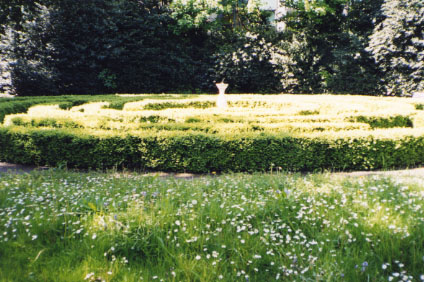
 Iveagh Garden: a lovely if small garden with secluded pathways and lots of landscaping. It also has a waterfall, a rose garden, and a mini-hedge maze. It's a nice place to bring kids, or to walk by yourself.
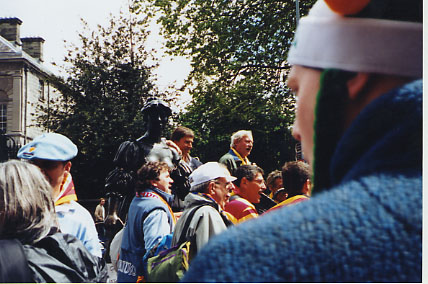
 Molly Malone: this statue commemorates an Irish song about a beautiful (and evidently, busty) lass, and she is with her cart. Surrounding her are singing Frenchmen, come to see the Heineken Cup rugby game. Too bad they came all that way to see their team lose. haha. Anyways, there's a song that goes along with her story:
In Dublin's fair city where girls are so pretty
Twas there that I first met sweet Molly Malone
As she wheeled her wheelbarrow
Through street broad and narrow
Crying, "Cockles and mussels, alive, alive oh!"
[chorus] Alive, alive oh, alive, alive oh,
Crying, "Cockles and mussels, alive, alive oh!"
Now she was a fishmonger and sure twas no wonder
For so were her mother and father before
And they each wheeled their barrows
Through streets broad and narrow
Crying, "Cockles and mussels, alive, alive oh!"
She died of a faver [fever] and no one could save her
And that was the end of sweet Molly Malone.
Now her ghost wheels her barrow
Through streets broad and narrow
Crying, "Cockles and mussels, alive, alive oh!"
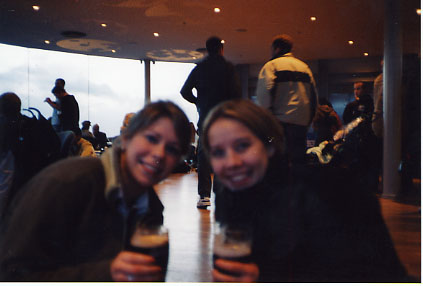
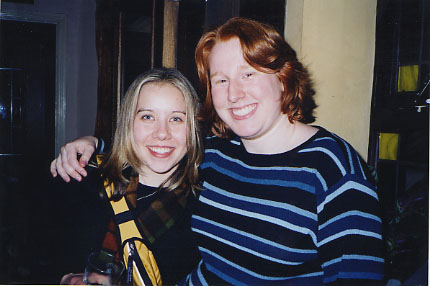
 Guinness Brewery, Gravity Bar: here's Jess (l) and Corinne (r) sipping a Guinness at the Guinness Brewery Gravity Bar. The Guinness Brewery is an amazing museum, though there're no guided tours. You are free to walk around the site of the original brewery, which has been converted into a museum and which contains much of the old equipment of the trade, including a giant wooden barrel about a storey high. There are quite a lot of videos and interactive installations, but some is merely labeled. The interior is an odd mixture of hyper-modern (steel, glass, chrome) and old (original girders). I was especially interested in the advertisements display. With every adult entrance fee (and this is no small price) you are entitled to a free pint of Guinness in the Gravity Bar, where it is rumored to be the best pour in the world. I'd recommend building up a taste for stout before partaking there, for if you're not familiar with the bitterness it might be a surprise. Also, the view of Dublin from the Bar is grand!
Shopping
A quick note on shopping in Ireland: you stand in a queue, not a line; you buy things in a shop, not a store. Happy bargain hunting! :)
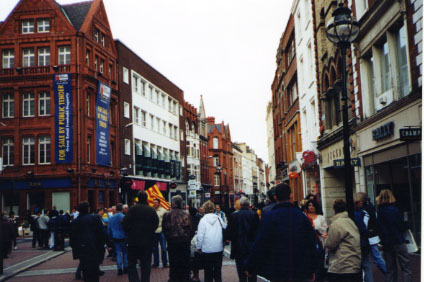
 Grafton Street: a main shopping thoroughfare off of St. Stephen�s Green, you can--at any time of the year--see street musicians, get life-altering Butler�s hot chocolate (gourmet...mmm), and do some window shopping and actual shopping. Contains more of the "trendy" shops. Lots of people everywhere, speaking all different languages, but mostly English. Grafton is packed at all times of the day. It is also very near other major shopping districts, such as Henry Street.
The Quays and Baggot St.: no tour of the city is complete without traversing the many and varied streets of Dublin city center! The Quays run along the Liffey on both sides for quite a distance, and allow access to the many bridges spanning the river. All of these streets are positively crowded with shops of all kinds and price ranges, both for natives' and tourists' needs. Baggot Street is located near Trinity College.
Nightlife
Coyote Lounge: the happening place to be for the 18-25 crowd, at least when I was there--the way these things go, I'd not be surprised if it were somewhere else by now. But anyways, the Coyote is an interesting place, if nothing else. The decor is outrageous, with semi-gloom and colored lights the order of the night, and alcoves with tables and a desert theme for groups. There's also a small dance floor, and if you like loud house and trance, go here! This last year, the Coyote was also one of several hotspots chosen by the Dublin International Student group as a party place.
If you're looking for "hip" places, Doyle's and the Q Bar are it. Doyle's is on the second floor of a triangular-shaped building, and is open until 2 or so, pretty late by Irish standards, and is a club in everything but entrance fee, with a pretty decent DJ. The Q Bar is just that, a bar, sleekly ultra-modern with neon blue lights, and lots of glass and chrome; there's a small dance floor with a DJ in the lower level. They play mostly house.
One of the best traditional pubs in Dublin is O'Donoghue's, which is inevitably packed with regulars and locals, but has several rooms to squeeze into. Oak panelling, cigarette smoke in the air, and lilting Irish accents lend the place a distinctly comfy feel.
 Pub Crawl: Corinne and me on a pub crawl, St. Patty's Day. A pub crawl is named such because if you do it right, you'll be crawling home by the end! Dublin is the perfect city to take on such a challenge: there are more pubs than churches, and that's saying something in Ireland. The rules are simple: go to a pub, have a drink of your choice, talk, have fun, and move on to the next, where you repeat the process. I think this night we hit 8 pubs, though I only had drinks in a few. Think of it like a whirlwind tour of the best that Dublin has to offer. ;)
Music Pub Crawl: during which you
are led by musicians to different pubs, seated in a private room with the rest of your tour, buy drinks, and listen to some great traditional music (from sad to rowdy, complete with explanations on the history of each type of instrument
[illand bagpipes, flute, bodhran, steel-stringed harp...] and song [jig,
reel, polka, hornpipe], as well as how they are passed along and how they
are popularly enjoyed). Plus, they told us jokes and stories, and were
talented musicians.
Regular Events
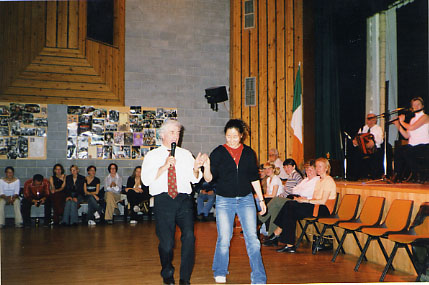
 Ceilidh: after getting extremely lost, taking several pitstops in nearby shopping malls, riding the DART (commuter train), and walking around in circles, several of my friends and I finally arrived at a Cultural Center out in Blackrock where they were holding a ceil�dh. Ceil�dhs were originally held in people�s homes, and feature traditional music and group/couple dances. Joanne, a friend from Amherst College, was picked to be a demonstrator for one of the dances, and showed her skills (shown here)! It was a lot of fun, even though we had no idea what we were doing, and kept running into each other and other people. No toes were permanently harmed in the making of this ceil�. The music was lively, the dances were relatively easy to learn, the tea was free, and the craic was good. :) After this, we walked all the way back to Belfield from Blackrock, more than an hour�s trek; by the time we got in all of us were exhausted. But it was a great night!

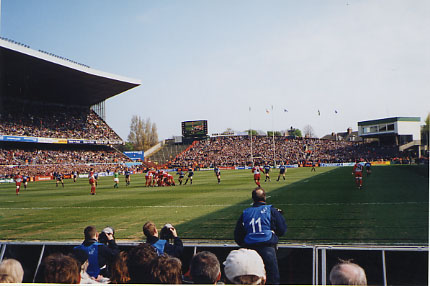
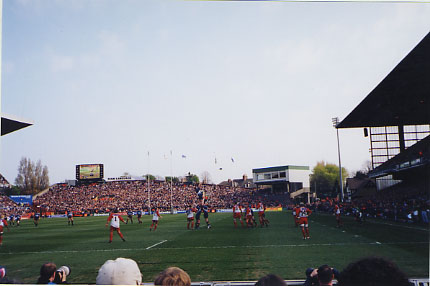
 Heineken Cup Quarter Final: although this particular game is a one-time deal, rugby games in Dublin (and in all of Ireland, for that matter) are amazing. There is no other word for it. Ireland is broken into 4 counties for the sport, Leinster, Munster, Ulster, and Connaught. The rugby game I saw was between Leinster Lions and Biarritz Olympique (a French team). It was fabulously exciting, and although I didn�t know much about the rules going in, it was very addictive. No wonder Dubliners prefer rugby to American football! It�s extremely fast and there are almost no time-outs. When the players fight for the ball in what�s called a scrum (image 1), it gets passed out of the huddle and to the players outside, ready to run with it, and it�s continually passed back and forth between players as they gain ground. They don�t even stop when someone gets hurt--they just play around them! And when they kick the ball out of bounds (a frequent practice), someone from out of bounds then throws it back into play, and two players hoist a third up to catch it, kind of like muscle-bound cheerleading (image 2). During the first half, Leinster was kicking Biarritz�s butt around the field, but they began to catch up with a strong beginning in the second half; the final score was 18-13, Leinster. The game was sold out, and supposedly about 45,000 people were there. What an interesting game! Now I want to see more! If you want to check out a match, turn on the nearest television. ;) If you want to see one live, try either the Lansdowne Rugby Field or a smaller one located along the main route from UCD to city center. You can find out about future games and buy tickets at the Irish Rugby homepage or the Leinster Rugby homepage.
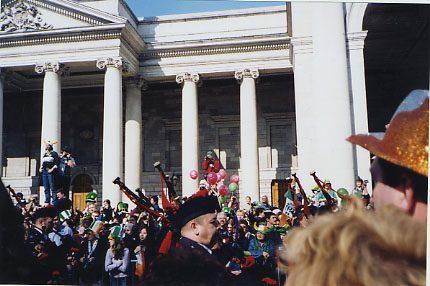
 St. Patrick's Day in Ireland is a unique thing; most activity centers around Dublin. As far as I remember, the city's population swelled from 1 million to about 8 million people over the extended weekend. People came from all over the world for the festivities. Though cities in the States do a bigger production for the parades (and turn rivers and beer green), the Irish are no slouches when it comes to their patron saint's special day. The older people visit church and spend most of the day in the pub; "pub", you will remember, is short for "public house", and is a place for more than drinking, though plenty of that does occur--even little kids are welcome, and whole families go to mingle with their community. They also go to avoid the tourists, though this is doomed to fail--the pubs are also quite a popular spot with the visitors. During the whole week previous to the actual day, Dublin hosts various performers and events, culminating in the weekend of St. Patrick's Day. Some of the performances and activities are regular every year, such as the parade.
Friday, I walked about downtown, at an open-air market. Lots of getting lost, lovely weather, bought some strawberries and a freshly baked scone. There were still not a lot of tourists.
Saturday, I listened to a Bagpiper Band from Madrid in front of St. Andrews Church. Beautiful facade, beautiful music, beautiful pipers. Oh yeah. If not for the crowd of people, I would have danced! The music was lively and well-orchestrated. Later that day, I saw St. Patrick's Cathedral--tourist central, especially on the big weekend. But I'm just a glorified tourist, and how could I not see St. Patrick's Cathedral on St. Patrick's Day weekend? That night there were fireworks--quite a let-down after all the hype, they were barely better than those put on by Manchester (NH) for Memorial Day. But we met some very drunk and very interesting Italian guys wearing Viking hats with women's lingerie on them. Hmm. The tourists are very much in evidence now. And to finish the night off, I went pubhopping with my roommate Corinne, Mark (who was studying in Amsterdam), and Mark's 3 roommates. They were all very nice people, and we had a great time and visited 8 (yes, count 'em, e-i-g-h-t) traditional Irish pubs. I got pretty drunk (yes, me) and chatted with a bunch of strangers, including a nice Irish fellow I met at one of the pubs (no ideas, you naughty people...he was too old for me). Great times had by all! See, this is what you're supposed to do in pubs: bump into people, talk, find out what's going on and what people think. This is a real pub crawl.
Sunday, I ran into Theresa (a Northern Irish friend from Art History class)& we went to find the Mummers. Unusual, and I don't know too much about the tradition, but the group was from Northern Ireland, and acted and wore costumes of ragged clothing and straw. Anybody? Fill me in? Also saw the Bagpipers again, even better the second time. More people, and some dancing in place! :) I had a fruit smoothie with Theresa; we had to gather our strength for our upcoming respective activities! We parted ways; I turned toward Merrion Square & the festivities there--all four sides of the Square were filled with events and entertainment. Several were devoted to carnival rides, kids' blow-up jumping games, and the like. The others had dance and music stages, artist's displays, foodstands, etc. The music included a samba band, Graffiti Classics (a string quartet, in which the bass player was most certainly insane), and 2 "boy" bands ("boy" because one had girls in it, but did the same kind of music, and apparently are quite famous here because there was the prerequisite group of screaming girls at the foot of the stage). ;) I finished the day up with a modern dance performance: quite unusual and hard to follow, but boy could those people dance! Amazing choreography, very powerful and graceful.
Monday, St. Patrick's Day, began slowly with coffee with Theresa, bright and early. The city is buzzing with millions and millions of people. I have never before seen so many people in such a compact area. Next came the parade, which was not everything it was cracked up to be. Lots of hiccups and lag time between each float, and most of the floats were advertisements for local and national companies. Blah. And the crowds were seriously beginning to get to me. But we met a nice group of folks from the States who were enjoying their time here, and chatted a bit. We escaped the hordes a bit early for lunch, and afterwards took a walk to Croakes Park, a sports arena; unfortunately we got there late the ticket boxes were closed. A very traditional activity for the Irish, there were two games on: Gaelic football and hurling. Sad we missed it, but the walk was pleasant, and we chatted with more nice random people. We parted ways until later that night, when we again went pub-hopping, and tried to find places that were less crowded so that we could at least get to the bar to order drinks. Many places turned us away because security was high against minors drinking, and Theresa hadn't brought an ID, and others because I was wearing sneakers ("trainers" there). Sneaker snobs. :P But we eventually found two nice places and chatted a bit, before turning in relatively early (for St. Patty's Day). We caught the NiteLink bus (i.e., the drunk bus, at least that day) back home, and I ran into two kids from Dartmouth College in NH!
Whew! What a whirlwind few days! It was a lot of fun, but my body was glad it was over, and I had a backlog of school stuff to do. A great time all around, and definately a unique Irish experience. ^_^
One thing I forgot to mention about St. Patty's day: I broke a personal
record, and got a sunburn...in March...in Ireland...in 3 hours' time. Grr. Wear sunscreen.
Best of all, these are only some of the things you can do and see in Dublin. It is a lively city with nice people and an unusual old/new feel that is quite engaging. I fell in love with the place, and you probably will too. Cheers!
Return Home
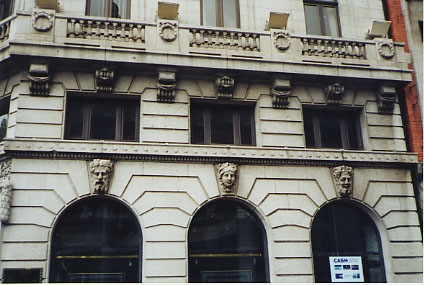 Stone faces: located on the side of a building in downtown Dublin, these stone faces are influenced by similar ones used to decorate bridges at the turn of the century. This sense of art in everyday life completely pervades Ireland, even in a city as bustling and modern as Dublin. In fact, one of the last things I saw while riding the bus downtown was the plaque on the facade of yet another Dublin brick house, identifying it as Mainie Jellett's residence (some of her work is shown in the NGI).
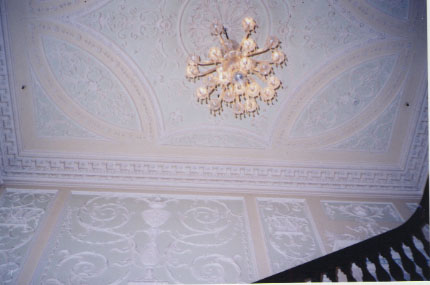 Powerscourt Townhouse Shopping Center: converted into a high-end shopping center, this is one of the younger townhouses in the Georgian style; the interior is decorated in both Rococo and Neo-classical stuccowork. If you sit on the staircase (careful, the security guard will yell at you for this) and look up, the view of delicately tinctured stucco is breathtaking. Oh, and the expensive jewelry, bridal, bansai tree and other shops and food kiosks are neat too. ;)
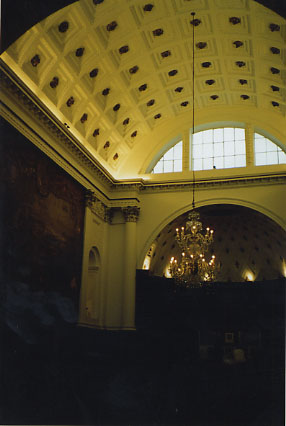 Parliament House: now the Bank of Ireland, houses the former House of Lords, the fa�ade is in an imposing Classical style (not Neo-classical, that came about a century later in Ireland) with an interior of elaborate diaperwork plaster and richly stained wood-panelled walls.
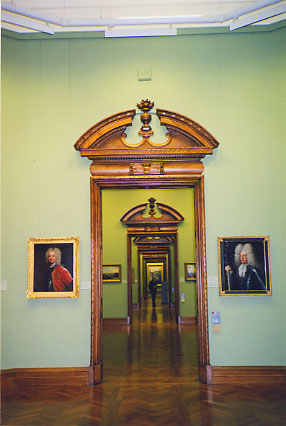 National Gallery of Ireland: I've been several times, and it just keeps getting better & better. It's difficult to see all of the art in one sitting, and they have regularly-changing special exhibits. A particularly interesting one was on Paul Henry, whose images of western Ireland were used on tourism posters during the past century. A lot of people have called his work "chocolate box" art because so much of it is seemingly similar, but in the exhibit there was a
definate sense of growth and range. Also, some of the works were just
downright crap. But some of them were almost transcendentally beautiful!
Goes to show that not even the best artists have good days every day. The gift shop has the requisite art books and postcards for sale, and the cafe, though charming, is overpriced. Like most art museums, they don't allow photography (camera flashes damage paintings, plus there's a question of copyright), but I took one anyways. Hehe. This depicts the receding doorways of the Irish wing, with Grotesque-modelled wooden doorframes and flanking Irish portraits of some old dead guys by some old dead guys. You'd think, for someone who studied Irish art, I could be more descriptive, but there you go.
National Gallery of Ireland: I've been several times, and it just keeps getting better & better. It's difficult to see all of the art in one sitting, and they have regularly-changing special exhibits. A particularly interesting one was on Paul Henry, whose images of western Ireland were used on tourism posters during the past century. A lot of people have called his work "chocolate box" art because so much of it is seemingly similar, but in the exhibit there was a
definate sense of growth and range. Also, some of the works were just
downright crap. But some of them were almost transcendentally beautiful!
Goes to show that not even the best artists have good days every day. The gift shop has the requisite art books and postcards for sale, and the cafe, though charming, is overpriced. Like most art museums, they don't allow photography (camera flashes damage paintings, plus there's a question of copyright), but I took one anyways. Hehe. This depicts the receding doorways of the Irish wing, with Grotesque-modelled wooden doorframes and flanking Irish portraits of some old dead guys by some old dead guys. You'd think, for someone who studied Irish art, I could be more descriptive, but there you go.
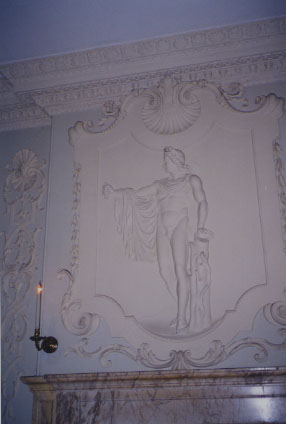
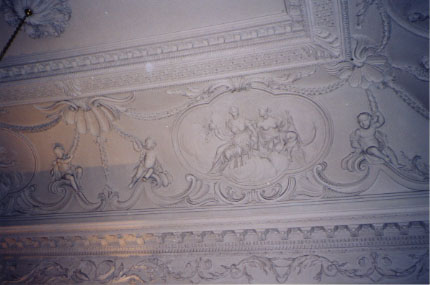 Newman House: The first of these images is of Apollo himself, modelled after the Apollo Belvedere (see my Cork page, or Apollo himself), surrounded by a shell frame and with flanking Grotesque acanthus fronds and swags of flora. The rest of the room contains the Muses, elegantly done. The second is of a stuccoed coved ceiling in the upstairs parlour, depicting different mythical couples in losenges with playful putti. Both of these rooms and several in the rest of the house are sculpted by the amazingly talented Lafranchini brothers, who were enticed to Ireland from the European continent by Irish patrons well versed in European taste and style.
 Royal Hospital Kilmainham: a lying-in hospital
for retired soldiers, built as a square with inner courtyard and palisades on the Italian model. It has been since renovated to be the Irish Museum of Modern Art (one of several in the city, might I add). The building itself was not so cool. The crowning glory of the building, for me, was the Chapel. It is decorated with the only example of Baroque interior in all of Ireland, if not all of the British Isles. The odd part is that the stuccowork is of English influence and the woodcarvings of French origin. The first image shows the stuccoworked overdoor at the entrance to the Chapel, with musical instruments and two flanking portraits. The second shows the stuccoed ceiling, designed in the Baroque style of extreme decorative detail and overwhelming magnificence. Flowers, fruit, garlands, and winged angels stand out in great relief. The third image depicts the altar, carved out of wood to match the stuccoed ceiling and without question a piece of art in its own right. Also, behind it is the mullioned stained-glass rose window, which bathes the interior in dazzling colorful light. They don't normally let people in to see the chapel, as it is used as a banquet/business hall and the doors are unlocked for people interested in renting it; however, if you ask nicely, and show some knowledge of the stucco interior, the receptionist might pull a few strings and get the guards to let you in. Call ahead.
Royal Hospital Kilmainham: a lying-in hospital
for retired soldiers, built as a square with inner courtyard and palisades on the Italian model. It has been since renovated to be the Irish Museum of Modern Art (one of several in the city, might I add). The building itself was not so cool. The crowning glory of the building, for me, was the Chapel. It is decorated with the only example of Baroque interior in all of Ireland, if not all of the British Isles. The odd part is that the stuccowork is of English influence and the woodcarvings of French origin. The first image shows the stuccoworked overdoor at the entrance to the Chapel, with musical instruments and two flanking portraits. The second shows the stuccoed ceiling, designed in the Baroque style of extreme decorative detail and overwhelming magnificence. Flowers, fruit, garlands, and winged angels stand out in great relief. The third image depicts the altar, carved out of wood to match the stuccoed ceiling and without question a piece of art in its own right. Also, behind it is the mullioned stained-glass rose window, which bathes the interior in dazzling colorful light. They don't normally let people in to see the chapel, as it is used as a banquet/business hall and the doors are unlocked for people interested in renting it; however, if you ask nicely, and show some knowledge of the stucco interior, the receptionist might pull a few strings and get the guards to let you in. Call ahead.
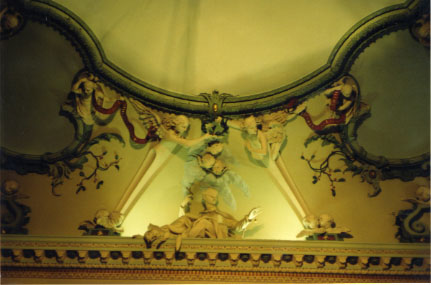
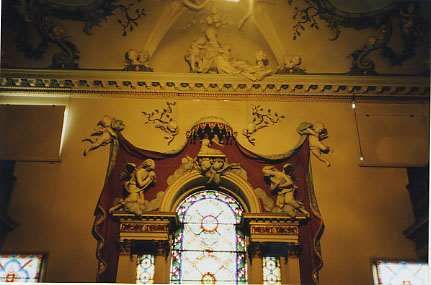 Rotunda Hospital Chapel: the first image shows the character Justice with her scales and blindfold, sculptured by Bartholomew Cramillion fully in the round and independent of the wall; around her are attenuated angel terms with garlands and banners and putti angel faces. Also, significantly, you can see the rocaille work that indicates this as of the Rococo period and style. The second photo is of the Altar, also modelled by Cramillion, with the Lamb of God and adoring angels, with the character of Charity above it. Unlike most stucco, these sculptures were meant to be (and obviously continue to be) brightly polychromed. Standing inside and looking up, one cannot help but be entranced by the multitude of figures, some of which stare uncannily back.