Ships in Waterford Harbor: Waterford is a really pretty little town, but very touristy. It is one of the main ports of Ireland.
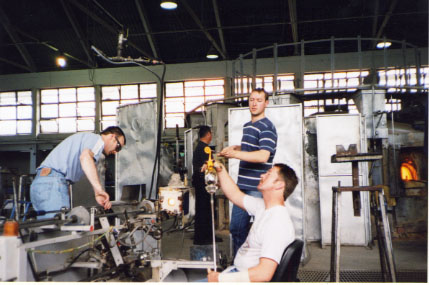
Putting a stem on a blown wine glass, Waterford Crystal Factory: The main attraction of Waterford County is, obviously, the Waterford Crystal Factory. The tour (which costs a moderate fee) brings you through the various steps of the crystal-making process. Make sure to get there before 4, as the last tour seldom includes all of the points of interest because the workers have already begun laying off work for the day by the time you get to them. The first few steps involve the blowing, cutting, and decorating of the crystal, and are all very open and interesting. You walk right through working labs/workshops. Interspersed are general storage areas where you can see previous works and one demo area where a master decorator (is that the official name of his/her job?) explains the process step-by-step and does it as you watch not 3 feet away, and accepts questions. An interesting fact is that the artists employed at the Factory have to attend various schools and apprenticeships for 8 years before being able to work there, and that it is therefore usually a lifetime job.
We spent very little time in the actual city of Cork, though our "guide" Joe, a student at UCCork, was very knowledgeable about the area. I'd recommend getting one of those dorky tourist maps. One thing to note: where Dublin has its Guinness, Cork has its Beamish.
![]()
![]()
![]()
St. Finbarr's Cathedral: located in the heart of Cork, surrounded by busy streets and telephone poles, its Neo-Gothic architecture stands out from the crowd. On the facade are several painstakingly-carved and attenuated virgins, saints, and angels. Inside, after a nominal fee, you can see the painted ceilings and a plaque to the only female stonemason. Perhaps more interesting is the huge pipe organ, the interior of which is visible if you lever yourself slightly up and over the wall around it (image 2). In the rear is a small cemetary, with lilacs and a nice place to sit and look out over Cork (image 1).
![]()
Crawford Municipal Art Gallery: The gallery was splendidly informal, with a mixture of older and modern art (generally Irish, and including some works by James Barry that I had studied, coolness of coolness), an impressive collection of casts from statues in the al'antica style formerly used by students of the Cork School of Art (including the Apollo Belvedere--the second image--and several Canovas), and best of all, not a lot of people were there, no guards were hounding us, and we could take photos! The first pic is of my friends Joe (American) and Teresa (Northern Irish) with The Archer.
![]()
![]()
![]()
![]()
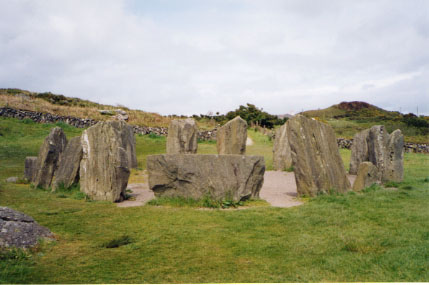
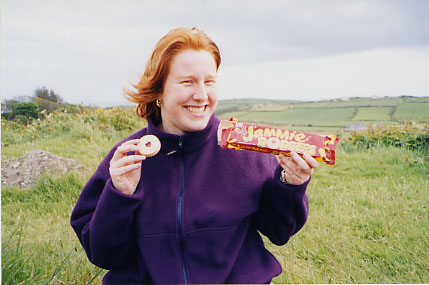
We three caught a bus to Rosscarbery, a very small town, so small in fact that it didn't have a bank and only had about three pubs. From there we set out on a trek to see the Drombeg Stone Circle, which I've been dying to see for years. The walk was approximately 6 miles round trip, all uphill on the way, but it was worth it. The circle was as cool as expected, and the surrounding landscape (it was on the top of a hill) was breathtaking (first image). The arrangement of the stones is, like Stonehenge, oriented with the stars; on the Winter Solstice the sun shines through the two framing stones and falls on the central stone, which held a jug and the cremated remains of a human. You can actually see the direction the sun comes through the stones in the second image. Also, there were a series of small walls surrounding an ancient cooking site. I guess that the people of the time had stones heating in a hearth, took water out of a nearby well and put it into a basin, threw the stones in, boiled the water that way, and threw food in to cook. Neat, and quite inventive. You can see that setup in the third photo. To honor the previous chefs, we had lunch there, and plenty of cookies--to fuel our way back to the town, of course (I found Jammy Dodgers, as you can see in the fourth photo, a personal favorite of the hysterical British comedian Eddie Izzard). On the return trip I was attacked by dogs, cows, and thorn bushes, and I peed in a bush. It doesn't get much better than that.
![]()
![]()
![]()
![]()
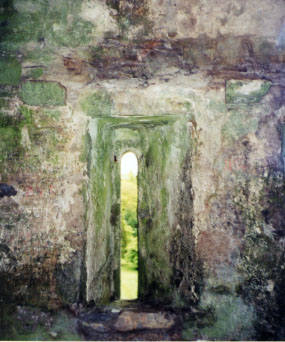
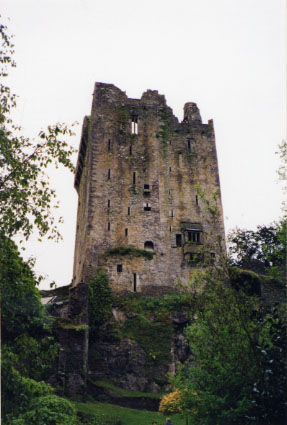
Blarney Castle: The castle is incredibly old, and there was no tour (and no map!) so we explored it on our own. Rooms are designated with their supposed use by small placards, labeled "Dining Room", "Chapel", and the like, though it is doubtful that there is any solid evidence to these claims. Regardless, the architecture is interesting and the ambience is unforgettable. Arrow loops pierce the outer walls for protection during times of war. The staircases were all very narrow, wet, and spiraling, some no wider than shoulder-width. The aforementioned rooms led off on all sides, some through "secret" passageways or through other rooms. In the largest central room, the remains of stone supports for wooden floors were visible jutting out of the walls. Also cool were the barred murder holes everywhere. The view from the top was spectacular, and even though it was slightly foggy you could see quite far. At the very top is the goal of many, the Blarney Stone itself. An employee of the castle holds you as you lean way, way back to kiss the stone, which is part of the outer wall. Like my grandfather before me, I kissed the Blarney Stone and have been granted the gift of the gab. After the castle we explored the grounds, which had (also) quaintly labeled stone ruins of houses, a few lookout towers, a brook, and an unlabeled building that may have been a guard house.
Return Home