
 |
SONOMA
STATE UNIVERSITY, EDUCATION
420
CHILD DEVELOPMENT IN THE FAMILY, SCHOOL AND COMMUNITY
| Instructor: Norman Rose, PhD | |
|
E-mail [email protected] |
Phone 664-2403 |
| (Note: If I'm not in, you'll get faster results with e-mail instead of voicemail) | |
|
Office:
Stevenson 2010G Mon. 7:30 - 8:30am |
|
|
Class Web
site: |
|
|
Let's spend a little time sharing your "Beating the Odds" articles. Final Exam Prep Here is the Study Guide. Download it, fill in the blanks however you like, and bring it to the exam: But before printing out your final version, let's discuss the Guide in class. You'll especially want to have a clear understanding of the chart at the bottom and the general concept of analyzing implications and applications of a situation or theory.
Final Exam is Monday, May 21, 8:00-9:50am
My Offices: Stevenson 2010G and Via E-mail If you want to meet with me, you can drop by during my office hours, but it's best to schedule a time. Send me an e-mail and allow for time to get my reply, or talk to me during a class break to arrange a time. My "virtual" office is open most days from early morning until early evening. You can ask me about the assignments or schedule a meeting. Just click the e-mail link above to reach me. Here is a
link to download a Word document on writing with more analysis: |

"The child is father of the man...." These words, from Wordsworth's Intimations of Immortality, tell volumes about why we should study child development. From the genes you packed to the jeans you packed, childhood cast you (and me) in a certain mold. Whether you're thankful for the mold or exerting energy to fight it, that mold encases your every thought and action to this day -- consciously or not. And isn't it better to be conscious?
In
this course we will explore the physical, cognitive, social, emotional, moral,
and language development of children from birth through
adolescence. Major theories of child development are studied and applications and critiques
of theories as they relate to children from a variety of cultural and family
backgrounds are discussed. Children's experiences in families, schools, and
communities are studied as they relate to children's views of the world, including
health and discipline practices. The impact of family and child rearing beliefs,
gender issues, and language development are discussed as they relate to developmentally-based
practices in educational settings. We also will discuss effective school-family
communication practices for a diverse society, and community resources available
to support families, including those that address issues of poverty and violence
and the effects of these on children and their families.

-
Paving Pathways. Child and Adolescent Development. by Laurel Hughes, Wadsworth Publishing Company, 2002.
- The Scientist in the Crib. What Early Learning Tells Us About the Mind .By Alison Gopnik, Andrew N. Meltzoff, Patricia K. Kuhl. HarperCollins, 2000.
"Book Club" Choices (Choose 2)
- Boys & Girls:
Superheroes in the Doll Corner by Vivian Paley
(preschoolers' fantasy play and gender roles) Class 5 - Last Child in the Woods: Saving Our
Children from Nature-Deficit Disorder
by Richard Louv
(more nature, less media?) Class 7 - True Notebooks by Mark Salzman
(adolescents' writings while in juvenile detention) Class 8 -
Under
Deadman’s Skin: Discovering the Meaning of Children’s Violent
Play
by
Jane Katch
(violence influences on 5-6 year olds, with added insight from 10-year old) Class 11 - The Hurried Child by David Elkind
(early/middle childhood emphasis; trends in family patterns & children's free time) Class 12 - High Risk: Children without a
Conscience by Ken Magid
(analysis of and therapy for unbonded, psychopathic children) Class 14
Besides the bookstore, you can look for these books on Amazon, in the university library, or in public libraries.
Additional articles will be assigned throughout the course to supplement and enrich the textbook information. These will be available on line, in a reader, or be handed out in class. Please check the course website for these readings.
COURSE OBJECTIVES
1. Demonstrate an understanding
of the physical, cognitive, emotional, and social development which occurs
in childhood from infancy through adolescence.
2. Demonstrate understanding of the effects of the family, school and the community
in the growth and development of the child, with special emphasis on multicultural
issues, the impact of poverty, discrimination and equity.
3. Articulate ways in which the theories of child development impact educational
programs, parenting and teaching strategies, and materials designed for children.
4. Identify a variety of community resources which are available to support
children and families.
GENERAL EDUCATION OBJECTIVES ADDRESSED
1.Acquire a foundation of intellectual skills and capacities including: developing intellectual curiosity;
developing research skills; writing and speaking effectively to various audiences; evaluating everyday
experiences critically; working collaboratively; developing skills in using information technology;
imagining, designing and executing scholarly and creative projects
2.Develop social and global knowledge including: understanding human diversity and multicultural
perspectives; actively engaging in the community; understanding the global environment; understanding
social justice issues
3. Use multiple methods of inquiry and approaches to knowledge
4. Develop capacities for integration and lifelong learning: including integrating general education
experiences; engaging in responsible citizenship
COURSE
REQUIREMENTS AND ASSIGNMENTS
1. Class attendance and participation: It is important that you come to class regularly and stay for the whole period. It will be difficult for you to make up your absence by getting the class notes, because we will be discussing the readings and conducting different learning experiences. Our class meetings are designed with the expectation that you have read all of the assigned readings prior to coming to class. Be prepared to share your understandings and questions about the readings. In our class discussions, please remember to respect divergent ideas and that our different life experiences have shaped our views. Also be sensitive to allowing your classmates equal access "to the floor", as well as actively listening to their comments.
Please email me in advance if you will not be able to attend classes. If you are absent for more than one class meeting, your grade may be affected.. If you miss more than three classes you will fail the class. Of course, I will take into consideration special cases, such as illness, family emergencies or other unforeseen crises. These have to be properly documented. It is your responsibility to find out what you have missed when you are absent, and to make-up any in-class assignments that were given. Being absent does not excuse you from anything that was discussed or due in class.
2. In-depth Research study: Choose a topic which holds a personal interest for you and which relates to the content of this course. Formulate a question and research the topic in scholarly journals. Interview one person in the field regarding your topic. Present your final results in research paper format. Any of the ideas which we have discussed in class or are covered in the textbook are suitable to study. You may work with a partner or by yourself. If you work with a partner, the study must include more complex components than an individual study. Topics must be approved before beginning this project. Please let me know if I can help in any way. For more details about this assignment click here
3. Mid-term and final in class essay exam: You will have a choice of essay questions. You are allowed to bring notes to class; rather than memorizing everything, I would like you to be familiar with the concepts, theory and research and to be able to apply these to different situations about child and adolescent development. The notes should be your own personal notes and you will hand them in together with your responses. I will return them to you. In your responses you will integrate the readings, class activities and discussions, and your personal experiences into a thoughtful essay.
4. From Theory to Practice. You will select one of the development or learning theories discussed in class, highlight its central concepts and discuss how these concepts can be applied in real life and/or in the classroom. This will be minimum 3 pages, double-spaced, using APA style. (Title page, reference page, etc. don't count in page count.)
5.
Analysis of a children's book or of a school text.
Books
which are designed for children, whether fiction or textbooks, are
written with the children's development and learning in mind. In
this assignment you will read either a children's chapter book or
a school textbook to apply what you are learning about child development
and analyze the author's theoretical perspective's are two options
for the type of book you read and analyze. If you are in the SSU
multiple subject credential program, you may wish to take option
B, and use this assignment as evidence for the Performance Expectation
# 3 in your digital portfolio CSW1.
Option A:
Read a chapter book that portrays a developing child who is in middle childhood
or adolescence. (A chapter book has chapters and is written for children approximately
3rd grade and up.) Make sure that you choose a book that depicts, with enough
detail, the physical, cognitive, and socio/emotional development of the main
character. Also, do not select a book that is part of an extended series of
books (erg. Goosebumps, The Babysitters' Club). Check with me if you are unsure
whether the book is appropriate for this assignment.
Option B:
Read a current textbook for any grade level, kindergarten to grade 6. You may
choose any subject area: language arts, social sciences, math or science, though
a social studies or language art text may be easiest to analyze.
Click
here for full guidelines for this assignment.
6. Book Club: During the semester, you will read 2 books from the Book Club list. You will write a review of each book, using this standard form. You will submit the form via e-mail and it will be posted on the class Web site as a study guide for others. (You will be graded on the quality of your reviews, but no one will see your grade.)
You and the others will discuss the book in class, in front of the rest of the class. Check calendar dates to see when each book will be highlighted in class.
Your grade in this course will be based on your completion of all course requirements. Your written work will be graded according to how fully and completely you demonstrate understanding of the course content and how well you integrate your knowledge with practical examples. All of your writing should include your own analysis and synthesis. Attention will also be given to the clarity and organization of your writing. Please check the Criteria for Good Writing. Make sure that your papers follow professional standards of presentation. The format and presentation should be equal in quality as the work you are expected to submit as a professional. Proof read your papers for spelling errors, grammatical usage, sentence structure, and clarity. You can also go to the Writing Center at SSU where you will receive excellent assistance in editing your papers (and it’s free). Useful resources for your writing process are available on the Writing Center Web site.
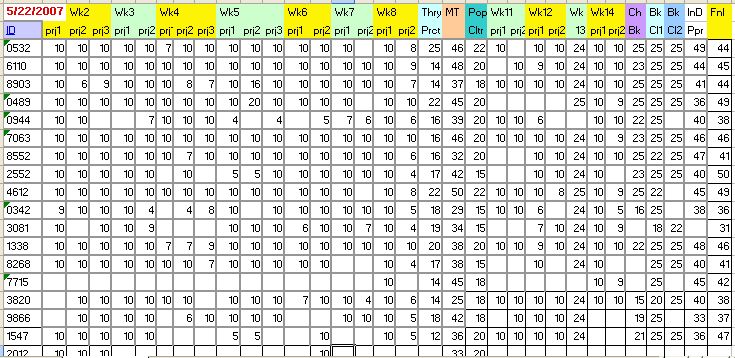
Late papers are not accepted. Your final grade will be calculated on the basis of your performance on the course requirements and will be weighted as follows:
| Assignments |
Max. Possible Points |
| Short written projects & journals 23 x 10pts | 230 |
| Midterm exam |
50 |
| From Theory to Practice paper |
25 |
| Analysis of children's book or school text |
25 |
| In-Depth Study paper |
50 |
| Group research & presentations 2 x 25pts | 50 |
| Book Club 2 x 25pts |
50 |
| Final exam |
50 |
|
Total
Points Forgiven (absences, "stuff" happens) Total Calculated Points
This means that your total
points will be divided by 5, |
530 |
Click here to see your current
points
The basis for letter grades is as follows (based on 700 points):
| A | Outstanding performance (you went the extra mile) | A-= 90-94% | A= 95-98 | A+= 99-100 |
| B | Good performance | B-= 80-83% | B= 84-87 | B+= 88-89 |
| C | Satisfactory performance | C-= 70-73% | C= 74-77 | C+= 78-79 |
| D | Poor Performance | D-= 60-63% | D= 65-67 | D+= 68-69 |
| F | Failing | Less than 60% |
|
A
brief reflection on grades: Please remember that grades are not a measure
of the value of the students as a human being. They are a measure of
demonstrated performance on specified criteria in a particular class.
Please keep this in mind, because sometimes we tend to take grades very
personally and our feelings get hurt unnecessarily.
Some important issues to keep in mind
1. Special Accommodations:. If you have a disability that requires accommodation in this class, you must notify me before the end of the second week of class regarding the nature of the accommodations) you require. You must register with the campus office of Disabled Student Services, located in Salazar Hall. DSS will provide you with written confirmation of your verified disability and authorize recommended accommodations. This authorization must be presented to me before any accommodations can be made.
2. Use of Sources: In your writing for this class, you will be referring to ideas from the textbooks and other sources. Make sure that you cite the references; please follow APA standards for citation format. (click on this link on the course website to obtain information about this citation style). If you are taking language directly from other sources, use quotation marks. If you are paraphrasing ideas, you must use your own words and list the reference following the sentence.
3.
Hand
in your assignments on time:
Keep a hard copy of the assignments you hand in. I will write comments
on your papers to give you feed back. Also, in the unlikely event
that an assignment is lost, the burden of proof that you completed
the assignment rests with you. Some of the assignments will
also be posted on the web, please check the guidelines for each assignment.
You may submit assignments by e-mail attachment if you follow
these rules:
a) Your subject line must identify you by name and course,
e.g. "John Doe, ED420 assignment #1"
b) Your attachments must be virus-free; word processed files
should be .DOC or .RTF; graphics files should be .JPG or .GIF; Excel,
PowerPoint, MP3, Flash, .AVI, .MOV (QuickTime), and .WMV files are also OK;
anything else, check with me first. Remember that I will be on a PC, not a
Mac.
4. Academic Honesty: My relationship with you is based on honor and mutual trust. Your work should reflect your own learning, thinking and elaboration. Also, all work handed in needs to be prepared specifically for this course. If you give me any reason to doubt that you have completed the work yourself or that the paper has been handed in for another course as well, I will have to proceed according to the SSU Policy on Cheating and Plagiarism. Make sure you cite sources appropriately; not crediting a source used can be construed as plagiarism. This includes sources from books, movies, the Internet, etc. If you have any questions about this issue, please come and talk to me before you hand in your work.
(Tentative
schedule, changes in readings may be made,
so please
check the website every week)
Session
1: Jan.29
Introduction to course
Getting to know each other
Overview of course and assignments
* What is the study of human development?
* Sequence & rationale of this course
* Reading Assignments
* Book Club -- readings, writings, discussions
* Projects: papers, presentations, journals, etc.
* Focus on analysis, implications and applications
Finding research articles; levels of respectability
Preview of readings & projects for next week
* Everyone reads Hughes (textbook) Ch.1 & 2, Gopnik et al. (Scientist) Ch. 1
* Divide class for Hughes Ch. 3 & 4
Session
2:
Feb.5
* Overview of theories of development
*
Studying Child Development
*
Prenatal development, birth, newborns
Reading (to be completed before coming to class)
Hughes: Chapter 1. Beginning Points of Theory (pp. 1-30);
Chapter 2. Studying Child
Development. (pp. 32- 61)
{Chapter 3. Biological Beginning points (pp 70-88)
OR
{Chapter 4. Entering the World (pp. 94-119)
Gopnik, Meltzoff and Kuhl.
Scientist Chapter One. (pp. 1-23)
Projects (to be completed before
class; turned in at class or before by e-mail)
(Notes: - Your e-mail address may not tell who you are, so always put your real name
in the subject line)
- Send
only 1 e-mail and attach all projects in it.)
Project #1:
Write an outline for each of these theoretical perspectives:
*Psychoanalytic
(Freud/Erikson),
*Behavioral (Watson/Skinner/Bandura),
*Cognitive
(Piaget et al.).
For each one, use these bullet points:
1) Basic Concepts & Terms with brief explanations (at least 3)
a) _________
b) _________ etc.
2) Position on the Nature-Nurture continuum -- 1 or 2 sentences
3) How it can be used to explain or analyze a child's behavior -- 1 or 2
sentences
4) How it can be used in research -- 1 or 2 sentences (see text Chapter 2)
Project #2:
You have read either chapter 3 or 4. Write up an outline or study guide
on your chapter. You will trade it with someone who read the other chapter.
Project #3:
Write the answers to these questions using Chapter 1 of The Scientist in the Crib
(with help from the textbook if you wish):
1. Name and explain the 3 epistemological problems every baby must solve (1-2 sentences each)
a)
b)
c)2. In 1-2 sentences, tell how each of these would explain how babies solve the 3 problems
a) Socrates
b) Piaget
c) Vigotsky
d) Skinner3. What is the modern analogy that helps researchers and other adults understand how babies work with those 3 problems? Why is that analogy useful and important?
For next week, divide Chapters 5,6,7
in Hughes and Chapters 2,3,4 in Gopnik et al.
Session
3: Feb.12
*
Infant and Toddler Development: Physical, Social-emotional, and Cognitive
*
Attachment Theory
Reading
Hughes:		Ch. 5, Infant/Toddler Physical Development and
Gopnik et al.	Ch. 3 What Children Learn about Things
				 OR
Hughes		Ch. 6 Infant/Toddler Cognitive Development and
Gopnik et al.	Ch. 4 What Children Learn about Language
				 OR
Hughes		Ch. 7 Infant/Toddler Social and Emotional Development and
Gopnik et al.	Ch. 2 What Children Learn about People
Wikipedia, Attachment Theory and related/referenced/linked articles
Projects
Project #1
After reading your assigned chapters, bring to class 2 copies of a study guide for discussion and trade,
plus one copy for instructor
* H Ch.5:	- Typical growth patterns and milestones for infants and toddlers
	- Physical risk factors in infancy and toddlerhood and suggestions for cure/prevention
	- Nutritional risk factors in infancy and toddlerhood and suggestions for cure/prevention
	* Bonus- Evaluate a commercial product for physical or nutritional benefits
  G Ch.3	- What infants seem to already know or be able to do at birth
	- How infants learn about things and categories of things
------------------------------------------------------------
* H Ch.6	- Typical cognitive milestones & growth for infants and toddlers
	- Factors for cognitive stimulation for infants and toddlers
	- Risk factors for under/over stimulation
	* Bonus- Evaluate a commercial product for cognitive stimulation
* G Ch.4	- What infants seem to already know or be able to do at birth
	- How infants learn about language
------------------------------------------------------------
* H Ch.7	- Typical emotional and social milestones and growth for infants and toddlers
	- Factors in infant/toddler stress
	- Stress reduction and/or prevention techniques for infants/toddlers
	* Bonus- Evaluate a commercial product for stress prevention or reduction
* G Ch.2	- What infants seem to already know or be able to do at birth
	- How infants learn about people
Project #2
Write a brief paper (up to 1 page double-spaced) on what attachment theory means and what it implies.
Session
4: Feb.19:
No class; all
assignments submitted via e-mail attachment to [email protected]
(Notes: - Your e-mail address may not tell who you are, so put your real name
in the subject line)
- Send
only 1 e-mail and attach all projects in it.)
Early Childhood: Physical, Cognitive,
and Language development
Piaget
Preschool Curriculum
Montessori
Reading
Hughes:
Chapter 8: Early Childhood Physical Development (pp. 216- 245);
Chapter
9: Early Childhood Cognitive Development (pp. 246- 314)
Gopnik, et al. (Scientist) Chapters 5,6,7
Web: http://en.wikipedia.org/wiki/NAEYC and any useful external links (bottom of Web page)
         http://en.wikipedia.org/wiki/Montessori_method and any useful external links (bottom of Web page)
	(Note: You will choose 1 of these themes for a report, so after you read the main Wikipedia
	 entry for each one, you only need to follow links for the one you are more interested in.)
Video: With no class session, you will have to go to the library and watch this video on your own:
	Piaget's Developmental Theory VHS 662
           The material on this video complements the textbook. The ideas will appear on exams.
Projects
Project #1
-
Visit a preschool. (The on-campus "lab" school is OK, and a Kindergarten is OK, too.)
AND/OR
- Interview a preschooler or two about his/her school
experience. (Or interview a child and parent)
Try to find out what kinds of
activities help develop cognitive and language development. Write 1-2 pages,
double-spaced.
Project #2
Choose one: Write a brief report on NAEYC standards
and accreditation OR on Montessori preschool philosophy and
methods.
Project #3
Write 3 main ideas from each chapter assigned in
Scientist. Each idea should be 1-3 sentences.
Session 5:
Feb.26
Early Childhood: Psychosocial development
Play, Preschool, Discipline, Parenting Styles, Subconscious
Reading
Hughes: Chapter 10: Early Childhood Social and Emotional Development (pp. 280- 313)
Websites:
http://abc.go.com/primetime/supernanny/index.html
http://www.fox.com/nanny911/
| We're looking for an answer to the question: Why do preschoolers love to listen to the same bedtime story over and over? Is it reassuring? Instructive? To help answer, we need to know some things about the young child's brain and thinking processes, as you did last week. Then we need to delve into speculative psychology regarding the subconscious. Some assert that everyone's subconscious is personal yet similar (Bettelheim), while others maintain that it is at times connected to everyone else's (Jung). Either way, the fairy tale has often been used to explore the workings of the subconscious of children through symbols and analogies. |
Rose:
Working with the Subconscious.
(For extra Jungian background,
http://www.kheper.net/topics/Jung/collective_unconscious.html
and
http://en.wikipedia.org/wiki/Collective_unconscious)
and for background on
Bettelheim
http://www.jamespmercurio.com/review_enchant.html
(This link might
also give you the idea that this topic isn't just about young children, and
not just about fairy tales!)
Then read the 2 stories that are gender-appropriate for you:
Males
Jack and the Beanstalk: http://liftoff.msfc.nasa.gov/academy/TETHER/JackandBeanstalk.html
Iron John: http://www.4literature.net/Jacob_and_Wilhelm_Grimm/Iron_John/
If either of these links does not work, do a search to find another online version of the tale.
(Suggested Extra Reading: He by Robert L. Johnson)
Females
The Frog Prince: http://childhoodreading.com/Edmund_Dulac_and_Gus/Magic_Jewel.html
The True Bride (or The Three Tasks): http://www.pinkmonkey.com/dl/library1/story173.pdf
If either of these links does not work, do a search to find another online version of the tale.
(Suggested Extra
Reading: She by Robert L. Johnson)
Book Club: Boys and Girls: Superheroes in the Doll Corner
Projects
Project #1
From the folk tale readings, make a
list of at least 10 phrases, objects, characters, or events that could be
interpreted as analogous or symbolic of something psychologically
important. Give your own interpretation to each item on your
list. There are no wrong answers. (Remember, these stories might have
survived not just for their entertainment value, but for their subtle
instructional or psychological value. And keep in mind that you are looking
for symbols that are universal -- that is, unconsciously significant to just
about anyone.) Bring the list to class for
discussion and to turn in.
Examples: Evil Stepmother -- stands
for adolescent view of real mother, who keeps thwarting plans
(This is interpreting a symbol or analogy as something outside oneself.)
Evil Stepmother -- stands for child's own self-critical inner voice
(This
is interpreting a symbol or analogy as facet
of oneself.)
Project #2
Watch an episode of "Supernanny" or "Nanny 911" and report on the types
of problems the nanny had to deal with, her creative solutions, and the
theoretical basis for them (behavioral, cognitive, psychoanalytic,
biological, etc.).
Alternative or Bonus: Watch an episode of "The Dog Whisperer" and report on
the types of problems he faced, how he solved them, and how it is all
analogous to dealing with preschoolers.
Project #3
Journal Writing: What parenting style(s)
did you experience in your childhood?
Tell what you now appreciate about that experience, and what you feel you
now have to overcome because of that experience. Bring to class for
discussion and to turn in.
In class video: The Power
of Play. First three sections. Video is available in the library.
Session 6:
March 5
Middle Childhood:
Physical and Cognitive development
School Curriculum, Multiple Intelligences
Theory to Practice
Assignment
Start
planning/outlining this assignment. Click here
for description. Final draft due Week 9.
Book
Analysis Assignment:
Begin work on this
assignment. Click here to review
guidelines. Due on Week 11.
Reading
Hughes:
Chapter 11 Middle Childhood Physical Development. (pp.315 -340)
Chapter 12: Middle Childhood Cognitive Development (pp. 341-380)
Web: The First Seven... and the
Eight. A conversation with Howard Gardner. Click
here
If
this link does not work, use these alternate links:
http://en.wikipedia.org/wiki/Howard_Gardner and
http://en.wikipedia.org/wiki/Multiple_intelligence
(plus any linked articles from these)
Projects
Project #1
Visit an elementary school and/or interview one or two children about their
school experience. (Children must be in grades 2 through 6.) Try to find out how the
school program helps develop middle childhood cognitive
skills, and how much the concept of multiple intelligences is
used. Write 1-2 pages, double-spaced. Bring to class.
Project #2
Journal Writing: Write about which of the 8 intelligences you think you
excel at. There are probably at least two, maybe more. Tell how these (and
perhaps the ones you don't excel at) have affected your
school experience, your interests, and your overall development. Bring to class.
In class Video: Cognitive Development in Middle Childhood. (also available in the Media Library on campus) If you missed class, you need to watch this video on our own. The material will be part of the final exam.
Session 7:
March 12
Middle Childhood: Psychosocial and Emotional development
Moral development, Discipline, Bullying, Friends/Peers/Gangs
Gender
and Socialization
Kohlberg and Gilligan
Reading
Hughes: Chapter 13: Middle Childhood Social and Emotional Development (pp. 382-414)
Web:
http://en.wikipedia.org/wiki/Lawrence_Kohlberg &
Kohlberg's stages of moral development
http://en.wikipedia.org/wiki/Carol_Gilligan &
In a Different
Voice
Talbot. Girls Just Want to be Mean, The New York Times.com, February 24, 2002. Click here for online article. You will be able to access the article in PDF format if you click at the bottom of the abstract (where it says "find it")
Young, Where the Boys Are. Cathy Young, Reason, February 2001. Click here for online article
Gurian, M. & Stevens, K. With Boys and Girls in Mind. Educational Leadership, 2004, 62, 3, 21-26. Click here for online article
Positive Discipline in the Home and the Community. Click here for online article
Children with Challenges. Click here for online article
Methods Of Discipline That Promote Self-Worth. Click here for online article
Preventing Gang Activity and Violence in Schools. Click
here for online
article
If link does not work, do your own search for an article on
this topic.
Bullying in schools. Click here for online article
Book Club: Last Child in the Woods
Projects
Project #1
Journal Writing: Think about all the topics this week -- moral
development, discipline, friendships, peers groups, violence, bullying.
Bring together some of those themes and write about how you were affected
during your middle childhood years. Then discuss how it might still be
affecting you, and the implications for your future life and profession.
Bring to class.
Project #2
Thinking about all the topics this week on middle childhood, write a
paper describing the pros and cons of one of these elementary school issues.
Remember, choose only one to discuss, and include citations from the
text and the extra readings. APA format
- Separate classes (part-day or full-day) for boys and girls
- School uniforms
- "Good Citizen" & "Child of the Month" awards or bumper stickers
In-class video: Moral Development
Session
8: March 19
Adolescence:
physical, cognitive, social and emotional development
In-depth research study:
Send me an e-mail telling what topic or question you would like to research.
Final draft due Week 14.
Reading
Hughes:
Chapter 14: Adolescent Physical Development.
Chapter
15 Adolescent Cognitive Development;
Chapter 16 Adolescent Social and
Emotional Development.
Book Club: True Notebooks
Projects
Project #1
Journal Writing: "Ways I Drove the Adults Around Me Crazy Between the
Ages of 13 and 17 and Either Didn't Care or Was Secretly Glad -- and What I
Think about It All Now" Bring to class.
Project #2
Look over this list: parents, siblings, peer group, best friends,
coaches, teachers
Based on your interest or on personal experience, write 1/2 to 1 page on how
one of these can make a significant impact on a teen's psychosocial
development. This is not a journal entry, so don't just include personal thoughts.
Cite sources from
the assigned readings and from your own searches. APA format. Bring to class.
In-class video; Adolescence
Session 9: March 26 -- Midterm Exam
From Theory to Practice Paper Due
Bring a hard copy of your Theory to Practice paper to class
Bring a Blue Book. Make sure you get a good night's sleep.
The exam will take up a little over half the class time.
After Exam: Youth & Pop
Culture
Technology, telecommunications, media, celebrities (real & virtual),
fashions, music, advertising, etc.
Bring a bunch of memories about how you were affected by pop culture during
your childhood and adolescence. There will be discussion, then you will join a small group for a presentation next week.
Session
10: April 2 (last class before Break)
Pop Culture Pt. 2
Reading
Web: Do searches for your pop culture presentation. Remember, you have to inform, not just entertain.
Projects
Project #1
Prepare and present a multi-media, multi-talented presentation on your group's
assigned pop culture component. Your main theme should be: How does this
element of pop culture affect youths' cognitive and emotional development? Your class presentation should run about 10
minutes, plus a few extra minutes for discussion & questions.
Also, each of you will turn in a 1-page synopsis of your research before your group makes its presentation. Make sure it has your name, group topic, and your subtopic at the top.
Session
11: April 16 (after Break)
The Bell
Curve and the Extremes
Emotional IQ (a different bell curve)
Bring a hard copy of your Book Analysis to class
Reading
Web:
http://members.shaw.ca/delajara/IQBasics.html
http://en.wikipedia.org/wiki/The_Bell_Curve
http://www.indiana.edu/~intell/bellcurve.shtml
Web: http://en.wikipedia.org/wiki/Emotional_intelligence and related links, especially to Goleman and Mayer.
In class-- view video on Emotional Intelligence with Daniel Goleman. (also available in the Media Library on campus) If you miss class, you need to watch this video on our own. The material will be part of the final exam.
Book Club: Under Deadman's Skin
Projects
Project #1
Write 1-2 pages on the pros and cons of using bell curve data. Think about
how such data
- is used to classify children's aptitudes (e.g. IQ tests)
- is used to rate the performance of children and schools (e.g. SAT's and
grade level achievement tests)
- affects income, real estate options, school populations, dating choices,
and gene pools
Where appropriate, cite the readings, plus any extra sources you use, in APA
style.
Project #2
Journal Writing: Answer and discuss these 2 questions:
1) What is my EQ? Rate yourself on each of these measures (based on Mayer et
al.). For each measure, score yourself on a scale of 0 to 10. Next to each
score, explain why you rated yourself that way and what you could do to
raise your score.
- Ability to accurately perceive emotions in oneself and others
- Ability to use emotions to facilitate thinking
- Ability to understand emotional meanings in text and in conversation
- Ability to manage own emotions
2) How might I use the concept of EQ in my future life and work?
In-class video: Emotional Intelligence
Session 12:
April 23
Cultural differences in family, school and community
Reading
Epstein, J. et al. 2004 Partnering with Families and Communities. Educational Leadership, 6, 8, 12-17 (click here for online article)
Garrett, M, 1996. Reflection by the Riverside: The traditional education
Journal of Humanistic Education & Development, 35, 1,
12-39 (click
here
for online article)
Greif, G., Hrabowski, F. , Maton, K. 2000 African American Mothers of Academically
Successful Sons: Familial Influences and Implications for Social Work.
Children & School, 22, 4, 232-248 Click
here
for online article .
Li, J. 2004 Parental expectations of Chinese immigrants: a folk theory about
children's school achievement. Race, Ethnicity & Education, 7,
2, 167-183. (click
here
for online article)
Nieto, S. Profoundly Multicultural Questions. 2003. Educational Leadership, 60, 4. (click here for online article)
Rubinstein-Ávila, E. Connecting With Latino Learners. 2006. Educational Leadership, 63, 5, 38-43. click here for online article
Note: If any of these links do not work, look at the title and do a search on some of the key words.
Some articles that might help you get a feeling for what is going on in
American culture:
http://www.lifeintheusa.com/religion/index.html
http://people-press.org/reports/display.php3?PageID=386
http://news.bbc.co.uk/1/hi/programmes/wtwtgod/3518221.stm
http://www.renewamerica.us/columns/fobbs/060117
http://www.renewamerica.us/columns/fobbs/060105
(You can probably find better examples)
Book Club: The Hurried Child
Projects
Project #1
Make a list of issues that parents, teachers, and children must face in a
multicultural society. Sort your issues into 3 headings: Cognitive/Language,
Social/Emotional/Psychosocial, and Physical/Nutritional. Each issue should
be written in 1-2 sentences. Bring to class.
Project #2
Interview someone who is not of your ethnic/religious background. Using your
list from Project #1, find out what that person dealt with during childhood
& adolescence in relation to his/her ethnicity and/or religion. Write a
report on your findings, and add 2 concluding paragraphs: one analyzing
this person's life experience and one telling what you learned from
the interview experience. Bring to class. (Note: Include religion only if the
person's faith actually affected the relationship he/she had with the rest
of the community.)
State of America's
Children and Community Support for Children and Families
The Effect of Poverty on Children and Families.
Reading
Brooks-Gunn
and
Duncan.
The Effects of Poverty on Children. The Future of Children, Summer/Fall 1997.
Click
here
to
access the paper on the web
America's Children 2006: Read about the situation of children in the US: at http://www.childstats.gov/americaschildren.
You will find statistics for different counties in California on the web site of Children Now .http://www.childrennow.org/california/rc-2003/county-profiles.cfm .
Community
Organization: Search the web for a community organization that
supports families and children in the field you explored (health,
education, social environment, etc.)
Project -- Group Presentation
You will be assigned to one group. Come prepared to class to present in small groups the main trends you found about the situation of children in your assigned topic. (Note: The topics follow the chapters in America's Children, but you should include information from the other reading sources. Then your presentation will include national, state, and local data.)
Group 1. Population and Family Characteristics
Group 2 Economic Security
Group 3. Health
Group 4. Behavior and Social Environment
Group 5. Education
Session 14:
May 7
Stress
and Success in Families; Socialization agents
Temperament and Resilience
Reading
Resilience: Click
here for
online article. Then click on the PDF file at the bottom of the page.
Where Does Resilience come from? Click
here
Note: If links do not work, do your own search with the
keywords children and resilience
Web, Library, Newspaper, or Magazine: Find one article on a program that helps economically, physically, or mentally disadvantaged students develop resilience, beat the odds, and rise above their circumstances OR find an article of a remarkable individual who exhibited resilience and beat the odds.
Web: Do a
search and find out about one of these:
- interaction
of birth order and temperament
- interaction
of parental expectations and temperament
Book Club: High Risk: Children without a Conscience
Projects
Project #1
Write and bring a synopsis of your "Beat the Odds" article. Make sure you
cover the journalism 4 W's and a citation for the source. (Also bring the
article itself, if you wish.)
Project #2
Write a 1-2 page report on temperament and how it is affected by birth order
or parent expectations.
Session 15: May 14 (last class before exam)
Microcosm to Macrocosm: Some
final thoughts on developing humanness
Theory to Practice Presentations
Preparation for Final Exam
Written
In-Depth Research paper due
Bring a hard copy of your
research paper to class
Reading
Readings for Socialization Click here
Project -- Presentation
Sharing of
In-Depth Research Study
You will present the highlights of the findings of your study to a
medium-sized group. You will have approximately 10 minutes for your presentation
and discussion.
Everyone will "sign up" to attend talks of their choice. Think of it as a
mock convention with break-out groups and presentations.
Final Exam
Bring your notes, inspiration and a Blue Book.
Have a great holiday!
-----------------------------------------------------------------------------------------------------------------------------------
A note to students who are taking this course as a prerequisite for the Multiple Subject Teaching Credential
This course addresses State of California Teacher Performance Expectations
and is connected to the School of Education Conceptual Framework as described below:
STATE OF CALIFORNIA TEACHER PERFORMANCE EXPECTATIONS:
TPE 6a - Developmentally appropriate practices in Grade K - 3
TPE 6b - Developmentally appropriate practices in Grade 4 - 8
TPE 8 -  Learning about students
TPE 11 - Social environment
TPE 12 - Professional, legal, and ethical obligations

CONNECTIONS TO THE SCHOOL OF EDUCATION CONCEPTUAL FRAMEWORK
   Performance expectations:
D. Successfully create and work in collaborative and inclusive communities
E. Develop and promote a global, multicultural perspective.
F. Act on key values, including social justice, anti-bias principles, and
democratic practices.
G. Make decisions based on developmental learning theory
J. Use technology to enhance teaching and support active, authentic learning
     Dispositions:
A. To be passionate about being educators
B. To promote social and emotional growth and an ethic of caring,
nurturing, and learning in their classrooms, schools, and communities
C. To be culturally responsive and responsible, knowledgeable and
appreciative of the diversity among learners
D. To appreciate the importance of a liberal arts education
E. To value the arts in learning
F. To be committed to anti-bias principles, social justice, and democratic
practices
G. To be committed to professional ethical standards