|

|
|
===================
|| Warm Compaction ||
[Index]
===================
Density of the bulk samples up to 95%
theoretical value has been obtained by
high-pressure warm compaction of chemically synthesized nanoparticles while the
nanostructured morphology is retained. The density increases with the compaction
pressure and temperature and is also affected by the phase transition of the
FePt compound from the disordered fcc structure to the ordered fct structure.
Energy products up to 16.3 MGOe of the isotropic bulk nanocomposite magnets have
been achieved, which is significantly higher than the theoretical limit for
fully dense single-phase FePt magnets.
Acta Materialia, In review
|
|
| |
|
|
|
|
|
======================
||
Magnetic Nanoparticles ||
[Index]
======================
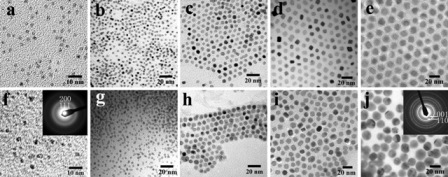
Direct
evidences for the size-dependent chemical ordering and magnetic ordering in L10
FePt nanoparticles have been obtained by measuring the monodisperse
nanoparticles prepared by the salt-matrix annealing technique. Quantitative
correlations between particle size and the structural and magnetic properties
show that the long-range chemical ordering parameter S, Curie temperature
and saturated magnetization drop significantly with decreasing particle
size d.
Advanced Materials, 18, 2984 (2006);
|
|
| |
|
| |
|
|
===============
|| Nanocomposite ||
[Index]
===============
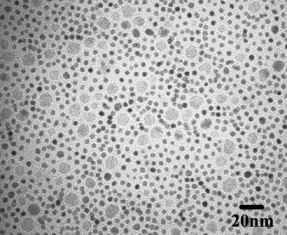
Atomic
interdiffusion between FePt and Fe3O4 nanoparticles has
been studied by means of structural and magnetic characterizations. The results
show that the Fe3Pt phase was formed during the annealing only when
the mass ratio x of Fe3O4/FePt is larger
than 1/20. When x
£
1/20,
only FePt single phase is formed.
Journal of Physics D: Applied Physics, 40, 712 (2007)
|
 |
|
| |
|
|
=============================
|| Extraordinary MagnetoResistance ||
[Index]
=============================
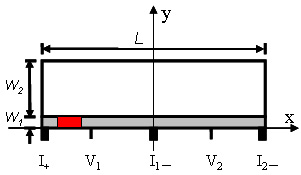
Designed a modified semiconductor-metal hybrid
device with IVIVI configuration. In this device, applied magnetic field can lead
to the current redistribution between the two output current leads. The change
of the output currents reaches 62.4% under magnetic field 5 T.
Appl. Phys. Lett. 89, 052503 (2006)
J. Magn. Magn. Mater., 301,407, (2006)
|
 |
|
| |
|
|
=============================
|| High-temperature SmCo magnets ||
[Index]
=============================
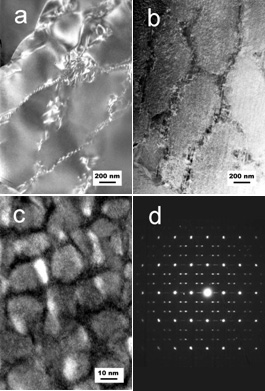
Studied the temperature dependence of coercivity
of RE(Co,Cu,Fe,Zr)z (RE=Gd,Sm) magnets, including compositional and annealing
effects. Coercivity mechanism of the precipitation-hardened RE(Co,Fe,Cu,Zr)z
high-temperature magnets was found to vary with temperature. It is found that
the anomalous Hc(T) near Tc of the 1:5 phase is caused by the fast drop of
intergranular exchange coupling. This mechanism can also explain the coercivity
behavior that the anomalous Hc(T) tends to disappear with increasing z-value.
Appl. Phys. Lett., 88, 042504, (2006).;
J. Phys. D: Appl. Phys. 39, 437, (2006). ; Appl. Phys. Lett., 86, 122506, 2005
Chinese Physics., 14, 2122, 2005.;
J. Appl. Phys., 97, 33907, 2005.;
J. Magn. Magn. Mater. ,
279, 143, 2004.
J. Phys. D: Appl. Phys. 37, 3285, 2004.
|
|
 |
|
| |
|
|
========================
|| Micromagnetic Simulation ||
[Index]
========================
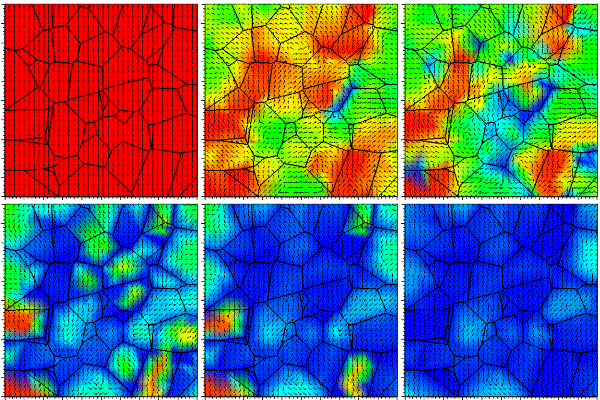
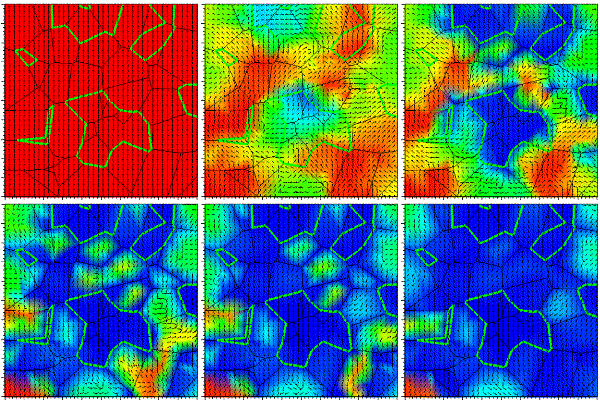
The
functions of intergrain exchange coupling and dipolar interaction on the
magnetization behavior and magnetic properties of nanocomposite magnets have
been studied by micromagnetic calculations using the finite-element method.
J. Magn. Magn. Mater., 302, 126, (2006).; J. Appl. Phys., 96, 3921, 2004; J. Magn. Magn. Mater. ,
277, 221, 2004 .
Also
the simulation is also applied to the high-temperature RE(Co,Cu,Fe,Zr)z magnets.
J. Appl. Phys., 100, 123913 (2006).;
J. Appl. Phys., 95, 1351, 2004.
|
|
| |
|
| |
|
|
======================
|| Bulk Amorphous Alloys ||
[Index]
======================
The effect of element additions on
the thermal stability of the Fe-based supercooled liquid has been studied.
Chinese Physics, 11, 77, 2002.;
Acta Physica Sinica, 50, 2235, 2001
|
|
| |
|
| |
|
| |
|
|


