
Three Generations
Michael Wong, the owner of the nearby Lun Fat Produce Co., has lived in Tai Tung for 20 years. He started out paying a subsidized rate for his apartment but must now pay market rate because his income has gradually risen. He says he continues to live here because the complex is so close to his business.
Wong estimates that a high percentage of Tai Tung residents have at one time or another worked in restaurants. While their American-born children prefer to speak English, many of the older people continue to speak Taishanese, a Chinese dialect similar to Cantonese.
 Mother and daughter crossing a bridge at Tai Tung Village.. |
Between 800 and 900 people live in the 25-year old housing complex. "Most of them know each other," says Wong. In the evening "the old folks come down and sit ... This project is very successful."
Last year the Chinese Consolidated Benevolent Association (CCBA) purchased the complex from Tai Tung Apartments Co., a real estate limited partnership managed by the Boston Financial Group.
A group of Tai Tung tenants had asked CCBA to purchase the building because they were afraid the Chinese community would eventually lose control of the complex once a federal Department of Housing and Urban Development (HUD) mortgage expired in the year 2014. At that time CCBA would no longer have the option to buy the building.
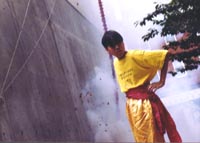 A firecracker display to celebrate the sale of Tai Tung Village to the Benevolent Association. |
There was, however, some controversy surrounding CCBA's purchase of Tai Tung, in part because the HUD mortgage wasn't scheduled to expire for another 20 years. CCBA also bought the building with rental money from a building it controls at 50 Herald St. That building was given to the CCBA on behalf of the Chinese community and was meant to be used to create "new" community housing. Although Tai Tung Village is housing, it's not "new" housing, critics of the deal say.
Three Generations
On an upper floor of Tai Tung Village, Fut Gee Moy sits with his mother in the living room of her one-bedroom apartment. His mother has lived in the building since the day it opened in 1973.
Moy, who immigrated from mainland China in the 1980s, lives with his wife upstairs. His son, a student at Cornell University, also lives here when he's not away at school.
Before he immigrated to the US 14 years ago, Moy was a teacher in China. But once in the US he had no choice but to become a restaurant worker.
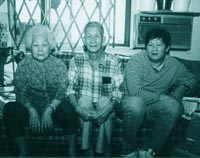 .Chun Yuen Mak and Kan Ho Mak sit with their visiting son in their Tai Tung apartment. |
In a nearby apartment, Chun Yuen Mak and Kan Ho Mak sit with their son, daughter-in-law and granddaughter in the living room of their apartment. The granddaughter says her family lives in North Quincy but regularly makes the trip into the city to visit her grandparents.
The apartment's sunny living room has a spectacular view of the expressway and the South End. Family photographs are displayed on a shelf and a small ancestral shrine is attached to the wall above the kitchen table.
A retired restaurant worker, Mak has few complaints about Tai Tung Village. It's safe and well-managed, he says, though he'd like to see his subsidized $290 rent drop a bit now that CCBA has purchased the building.
Former Boston School Committee member Robert Guen points out that Tai Tung Village is a model for how city apartment buildings should be run. While there have been some breaking and entering and some robberies in the parking lot and on the elevator, he says, crime at the complex hasn't been a serious problem.
There are no gangs hanging around the building and no graffiti on the walls, says Guen. The Chinese community "polices itself well," he adds.
"These kids are a gem," he says. "Our young people are overall a credit to the community."
"You don't have a sense of danger or dread" at Tai Tung Village, he says. By any standard it's a good place to live, though not because "the government" or some "bureaucrats" make it that way.
"It's more the community itself," he says. "There's a certain degree of respect there."
Guen says he once walked through the complex with former Boston Redevelopment Authority director Ted Chandler, who was impressed by the condition of the complex.
"Here was a housing project in the midst of an urban area and there was no sign of graffiti," says Guen.
| Introduction |