
Getting Along
When Fannie Kwan walks through the Tai Tung courtyard, she inevitably runs into someone she knows. Everybody at Tai Tung Village seems to know Fannie. As manager of the complex for Boston Financial Management, Kwan is responsible for keeping Tai Tung in good working order, says Michael Wong, the chairman of the Tai Tung Tenants Association.
Kwan has been managing the building since 1978. At one time she also lived here. Overseeing Tai Tung over the years she has had the chance to watch the Chinatown community grow and change.
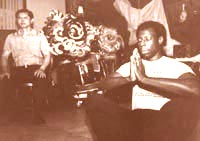 Kung Fu student Eddie Watkins (right) with his master in a Tai Tung Village martial arts club. |
"The community has become more modern," she says. "The attitude of the more recent immigrants is different from that of earlier generations."
"We were brought up differently, more disciplined," she says of the older generation. "They (the young) don't have the same feeling ... they take everything for granted."
If some of the young people can't speak English they quickly give up, she says. They believe they don't have to speak English to survive here because they can always live in Chinatown where everyone speaks Chinese.
"They don't have to go through the hardships we went through," says Kwan. The new generation also has more job options than their predecessors. They are not as confined to restaurants and the closed-in world of Chinatown. They can move to the suburbs if they want. They don't have to limit themselves to Chinatown as they did in the old days.
"Our grandfathers came here mainly to make a living and sent their money back to China," she says.
Kwan grew up in a small town in rural Mississippi. Her grandfather owned a cotton farm and a grocery store. The town had just three Chinese families and they were all related. Kwan came to Boston because she wanted to see the rest of the world. "I just wanted a new life, she says.
A Hard-Working Community
While Kwan has witnessed many changes in Chinatown over the years, she says some things about the community remain constant. Hard work is still the mainstay of Chinatown life. Both parents in many Chinatown families work "to provide the best for their children," she says.
Kwan says the people who live in Tai Tung Village generally get along well with each other, though some tenants complain that more problems exist now than in the past. There are some noisy people in the development and some are not Chinese.
Like other groups in Boston, Chinese are sometimes reluctant to have people from outside their racial and ethnic group move into the neighborhood.
More than 80 percent of Tai Tung tenants are Chinese, though whites, Hispanics, and African Americans also live here now.
"Some non-Chinese have lived here a long time, over a decade, and they don't want to move," says Kwan. "It's a peaceful community."
Kwan says that when disagreements arise, she tries to sit down with the people and talk with them about their differences. "I try to work with people," she says. "Every story has two sides. You have to listen to what's going on."
Respect for the
Environment
 The Chinatown Cafe, one of Chinatown's most popular restaurants, is located in a Tai Tung Village storefront. |
Tai Tung Village is a clean housing complex without graffiti on the walls or trash on the sidewalks. The building's courtyard is like a park. On summer afternoons, children, adults, and youths coexist peacefully in the common space.
"This is their home, so they need to [keep] the place clean," says Kwan of the 214-unit complex.
While single people over the age of 62 can live here, most tenants are families or couples whose children have grown up. Many tenants have lived in the building since the 1970s and a large number continue to be employed in restaurants.
Many of the apartments are government subsidized. Under the federal Section 8 housing program, the government pays a portion of the monthly rent of low-income tenants. Sometimes tenants start out paying the subsidized rate but are eventually required to pay the market rate when their incomes rise beyond a certain level. Whether everyone actually plays by these rules is uncertain.
| Next: Three Generations |