KING COUNTY DISTRICT COURT, SOUTH DIVISION


STATE OF WASHINGTON,                          )

                                                                        )           No. CQ54646KC

                                    plaintiff,                        )

                                                                        )

            v.                                                         )           MOTION TO DISMISS COMPLAINT

                                                                        )

ROGER W. KNIGHT,                                    )

                                                                        )

                                    defendant.                    )

____________________________________)


MOTION

            Comes now ROGER W. KNIGHT, defendant, to move for dismissal of the Complaint.

INTRODUCTION

            An order to pay child support was entered in In re Marriage of Knight, King County Superior Court No. 90-3-04471-1.  The decree was entered on July 11, 1991, setting the payment rate at $851.76 per month.  This decree contains no provision for the suspension of any license upon any failure to comply.  It has not been modified since.  Declaration of Roger W. Knight in Support of Motion to Dismiss Complaint (Knight Declaration) page 1.  RCW 74.20A.320 was enacted as part of the Workfirst Act, Laws 1997 chapter 58, which became effective on July 1, 1997, subsequent to the entering of the decree.

            On September 11, 2001, the Department of Social and Health Services (DSHS), Division of Child Support (DCS) found time on that terrible day to certify the defendant as being out of compliance with a support order and by September 16, 2001 the Department of Licensing (DOL) suspended the defendant’s license.

            On January 6, 2002, the defendant found out about this suspension when the Seattle Police Department impounded his vehicle and cited him for Driving While License Suspended (DWLS), 3d degree.  On January 23, 2003, the charge was dismissed with prejudice, City of Seattle v. Knight, Seattle Municipal Court No. 415256.  Knight Declaration, page 1, and its Exhibit A.

            On January 21, 2002 and again on February 2, 2002, the Mercer Island Police Department cited Mr. Knight for DWLS, 3d degree.  The resulting two cases were joined, City of Mercer Island v. Knight, King County District Court, Bellevue Division Nos. MIC 84199 and MIC 84268.  The district court denied Mr. Knight’s motions to dismiss the complaints on the grounds that a court in a criminal DWLS case lacks the jurisdiction to consider whether the license suspension was valid, and Mr. Knight was convicted of two counts of DWLS by a jury.  Knight Declaration, page 2.

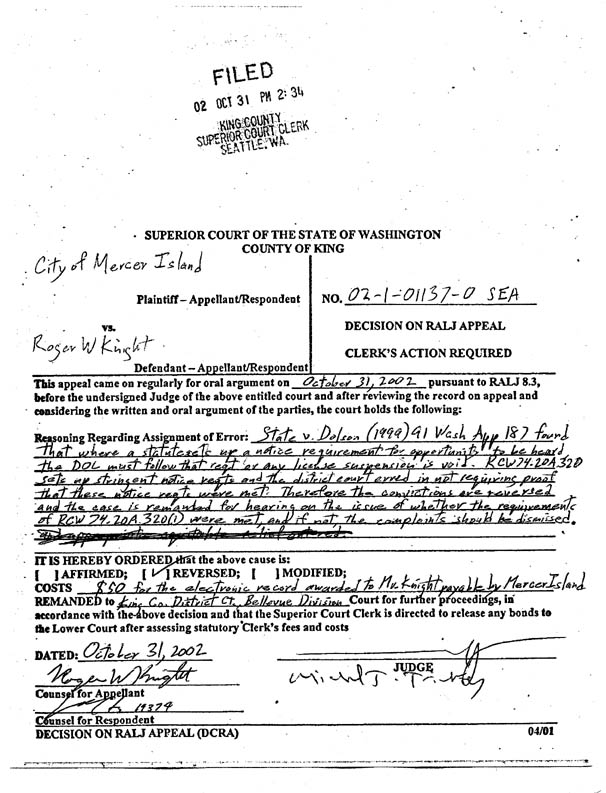
            On appeal, Judge Michael Trickey reversed the two convictions for DWLS and remanded with instructions for a hearing to determine whether notice and service required by RCW 74.20A.320(1) was successfully completed.  Without such finding, the charges were to be dismissed.  Decision on RALJ Appeal entered October 31, 2002 in City of Mercer Island v. Knight, King County Superior Court No. 02-1-01137-0 SEA.  Knight Declaration page 2 and its Exhibit B.

            On remand, on January 13, 2003, the City of Mercer Island moved for dismissal of the complaints without prejudice.  The district court granted dismissal, and granted Mr. Knight’s request that it be with prejudice.  Knight Declaration pages 2-3 and Declaration of Judith Calhoun in Support of Motion to Dismiss Complaint.

            This present case arises from an incident on November 2, 2002.

THIS COURT HAS JURISDICTION TO DETERMINE IF THE NOTICE REQUIREMENTS OF RCW 74.20A.320(1) WERE MET BEFORE THE LICENSE SUSPENSION AND IF SUCH NOTICE REQUIREMENTS WERE NOT MET, THEN TO DISMISS ALL DWLS CHARGES BASED ON SUCH SUSPENSION


            In a case where a license is suspended for child support and only for child support, the District Courts in King County are bound by the Superior Court’s determination in Mercer Island v. Knight that the prosecution must prove that prior to certification to the DOL, the DCS met the notice requirements of RCW 74.20A.320(1).  If the notice requirements are found not met, then all DWLS charges based upon such suspension must be dismissed.

            Judge Trickey found that he is bound by State v. Dolson, (1999) 138 Wash. 2d. 773, 779-780, 982 P. 2d. 100 and applied its logic to Mr. Knight’s case.

PRESENT CHARGE FOR DWLS IS DEPENDENT UPON THE VALIDITY OF THE SAME LICENSE SUSPENSION AS THREE OTHER DWLS CHARGES THAT HAVE BEEN DISMISSED WITH PREJUDICE


            The DWLS charge arising from the incident of January 6, 2001 within the City of Seattle was dismissed with prejudice.  The two DWLS charges arising from the incidents of January 21 and February 2, 2002 within the City of Mercer Island were dismissed on remand with prejudice.

            The City of Mercer Island was specifically required on remand to establish that the license was validly suspended subsequent to notice accomplished as required by RCW 74.20A.320(1) prior to the two incidents in question.  Mr. Knight attended the remand hearing on January 13, 2003 and was prepared to defend himself.  The City moved for dismissal instead and Mr. Knight requested that the dismissal be with prejudice.  The Bellevue District Court granted the dismissal with prejudice.

            No further suspension or license restoration activity was conducted by the DOL or by the DCS between September 2001 and November 2002.  No violations are proven against Mr. Knight with respect to operating a motor vehicle during that time frame.  Therefore, the present charge of DWLS is dependent upon the same suspension as the three previous charges that have been dismissed with prejudice.

            There is no basis independent of the child support issue for suspending or revoking any license held by Mr. Knight.

THE PROSECUTION IS BARRED FROM PRESENTING EVIDENCE THAT LICENSE WAS VALIDLY SUSPENDED IN SEPTEMBER 2001 BY COLLATERAL ESTOPPEL AND ISSUE PRECLUSION AS AN INTEGRAL PART OF DOUBLE JEOPARDY


            Harris v. Washington, (1971) 404 U.S. 55, 56, 30 L. Ed. 2d. 212, 92 S. Ct. 183 found:

            In Ashe v. Swenson, (1970) 397 U.S. 436, 25 L. Ed. 2d. 469, 90 S. Ct. 1189, we held that collateral estoppel in criminal trials is an integral part of the protection against double jeopardy guaranteed by the Fifth and Fourteenth Amendments.  See Benton v. Maryland, (1969) 395 U.S. 784, 23 L. Ed. 2d. 707, 89 S. Ct. 2056.  We said that collateral estoppel “means simply that when an issue of ultimate fact has once been determined by a valid and final judgment, that issue cannot again be litigated between the same parties in any future lawsuit.” 397 U.S., at 443.  The State concedes that the ultimate issue of identity was decided by the jury in the first trial.  That being so, the constitutional guarantee applies, irrespective of whether the jury considered all relevant evidence, and irrespective of whether the State acted in good faith in bringing successive prosecutions.


Ashe and Benton established and reaffirmed that the Fifth Amendment Double Jeopardy Clause was incorporated upon the States by the Fourteenth Amendment.

            State v. Tili, (2003) 149 Wash. 2d. 350, 360-361, citing State v. Peele, (1968) 75 Wash. 2d. 28, 30, 448 P. 2d. 923 reaffirmed that collateral estoppel applies to criminal cases.  Tili and Peele adopted the four criteria for collateral estoppel set forth in Rains v. State, (1983) 100 Wash. 2d. 660, 665, 674 P. 2d. 165:

      The doctrine of collateral estoppel differs from res judicata in that, instead of preventing a second assertion of the same claim or cause of action, it prevents a second litigation of issues between the parties, even though a different claim or cause of action is asserted.

Seattle-First Nat’l Bank v. Kawachi, 91 Wn. 2d 223, 225-26, 588 P. 2d 725 (1978).  The Court of Appeals in Seattle-First Nat’l Bank v. Cannon, 26 Wn. App. 922, 927, 615 P.2d 1316 (1980) (quoting Lucas v. Velikanje, 2 Wn. App. 888, 894, 471 P. 2d 103 (1970)) stated:

Affirmative answers must be given to the following questions before collateral estoppel is applicable:

(1) Was the issue decided in the prior adjudication identical with the one presented in the action in question? (2) Was there a final judgment on the merits? (3) Was the party against whom the plea is asserted a party or in privity with a party to the prior adjudication? (4) Will the application of the doctrine not work an injustice on the party against whom the doctrine is to be applied?


Shuman v. Dept. of Licensing, (2001) 108 Wash. App. 673, 677-678, 32 P. 2d. 1011 found:

A party seeking to invoke the doctrine of collateral estoppel must prove: '(1) the issue decided in the prior adjudication is identical with the one presented in the second action; (2) the prior adjudication must have ended in a final judgment on the merits; (3) the party against whom the plea is asserted was a party or in privity with the party to the prior adjudication; and (4) application of the doctrine does not work an injustice.' Thompson v. Dep't of Licensing, 138 Wn.2d 783, 790, 982 P.2d 601 (1999).


The focus of the dispute in Shuman is the fourth element, whether the application of the doctrine works an injustice.  Mr. Shuman argued, through attorney Kenneth D. Beckley, that because the prosecution had a full and fair opportunity to present the case that he refused a breath test in a previous criminal proceeding for driving while under the influence (DUI), and because the officer involved in the breath test did not appear to give testimony resulting in an order prohibiting the City of Cle Elum from alleging that he refused the breath test, the DOL was collaterally estopped from revoking his license on the basis of his alleged refusal of the breath test.  The DOL made the argument that because the issue was not fully litigated in the criminal proceeding, collateral estoppel did not apply even thought the OPPORTUNITY to litigate the issue was there for Cle Elum.  The DOL relied on In re Marriage of Murphy, (1998) 90 Wash. App. 488, 952 P. 2d. 624, in which the Washington court declined to give preclusive effect to an agreed Ohio divorce decree.  However, the precise issue in Murphy was whether the Ohio court had acquired subject-matter jurisdiction, which may not be acquired by agreement or stipulation (other issues may be decided by such means, see below).  The refusal to give collateral estoppel was based on an absence in the record that this issue of jurisdiction had actually been fully and fairly litigated, and finally decided.  Murphy at 90 Wash. App. 498 and Shuman at 108 Wash. App. 680-681.

            At 108 Wash. App. 680, the Shuman Court found that in Hanson v. City of Snohomish, (1993) 121 Wash. 2d. 552, 561, 852 P. 2d. 295 and Barlindal v. City of Bonney Lake, (1996) 84 Wash. App. 135, 142, 925 P. 2d. 1289, the prior rulings were the result of actually contested hearings as part of the criminal proceedings. Therefore, neither of these decisions directly supports the proposition that an OPPORTUNITY to contest an issue is enough to invoke collateral estoppel.

            But Mr. Shuman cited Miles v. Child Protective Services Department, (2000) 102 Wash. App. 142, 153, 6 P. 3d. 112, review denied, (2001) 142 Wash. 2d. 1021 where the court held that an agreed order of dependency, which amounted to a finding that the children were abused or neglected, estopped the parents from relitigating such issues in a subsequent civil action.  At 108 Wash. App. 681-682, the Court of Appeals found:

The Department contends Miles is distinguishable because in this case there were no findings or conclusions and it is unclear precisely what happened in the district court.  But the Department nay not have it both ways; either the suppression order was agreed or otherwise uncontested (in which case Miles applies) or it was contested (in which case Thompson, Hanson, and Barlindal apply).

            As Professor Trautman has noted, the requirement that an issue must have been “actually litigated” in the prior case is not as clear as it may appear.  Philip A. Trautman, Claim and Issue Preclusion in Civil Litigation in Washington, 60 Wash. L. Rev. 805, 833 (1985).  More useful that Thompson’s litigation morass is an examination into

whether the issue was actually recognized by the parties as important and by the judge as necessary to the first judgment.  If so, the determination should be conclusive, with an important qualification being whether the significance of the issue for purposes of the subsequent action was sufficiently foreseeable at the time of the first action.

Id. at 835.

            This formulation is consistent with our decision in Murphy, in which there was no showing that the Ohio court or the parties considered subject-matter jurisdiction to be an issue.

            Here, although the reasons for its decision are not clear from the record, the district court and the parties clearly recognized that the circumstances of Mr. Shuman’s breath test were important and necessary to the criminal litigation.  No more should be required.

            Indeed, requiring more would be an injustice to Mr. Shuman, who undeniably would be entitled to the benefit of collateral estoppel under Thompson it the court had conducted a full-blown evidentiary hearing on the issue.  This injustice is recognized in the res judicata context, in which courts must respect “the convenience of the defendant addressing the merits of the case on multiple occasions.” Wagner v. McDonald, 10 Wn. App. 213, 218, 516 P. 2d 1051 (1973).  Mr. Shuman appeared in district court, ready to address the merits of his case.

            The result should be binding on the City of Cle Elum and other parties in privity, whatever the reasons for the prosecutor’s failure or inability to present a case.


and thereby established that OPPORTUNITY on the part of a prosecutor to contest an issue, where it is recognized by the parties and by the courts that the issue is necessary to the proceeding at hand, is sufficient to invoke collateral estoppel without working an injustice.

            In the present case, the prosecution is alleging a crime of DWLS on November 2, 2002.  There are two elements of this crime both of which have to be proven for there to be a conviction: 1) that the defendant operated a motor vehicle, and 2) that the license was validly suspended at the time the motor vehicle was operated.  If either of these elements was previously litigated in a case that was dismissed with prejudice, wherein the prosecution had a full and fair opportunity to litigate the issue, then such element cannot be relitigated in this present case.

            In Mercer Island v. Knight, the prosecution alleged two crimes of DWLS, on January 21 and February 2, 2002.  The issue of whether Mr. Knight operated a motor vehicle on each of those two days is clearly a separate issue than whether he operated a motor vehicle on November 2, 2002, and thus would not preclude the charge in this present case.  But the issue of whether his license was validly suspended was litigated, with the City of Mercer Island dropping the charges when it was required to prove that notice required by RCW 74.20A.320(1) was accomplished, to prove the element of license suspension.  There is no question that this issue was recognized by the parties as important to the criminal litigation, and recognized by the courts on appeal and on remand.  Mercer Island had from October 31, 2002 through to January 13, 2003 to obtain the necessary evidence of notice and to prepare to present it on remand.  Mr. Knight was present in court on January 13, 2003 and fully prepared to represent himself in litigating the matter.  Therefore under Shuman, Mercer Island’s decision to drop the case and the Bellevue District Court’s decision to grant Mr. Knight’s request that the dismissal be with prejudice is conclusive.

            This issue is identical to the issue of valid license suspension in this present case, as no further license suspension or restoration activity was engaged in by the DCS or the DOL between September 2001 and November 2002.  Mercer Island had an unencumbered, full and fair opportunity to litigate this issue.  With these previous charges dismissed with prejudice, as such is a final judgment on the merits, the doctrine of collateral estoppel bars relitigation of the issue of whether notice required by RCW 74.20A.320(1) was accomplished prior to the license suspension.

            While the prosecution in this present case is not the City of Mercer Island, it is clearly in privity with Mercer Island, as Mercer Island was as dependent upon the actions of the DSHS and the DOL to establish the element of valid license suspension as is the prosecutor in this present case.  Had there been no incorporated City of Mercer Island, then the King County Prosecutor would have been the office to bring the charge and the State of Washington would have been the named plaintiff, as they are in this present case, arising from an incident on unincorporated land between the City of Federal Way and the City of Auburn.  In both cases, the prosecution was bringing a criminal charge for a violation of Washington law, not of a local ordinance.  Rains at 100 Wash. 2d. 665-666 found:

A substitution of parties who are qualitatively the same does not lessen the equivalency of the issues. 

And Rains found at 100 Wash. 2d. 664-665:

            Plaintiff claims the parties and their quality were not the same since Quast as a member of the PDC was not authorized to act on behalf of the State and the State, under the Eleventh Amendment, is immune from suit in federal court.  The parties, although somewhat differently named on the complaints, were “qualitatively” the same.  A suit against members of the PDC is in effect, a suit against the State.  As the federal district court held, there were no violations of the plaintiff’s rights “by the state’s action”.  “Identity of the parties is not a mere matter of form, but of substance . . . [P]arties nominally different may be, in legal effect, the same.”


The prosecution in this present case is qualitatively the same as the City of Mercer Island.  The issue of whether notice required by RCW 74.20A.320(1) was accomplished before the license suspension is identical in this present case and in Mercer Island v. Knight.  As the prosecution is barred by collateral estoppel from presenting this issue without working an injustice, it cannot prove a necessary element of the crime of DWLS: valid license suspension.  King County Superior Court has ruled that this element must be proven and this ruling is binding on the district courts in King County.

            The interest expressed in the doctrines of res judicata, collateral estoppel, and by the constitutional prohibition of double jeopardy is served by not requiring Mr. Knight to repeatedly litigate the same issue.

            Therefore the Complaint should be dismissed.

CRIMINAL RULE 4.3(c) ALSO BARS THIS PROSECUTION

            State v. Dixon, (1985) 42 Wash. App. 315, 711 P. 2d. 1046 found that CrR 4.3(c) prohibited a prosecution for felon in possession of a firearm subsequent to a dismissal of a charge of aiming or discharging the firearm.  The two charges arose from the same incident and each crime requires proof of a common element: possession.  One cannot aim or discharge a firearm if one does not possess it.

            The present case arises from an incident separate from the Mercer Island incidents, however, it is dependent upon a common element: validity of license suspension based on accomplishment of notice required by RCW 74.20A.320(1).  Therefore, these are related offenses.  As to the rationale of issue preclusion, Dixon found at 42 Wash. App. 318-319:

            The rationale of “issue preclusion” underlying the mandatory joinder rule, State v. Russell, supra, also supports the conclusion that Dixon had been tried on the misdemeanor charge.  The doctrine of issue preclusion “seeks to prevent relitigation of previously determined issues between the same parties, to promote judicial economy, and to prevent harassment of and inconvenience to litigants.”  Malland v. Department of Retirement Sys., 103 Wn.2d 484, 694 P.2d 16 (1985).  The State does not, nor could it reasonably, argue that it was unaware of the facts constituting the felony offense or did not have sufficient evidence to warrant trying this offense at the time of the misdemeanor trial.  . . .

            Finally, we note that it is more important that the offenses are “related” under the rule than that the defendant was “tried” for the earlier offense.  State v. Russell, supra at 353.  There is no dispute that these are related offenses.  Furthermore, we do not see how the ends of justice will be defeated by a dismissal of the felony charge.


            CrR 4.3(c) precludes this prosecution.

CONCLUSION

            For the reasons stated herein, this Motion should be granted and the Complaint should be dismissed.

            Respectfully submitted this 6th day of November, 2003.


                                                                        __________________________

                                                                        Roger W. Knight, pro se

If the back button does not take you there, click Home to go to the Index page of this Antipeonage Act Website, click Enemies for the main Enemies page, click Letters for the Letters page, and click Allies for the Allies page.  Click CQ54646KC to get to the main page for this case.  Or you can use the Antipeonage Act Site Map.
Hosted by www.Geocities.ws

1