Action below is a suit for relief under 42 U.S.C. §1983. District Court had subject matter jurisdiction provided by 42 U.S.C. §1983, for enforcement of civil rights by 28 U.S.C. §1343(a)(3) and (4), and for federal question by 28 U.S.C. §1331.
The Order, Document No. 33, ER 7, dismissing Roger W. Knight’s complaint on summary judgment, and the Judgment, Document No. 34, ER 6, were filed on July 7, 2000. The Judgment is the final disposition of the case in district court. This court therefore has jurisdiction to hear this appeal under 28 U.S.C. §1291. The Notice of Appeal, Document No. 35, ER 1, was filed on July 17, 2000, less than thirty days after the entry of the Judgment. This appeal is timely under FRAP 4(a)(1).
II. STATEMENT OF THE ISSUES PRESENTED FOR REVIEW
Was the district court in error in granting the appellees’ cross motion for summary judgment dismissing the complaint that state court contempt proceedings to coerce employment to pay child support violated the Antipeonage Act, 18 U.S.C. §1581 and 42 U.S.C. §1994 and that it violated the Thirteenth Amendment while denying Mr. Knight’s motion for summary judgment that it did?
Does Younger abstention doctrine preclude litigation of this case in federal court pending exhaustion of remedies in state court?
Does res judicata, collateral estoppel, claim preclusion, or any other such doctrine bar litigation of this case?
III. REVIEWABILITY AND STANDARD FOR REVIEW
A dismissal on summary judgment is reviewed de novo, Hiser v. Franklin, (9th Cir. 1996) 82 F. 3d. 869, 871.
IV. STATEMENT OF THE CASE
On January 30, 2000 papers related to the appellees’ prosecution of Roger W. Knight for contempt for nonpayment of child support were served upon Mr. Knight. These papers, ER 32-65, are attached as exhibits to the Declaration of Roger W. Knight (Knight Declaration I), Document No. 4, ER 30-65.
On February 1, 2000, Roger W. Knight filed the Complaint, Document No. 1, and his Motion for Preliminary Injunction, Document No. 2.
On February 16, 2000 Judge Thomas S. Zilly referred the case to Magistrate Judge Ricardo Martinez, Document No. 9.
On March 2, 2000 Magistrate Judge Martinez filed his Report and Recommendation with respect to the Motion for Preliminary Injunction, Document No. 17, ER 12-14.
On March 6, 2000 Mr. Knight filed his Plaintiff’s Objections to Report and Recommendation, Document No. 18.
On March 31, 2000 Judge Zilly entered his Order, Document No. 20, ER 11 denying Mr. Knight’s Motion for Preliminary Injunction.
On April 6, 2000 Mr. Knight filed his Motion for Summary Judgment, Document No. 23.
On April 21, 2000 Appellees Norm Maleng and Calvin G. Rapada filed their King County Defendants’ Response to Motion for Summary Judgment, Document No. 26. On page 1 of this Response, is a request “that plaintiff’s motion for summary judgment be denied and that this entire action be dismissed with prejudice.”
On May 24, 2000 Magistrate Judge Martinez filed his Report and Recommendation with respect to the cross motions for summary judgment, Document No. 30, ER 8-10.
On June 1, 2000 Mr. Knight filed his Plaintiff’s Objections to Report and Recommendation on Motions for Summary Judgment, Document No. 31.
On July 7, 2000 Judge Zilly entered his Order, Document No. 33, ER 7 denying Mr. Knight’s Motion for Summary Judgment and granting the appellees’ cross motion for summary judgment dismissing the case.
On July 7, 2000 the district court entered the Judgment, Document No. 34, ER 6.
On July 17, 2000 Mr. Knight filed the Notice of Appeal, Document No. 35, ER 1.
V. ARGUMENT
A. No Genuine Issue of Material Fact
The facts material to this case are established in the four Declarations of Roger W. Knight and their attached exhibits, Documents Nos. 4, 12, 16, and 21, ER 12-65. Mr. Knight was prosecuted by Mr. Maleng and Mr. Rapada for contempt for nonpayment of support, the appellant was imprisoned pursuant to such contempt proceeding, and he lacks wealth sufficient to comply with the support order without employment. The appellees do not dispute any of these facts and do not deny that the purpose of their prosecution effort is to coerce Mr. Knight’s employment to pay child support. Instead, they assert that “child support falls within the narrow class of obligations that may be enforced by means of imprisonment without violating constitutional prohibition of slavery”, King County Defendants’ Response to Motion for Preliminary Injunction, Document No. 10, pages 4-7.[1]
Therefore, summary judgment was appropriate pursuant to the standards set forth in Reeves v. Sanderson Plumbing Prod., Inc., (2000) 147 L. Ed. 2d. 105, 120 S. Ct. 2097, 2110; Anderson v. Liberty Lobby, Inc., (1986) 477 U.S. 242, 91 L. Ed. 2d. 202, 106 S. Ct. 2505; Celotex Corp. v. Catrett, (1985) 477 U.S. 317, 322-323, 91 L. Ed. 2d. 265, 106 S. Ct. 2548; and Adickes v. S.H. Kress & Co., (1970) 398 U.S. 144, 158-159, 26 L. Ed. 2d. 142, 90 S. Ct. 1598. Reeves at 120 S. Ct. 2110 found that the standard applies to motions for judgment as a matter of law as well as for summary judgment. See also Weisgram v. Marley Co., (2000) 145 L. Ed. 2d. 958, 120 S. Ct. 1011, 1021-1022. Motions to dismiss are ordinarily disfavored, doubts should be resolved in favor of plaintiff. Williams v. Gorton, (9th Cir. 1976) 529 F. 2d. 668, 672. The genuine issue of material fact standard applies to motions to dismiss, however they are characterized by the moving party. Once genuine issues of material fact are resolved, then the matter is whether the district court applied the relevant substantive law. Jones v. Union Pacific R.R. Co., (9th Cir. 1992) 968 F. 2d. 937, 940. That is what is at issue in this appeal.
B. Antipeonage Act Applies to Child Support
A starting point in the rules of statutory construction is the assumption that Congress knew what it was doing when it passed a bill and the President knew what he was doing when he signed it into law. The Supreme Court found that:
“Our task is to give effect to the will of Congress, and where its will has been expressed in reasonably plain terms, that language must ordinarily be regarded as conclusive.”
Negronsott v. Samuels, (1993) 507 U.S. 99, 104, 122 L. Ed. 2d. 457, 113 S. Ct. 1119, (internal quotation marks omitted) quoting Griffin v. Oceanic Contractors, Inc., (1982) 458 U.S. 564, 570, 73 L. Ed. 2d. 973, 102 S. Ct. 3245. Griffin in turn quoted Consumer Product Safety Commission v. GTE Sylvania, (1980) 447 U.S. 102, 108, 64 L. Ed. 2d. 766, 100 S. Ct. 2051. The GTE Sylvania court specifically found that:
We begin with the familiar canon of statutory construction that the starting point for interpreting a statute is the language of the statute itself. Absent a clearly expressed legislative intention to the contrary, that language must ordinarily be regarded as conclusive.
The Antipeonage Act, passed in 1867 as appropriate legislation to enforce the Thirteenth Amendment, survives in 18 U.S.C. §1581 and 42 U.S.C. §1994. 42 U.S.C. §1994 reads:
The holding of any person to service or labor under the system known as peonage is abolished and forever prohibited in any Territory or State of the United States; and all acts, laws, resolutions, orders, regulations or usages of any Territory or State, which have heretofore established, maintained, or enforced, or by virtue of which any attempt shall hereafter be made to establish, maintain, or enforce, directly or indirectly, the voluntary or involuntary service or labor of any persons as peons, in liquidation of any debt or obligation, or otherwise, are declared null and void.
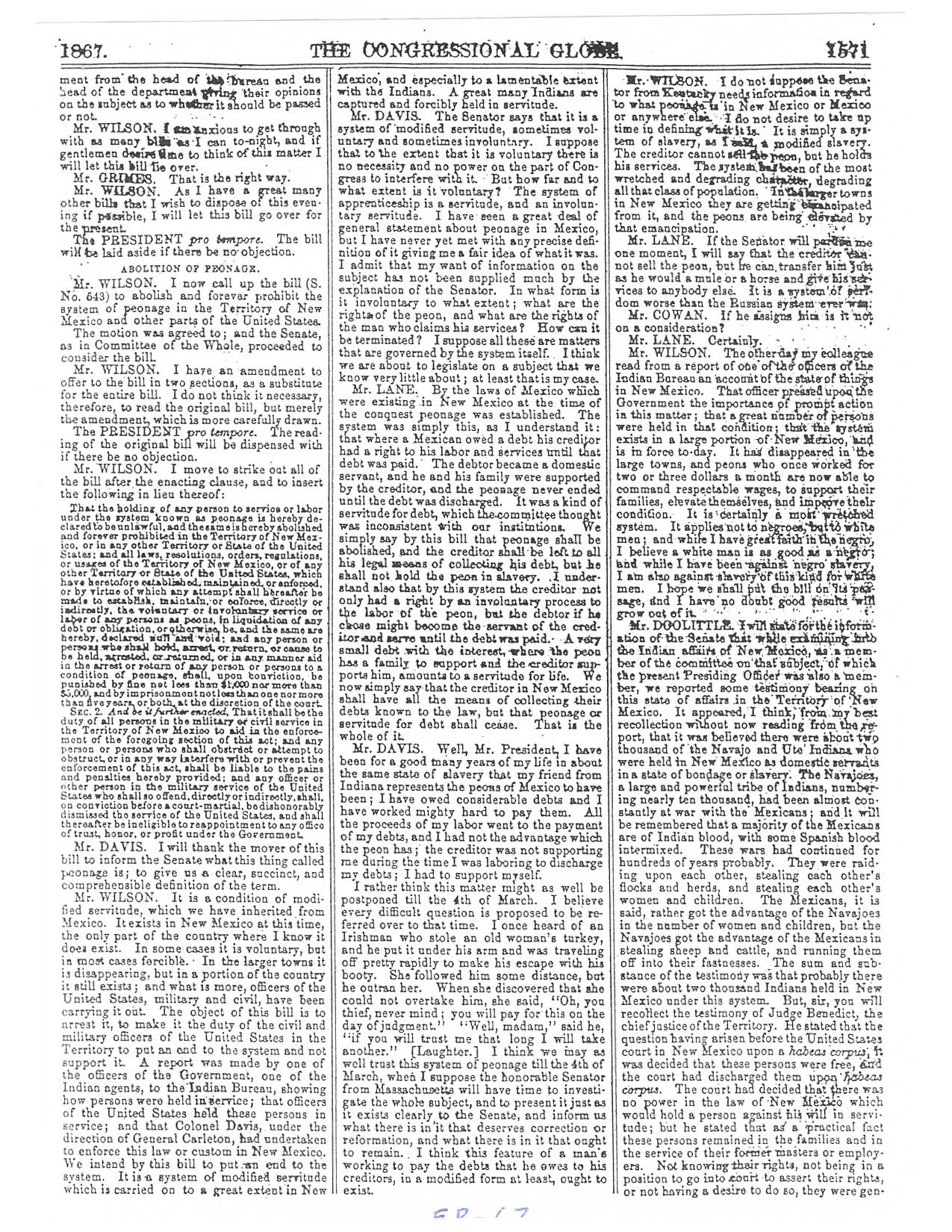
This provides a civil right enforceable under 42 U.S.C. §1983, originally passed in 1871. That Congress very clearly intended to prohibit the involuntary service or labor of any peon in liquidation of any obligation to provide support for his family is proved beyond reasonable doubt by Senator Lane’s speech on the Peonage Bill:
By the laws of Mexico which were existing in New Mexico at the time of the conquest peonage was established. The system was simply this, as I understand it: that where a Mexican owed a debt his creditor had a right to his labor and services until that debt was paid. The debtor became a domestic servant, and he and his family were supported by the creditor, and the peonage never ended until the debt was discharged. It was a kind of servitude for debt, which the committee thought was inconsistent with our institutions. We simply say by this bill that peonage shall be abolished, and the creditor shall be left to all his legal means of collecting his debt, but he shall not hold the peon in slavery. I understand also that by this system the creditor not only had a right by an involuntary process to the labor of the peon, but the debtor if he chose might become the servant of the creditor and serve until the debt is paid. A very small debt with the interest, where the peon has a family to support and the creditor supports him, amounts to servitude for life. We now simply say that the creditor in New Mexico shall have all the means of collecting their debts known to law, but that peonage or servitude for debt shall cease. That is the whole of it.
Congressional Globe, 39th Cong. 2d. Sess. p. 1571, ER 67.
“where the peon has a family to support and the creditor supports him, amounts to servitude for life.” That is an accurate description of a child support order. A father is deprived of custody of his child, the child is supported by someone else, either the mother or a government agency spending the taxpayer’s money, and he is thus held in servitude for life.[2]
The Vagrancy Act of 1860, then in force in New Mexico Territory, included within its definitions of vagrants “Persons who shall have abandoned their families, leaving them without the means of their support”.[3] When a person was convicted of vagrancy in a New Mexican court, the sentence usually included a stiff fine that was paid by a wealthy person, who then owned the labor of the convicted vagrant. This is what is meant by the phrase: “and in case he shall be sold as hereinafter provided.” The convicted vagrant became a peon to the master who paid the fine. It was used as a means to enforce child support obligations of parents with and without custody of their children, whether they were married to each other or not, whether they were divorced or not.
42 U.S.C. §1994 is based upon the language of the first clause of the original 1867 Act, 14 Stat 546. Section 1 of the original statute read:
Be it enacted by the Senate and House of Representatives of the United States of America in Congress assembled, That the holding of any person to service or labor under the system known as peonage is hereby declared to be unlawful, and the same is hereby abolished and forever prohibited in the Territory of New Mexico, or in any other Territory or State of the United States and all acts, laws, resolutions, orders, regulations, or usages of the Territory of New Mexico, or of any other Territory or State of the United States, which have heretofore established, maintained, or enforced, or by virtue of which any attempt shall hereafter be made to establish. maintain, or enforce, directly or indirectly, the voluntary or involuntary service or labor of any persons as peons, in liquidation of any debt or obligation, or otherwise, be, and the same are hereby, declared null and void; and any person or persons who shall hold, arrest, or return, or cause to be held, arrested, or returned, or in any manner aid in the arrest or return of any person or persons to a condition of peonage, shall, upon conviction, be punished by fine not less than one thousand nor more than five thousand dollars, or by imprisonment not less than one nor more than five years, or both, at the discretion of the court.
Since 1867, the changes to the Antipeonage Act consist of changes to the criminal provision, now 18 U.S.C. §1581, as to sentencing and punishment, but there has been no change as to what it prohibits and declares null and void.
The language “any debt or obligation, or otherwise” includes the duty to support one’s family. Congress knew about the obligation,[4] commented upon how peonage affected the peon with a family to support, and the fact that the New Mexican system was used to enforce the duty to support the family, by parents with and without custody of their children, whether married to each other or not. The 1867 Congress knew that for the Thirteenth Amendment to be effective, its protection must not be denied to the majority of the adult population that has children to support, and it must not be denied to those with debts and obligations other than children.
The language of 42 U.S.C. §1994 is expressed in plain terms, clearly designed to cover loopholes and to not allow exceptions, and must be considered conclusive. It has not been significantly altered since 1867. The legislative history of the 1860’s is the legislative history that is relevant to the statute. Subsequent legislative history is of little value in the construction of a statute. In GTE Sylvania, supra, at 447 U.S. 108, the Supreme Court found:
Although there is some support for petitioners’ interpretations of §6(b)(1) in legislative history contained in a Conference Report four years after the enactment of that section, . . . we agree with the Court of Appeals’ determination that “legislative history” of this sort cannot be viewed as controlling.
That means that subsequent Acts of Congress that pertain to child support are not relevant to the meaning and the Congressional intent of this statute.
The Antipeonage Act is the first in a long series of Acts of Congress intended to protect the rights of working people. This 1867 Act for the first time provided that every employee can tell his employer, “I quit. I’ll try to pay my debts to you, but if I am unable, then you will just have to write them off.” The immediate improvement in labor relations is the incentive employers had to treat their workers well enough to keep them from quitting, and to get them to accept offers of employment. No longer could an employer legally go to the county courthouse and purchase labor from convicted vagrants. The next improvement is the rise of unions and collective bargaining. The right to strike originated in the Antipeonage Act. Peons did not have that right.
With respect to statutes passed to enforce civil rights and the rights of working people, this Court found in Lambert v. Ackerley, (9th Cir. 1999) 180 F. 3d. 997, 1003, cert. den. 145 L. Ed. 2d. 814, 120 S. Ct. 936:
Over fifty years ago, the Supreme Court determined the approach that must be followed in construing the provisions of the Fair Labor Standards Act. A number of the other circuits have explicitly followed that approach. It is a simple one, often used in construing statutes designed to protect individual rights. In Tennessee Coal, Iron & R. Co. v. Muscoda Local No. 123, 321 U.S. 590, 597, 64 S. Ct. 698, 88 L. Ed. 949 (1944), the Court explained that because the FLSA is a remedial statute, it must be interpreted broadly. As the Tennessee Coal Court wrote:
[The FLSA is] remedial and humanitarian in purpose. We are not here dealing with mere chattels or articles of trade but with the rights of those who toil. . . Those are rights that Congress has specifically legislated to protect. Such a statute must not be interpreted or applied in a narrow, grudging manner
Bold face emphasis added. As the FLSA must be interpreted broadly, so must the Antipeonage Act, which is a remedial statute designed by Congress to protect individual rights.
To prevent American capitalism from the degenerating to the condition of exploitation of labor at the lowest possible wages and worst possible conditions, subsequent remedial Acts of Congress have been passed to make American capitalism work. The Fair Labor Standards Act, (FLSA) 29 U.S.C. §§201-219. The Rehabilitation Act, 29 U.S.C. §§701 et seq. The Americans with Disabilities Act, (ADA) 42 U.S.C. §§12101-12213. The Civil Rights Act of 1964, 42 U.S.C. §2000. The Family Medical Leave Act, (FMLA) 29 U.S.C. §§2601-2654. And the Employee Retirement Income Security Act, (ERISA) 29 U.S.C. §§1001-1461. Every one of these laws is construed in a manner to best protect the interests of the working people they are intended to protect. Even so, what Congress specifically left in and what Congress specifically left out guides how the courts interpret these laws and what rights the courts enforce.
With the FMLA, Brown v. JC Penney Corp., (S.D. Fla. 1996) 924 F. Supp. 1158, 1162 found that the statute, 29 U.S.C. §2611(11) did not define “serious health condition” as continuing after death:
Put simply, if Congress wanted to ensure that employees on FMLA leave could take additional time off after a family member died from a serious health condition, it could easily have said so in the statute.
If Congress wanted to exclude child support from the Antipeonage Act, it could have easily said so in the statute.
With the FLSA, Arnold v. Kanowski, Inc. (1960) 361 U.S. 388, 4 L. Ed. 2d. 393, 80 S. Ct. 453, found that the then existing (since repealed) 29 U.S.C. §213(a)(2) and (4) which defined retail or service establishments exempt from the requirements of the wage and hour law, an aircraft parts manufacturer could not qualify for the exemption because it could not prove that at least 75% of its aircraft parts were sold retail, as required by the plain language of the statute.
Mitchell v. Kentucky Finance Co., (1959) 359 U.S. 290, 293, 3 L. Ed. 2d. 815, 79 S. Ct. 756 found that debates and reports by Congress are explicit and had bearing on construction of statute. Thus Senator Lane’s remarks on peons with families to support has bearing on construction of Antipeonage Act.
Powell v. United States Cartridge Co., (1950) 339 U.S. 497, 506-511, 94 L. Ed. 1017, 70 S. Ct. 755 found that a defense contractor was an employer and its workers employees within the meaning of the FLSA, and that both engaged in production of goods for commerce within the meaning of the FLSA. Mere transportation of munitions outside the originating state, even if not for sale or exchange, but only for prosecution of war, was commerce. Reason: statutory definition of commerce includes “trade, commerce, transportation, transmission or, communication among the several States or from any State to any place outside thereof.” 29 U.S.C. §203(d).
What Congress actually writes into a statute is what guides the construction and interpretation and meaning of the statute. There is no exception, nor did Congress intend an exception, for child support in the wording and the operation of the Antipeonage Act. This was recognized in Brent Moss v. Superior Court, (1996) 56 Cal. Rptr. 2d. 864, 868-870. As found in Pollack v. Williams, (1944) 322 U.S. 4, 18, 88 L. Ed. 1095, 64 S. Ct. 792, 799:
The Antipeonage Act is a dual purpose statute. Because this statute defines any attempt by virtue of state law to establish, maintain, or enforce, directly or indirectly, the voluntary or involuntary service or labor of any persons as peons, in liquidation of any debt or obligation, or otherwise, to be null and void and denounced as a crime any such attempt, Congress thus raised both a shield and a sword against forced labor because of debt. Pollack at 322 U.S. 8.
Thus it matters not that the criminal provision, 18 U.S.C. §1581, the sword, does not by itself provide a civil right that may be enforced in an action under 42 U.S.C. §1983, see United States v. Kozminski, (1988) 487 U.S. 931, 939-941, 101 L. Ed. 2d. 788, 108 S. Ct. 2751 (finding criminal sanction of 18 U.S.C. §1584 does not provide a civil right enforceable through prosecution of conspiracy to violate civil rights under 18 U.S.C. §241, but not fatal to prosecution for conspiracy to violate Thirteenth Amendment itself which does provide a civil right). 42 U.S.C. §1994, the shield, provides the civil right.
United States v. Ballek, (9th Cir. 1999) 170 F. 3d. 871, cert. den. 145 L. Ed. 2d. 114, 120 S. Ct. 318 is thus irrelevant to the issue of whether the Antipeonage Act applies to child support. The Antipeonage Act is appropriate legislation authorized by Section 2 of the Thirteenth Amendment. Congress has the authority under the Appropriate Legislation Clauses to go beyond the protections contemplated by the Civil War Amendments to implement these Amendments: Jones v. Alfred H. Mayer, Co., (1968) 392 U.S. 409, 413, 437-444, 20 L. Ed. 2d. 1189, 88 S. Ct. 2186 and Griffin v. Breckenridge, (1971) 403 U.S. 88, 105, 29 L. Ed. 2d. 338, 91 S. Ct. 1790, Thirteenth Amendment Section 2; Katzenbach v. Morgan, (1966) 384 U.S. 641, 648-651, 16 L. Ed. 2d. 828, 86 S. Ct. 1717, Fourteenth Amendment Section 5; South Carolina v. Katzenbach, (1966) 383 U.S. 301, 15 L. Ed. 2d. 769, 86 S. Ct. 803, Fifteenth Amendment Section 2. South Carolina and Morgan cited McCulloch v. Maryland, (1819) 17 U.S. (4 Wheat.) 316, 421, 4 L. Ed. 579 in setting the limits of Congressional power to implement and enforce the Civil War Amendments:
Let the end be legitimate, let it be within the scope of the constitution, and all means which are appropriate, which are plainly adapted to the end, which are not prohibited, but consistent with the letter and the spirit of the constitution, are constitutional.
South Carolina at 383 U.S. 326 and Morgan at 384 U.S. 650 quoting McCulloch.
With 42 U.S.C. §2000d-7(a)(1) and 42 U.S.C. §12202, Congress specifically abrogated the States’ Eleventh Amendment immunity for discrimination lawsuits with the power of Section 5 of the Fourteenth Amendment. Clark v. California, (9th Cir. 1997) 123 F. 3d. 1267, 1269-70, cert. den 118 S. Ct. 2340, 141 L. Ed. 2d. 711 citing Seminole Tribe v. Florida, (1996) 517 U.S. 44, 134 L. Ed. 2d. 252, 116 S. Ct. 1114; Atascadero State Hospital v. Scanlon, (1985) 473 U.S. 234, 240-241, 87 L. Ed. 2d. 17, 105 S. Ct. 3142, and Katzenbach v. Morgan. Duffy v. Riveland, (9th Cir. 1996) 98 F. 3d. 447, 452, citing Atascadero State Hospital.
Seminole Tribe found that the Commerce Clause, Article I Section 8 clause 3 of the Constitution, did not provide Congress with the authority to abrogate States’ Eleventh Amendment immunity with respect to commerce among the several States and with the Indian Tribes.[5] The original Constitution framed at the Philadelphia Convention does not limit the power of or supersede subsequent Amendments. But subsequent Amendments can limit the power of, supersede, or even repeal previous Amendments or provisions of the original Constitution. For that reason, Atascadero State Hospital found that Section 5 of the Fourteenth Amendment provided Congress with the power to abrogate States’ Eleventh Amendment immunity, but that such abrogation must be explicitly worded and unambiguous. Presumably Congress can similarly abrogate States’ Eleventh Amendment immunity with appropriate legislation to enforce the Thirteenth and Voting Rights Amendments.
But there are limits to Appropriate Legislation power. City of Boerne v. Flores, (1997) 521 U.S. 507, 519, 138 L. Ed. 2d. 624, 117 S. Ct. 2157 found that Congress may enforce freedom of religion as incorporated upon the States by the Fourteenth Amendment, but may not redefine or change the rights guaranteed by the Amendment it is enforcing. For an Act of Congress to be affirmed under an Appropriate Legislation Clause, it must be rationally related to the Constitutional right the Amendment protects: freedom from involuntary servitude, due process, equal protection, or the right to vote without qualification based on race or gender or the payment of a poll tax. It must not violate other provisions of the Constitution aimed at individual rights. The Antipeonage Act was found to be authorized by Section 2 of the Thirteenth Amendment even in the Civil Rights Cases, (1883) 109 U.S. 3, 20-23, 27 L. Ed. 835, 3 S. Ct. 18, which struck down other civil rights legislation as beyond the authority of the Appropriate Legislation Clauses.
The current Supreme Court is committed to the doctrine that the Appropriate Legislation Clauses authorize Congress to go beyond the limitations of Constitutional protection found by the courts as defined in the Amendments, provided Congress stays within the reasonable rationality standard of McCulloch and City of Boerne. It is thus clear that the 1867 Congress had the right to prohibit peonage to enforce child support or the duty to support the child however it is defined, whether or not the 21st Century Supreme Court eventually affirms this Court’s finding in Ballek. It is legally coerced labor that is the target of the Thirteenth Amendment, Congress can by appropriate legislation prohibit legally required labor, even where it involves a traditional government obligation, such as the payment of taxes or maintenance of the roads and highways. Congress can abolish the draft in peacetime. Congress could prohibit punishing seamen for leaving their ships when docked in an American port and arresting such seamen to return them to their ships.
It is also clear from its legislative history, and by the rules of statutory construction, the Antipeonage Act applies to child support as was intended by the 1867 Congress.
C. Decision on Younger Abstention Requires Decision on Whether Antipeonage Act Applies to
Child Support
Clyatt v. United States, (1905) 197 U.S. 207, 218, 49 L. Ed. 726, 15 S. Ct. 429 found that:
In the exercise of that power Congress has enacted these sections denouncing peonage, and punishing one who holds another in that condition of involuntary servitude. This legislation is not limited to the territories or other parts of the strictly national domain, but is operative in the states and wherever the sovereignty of the United States extends. We entertain no doubt of the validity of this legislation, or its applicability to the case of any person holding another in a state of peonage, and this whether there be a municipal ordinance or state law sanctioning such holding.
“In the exercise of that power” refers to Section 2 of the Thirteenth Amendment, “these sections denouncing peonage” refers to the Antipeonage Act. 18 U.S.C. §1581(a) in its present form reads:
Whoever holds or returns any person to a condition of peonage, or arrests any person with the intent of placing him in or returning him to a condition of peonage, shall be fined under this title or imprisoned not more than ten years, or both.
“Federal crimes are defined by Congress, and so long as Congress acts within its Constitutional power in enacting criminal statute, this Court must give effect to Congress expressed intention concerning the scope of conduct prohibited.” Kozminski, supra at 487 U.S. 939 citing Dowling v. United States (1985) 473 U.S. 207, 213-4, 87 L. Ed. 2d. 152, 105 S. Ct. 3127 and United States v. Wiltberger, (1820) 18 U.S. (5 Wheat.) 76, 95, 5 L. Ed. 37.
However sanctioned by Washington state law, if child support is included in the phrase “debt or obligation, or otherwise” in 42 U.S.C. §1994, then those who attempt to enforce such obligation with contempt proceedings, arrest, and imprisonment, with the intent to coerce employment to liquidate such obligation, are subject to indictment and prosecution for the felony defined by 18 U.S.C. §1581. The doctrine of judicial immunity does not apply to criminal liability, judges can be and are prosecuted for accepting, soliciting, or demanding bribes. Pursuant to Clyatt, judges can be indicted and prosecuted for enforcing peonage.[6]
The Fourth Declaration of Roger W. Knight (Knight Declaration IV), Document No. 21, pages 1-3, ER 15-17, describes the reaction of Family Court Commissioner Hollis Holman of the King County Superior Court in Kent, Washington to his Antipeonage Act argument. Contempt proceedings for child support are a regular part of her weekly schedule. She could no more deny the motion for contempt on the basis of the Antipeonage Act than O.J. Simpson could admit to killing his ex-wife, whether he actually did it or not.
The district court’s authority to enforce civil rights under 42 U.S.C. §1983 has been qualified where the actions under color of state law involve state court proceedings, by the abstention doctrine defined by Younger v. Harris, (1971) 401 U.S. 37, 27 L. Ed. 2d. 669, 91 S. Ct. 746. But Younger at 401 U.S.C. 46-54 defined exceptions to its doctrine of abstention, including lack of adequate remedy in state courts, particularly where conflict of interest arises. In this case, the conflict of interest arises from possible criminal liability of court personnel for violating or aiding and abetting the violation of 18 U.S.C. §1581 in the enforcement of support orders. Any violation of 42 U.S.C. §1994 is a violation of 18 U.S.C. §1581.
In Calder v. Bull, (1798) 3 U.S. (3 Dall.) 386, 388, 1 L. Ed. 648, Justice Chase listed “law that makes a man a Judge in his own cause;” as among the laws that is against all reason and justice for a people to empower a Legislature to enact. Therefore, it cannot be presumed that they have. If the plaintiff is asking state court judges to find themselves guilty of numerous felonies of peonage, then Younger abstention does not apply due to lack of adequate opportunity to obtain a fair hearing to such a federal question by a disinterested party in state court.
Therefore, this Court has the authority where appropriate to enjoin state court proceedings under 42 U.S.C. §1983, which creates a statutory exception to the Anti-Injunction Act, 28 U.S.C. §2283. Mitchum v. Foster, (1972) 407 U.S. 225, 32 L. Ed. 2d. 705, 92 S. Ct. 2151.
If the Antipeonage Act applies to child support, then Mr. Maleng and Mr. Rapada have acted in criminal bad faith, in violation of 18 U.S.C. §1581. Younger did not reverse or modify Dombrowski v. Pfister, (1965) 380 U.S. 479, 482, 14 L. Ed. 2d. 22, 85 S. Ct. 1116, which found that federal courts do not abstain where prosecution amounts to criminal bad faith. In such case, there is no need for a finding that plaintiff lacks adequate remedy at law in the state courts to establish federal court jurisdiction.
D. Ballek Misapprehended Thirteenth Amendment
Younger abstention does not preclude federal review of this issue because any violation of the Thirteenth Amendment is a violation of 18 U.S.C. §1584, a criminal statute, Kozminski, supra. The district court and this Court thus have jurisdiction over this claim under 42 U.S.C. §1983 for the same reasons that the federal courts have jurisdiction over the Antipeonage Act claim.
Ballek at 170 F. 3d. 874 found that all States impose a duty to support children upon parents, whether they have custody of their children or not:
We start with the self-evident observation that the relationship between parent and child is much more than the ordinary relationship between debtor and creditor. The parent is responsible for bringing the child into the world and in so doing assumes a moral obligation to provide the child with the necessities of life, and to ensure the child’s welfare until it is emancipated and able to provide for itself. When parents neglect their children, this raises more than a private legal dispute. It is a matter of vital importance to the community, and every state now enforces, by means of criminal sanctions, the parent’s obligation to support children within his custody.
From this observation, this Court derived the state courts’ (and federal courts through 18 U.S.C. §228) practice of legally coercing parents to support their children not in their custody by paying money, and where necessary, legally coercing their employment to enable them to pay money. It is this duty that this Court thus found to create an exception to the Thirteenth Amendment.
But then in Troxel v. Granville, (2000) 147 L. Ed. 2d. 49, 120 S. Ct. 2054, 2060 Justice O’Connor found:
In light of this extensive precedent, it cannot now be doubted that the Due Process Clause of the Fourteenth Amendment protects the fundamental right of parents to make decisions concerning the care, custody, and control of their children.
And struck down RCW 26.10.160(3) which provided that nonparents may bring action in the state’s Superior Courts to establish visitation orders. The extensive precedent she cited: Meyer v. Nebraska, (1925) 262 U.S. 390, 399, 67 L. Ed. 1042, 43 S. Ct. 625; Pierce v. Society of Sisters, (1925) 268 U.S. 510, 69 L. Ed. 1070, 45 S. Ct. 571; Prince v. Massachusetts, (1944) 321 U.S. 158, 88 L. Ed. 645, 64 S. Ct. 438; Stanley v. Illinois, (1972) 405 U.S. 645, 31 L. Ed. 2d. 551, 92 S. Ct. 1208, which found that such rights belonged to an unwed father; Wisconsin v. Yoder, (1972) 406 U.S. 205, 32 L. Ed. 2d. 15, 92 S. Ct. 1526; Quillon v. Walcott, (1978) 434 U.S. 246, 54 L. Ed. 2d. 511, 98 S. Ct. 549; Parham v. J.R., (1979) 442 U.S. 584, 61 L. Ed. 2d. 101, 99 S. Ct. 2493; Santosky v. Kramer, (1982) 455 U.S. 745, 71 L. Ed. 2d. 599, 102 S. Ct. 1388; and Washington v. Glucksberg, (1997) 521 U.S. 702, 138 L. Ed. 2d. 772, 117 S. Ct. 2258.
Justice O’Connor found unimpressive the fact that similar statutes had been enacted in all fifty States. Troxel at 120 S. Ct. 2064, n. 1. Without ruling on the Constitutionality of the other States’ statutes, she upheld a Washington parent’s fundamental rights under the Fourteenth Amendment. Contrast this with Ballek at 170 F. 3d. 875:
Were we to hold, as defendant urges us to, that enforcing child support obligations by threat of imprisonment violates the Thirteenth Amendment, we would undermine the well-established practices in the state courts for policing compliance with child support obligations. We would, effectively, put children on the same footing as unsecured creditors. We decline to interpret the Thirteenth Amendment in a way that would so drastically interfere with one of the most important and sensitive exercises of the police power-ensuring that persons too young to take care of themselves can count on both their parents for material support.
This Court found that a particular practice being policy of all fifty States to be a strong argument against enforcing the Constitutional right. The Supreme Court considers widespread use irrelevant to whether a practice is unconstitutional.
Justice O’Connor also found at 120 S. Ct. 2061:
Accordingly, so long as a parent adequately cares for his or her children (i.e., is fit), there will normally be no reason for the State to inject itself into the private realm of the family to further question the ability of that parent to make the best decisions concerning the rearing of that parent’s children.
That is an eye opener. To the extent that “adequately cares for his or her children” can be reduced to the monetary expense of supporting her children, then what the parent does with the rest of her money IS NONE OF THE GOVERNMENT’S BUSINESS. The Supreme Court has recognized that noncustodial parents are also protected by substantive due process in their fundamental rights, Zablocki v. Redhail, (1978) 434 U.S. 374, 384-386, 54 L. Ed. 2d. 618, 98 S. Ct. 673.
Under Troxel, there is no legitimate or compelling interest of government beyond the minimum level of support necessary to “adequately care for his or her children” that can justify the modification of a Constitutional right. That is regardless of the parent’s wealth and income. Chapter 26.19 RCW, which includes the support schedule upon which the child support order imposed upon Mr. Knight is based, ER 50, page 5 of Findings of Fact, Conclusions of Law, and Decree of Dissolution attached to Knight Declaration I, Document No. 4, ER 54-55, Id. pages 9-10, is unconstitutional on its face to the extent that it is based upon the Legislative intent not only to provide the minimum level of support necessary to adequately care for the child, but “to provide additional child support commensurate with the parents’ income, resources, and standard of living.” RCW 26.19.001. Standard of living is a parental decision, not a state decision.
The mathematical effect of the support schedule in RCW 26.19.020 and the rules for applying it is that even if the custodial parent has substantial resources and income, more than enough to “adequately care for his or her children”, the reduction in the obligation imposed upon the noncustodial parent is small. That is because the TOTAL obligation of both parents is presumed to increase with the TOTAL income. Then the proportion of the support obligation imposed upon the noncustodial parent is the proportion of the total income he earns.
Example 1: Noncustodial earns net income (after federal taxes) of $1,800 per month and is responsible for three children under age 12. Custodial earns no income. Combined income is $1,800 per month. Support obligation based upon the Economic Table, RCW 26.19.020, $251 per month per child, is $753.00 per month. As noncustodial earns all of the combined income, he is responsible for all of the support obligation. State’s interest does not require that the custodial seek employment, but Ballek opens the way for that.
Example 2: Noncustodial earns net income of $1,800 per month. Custodial earns net income of $3,000 per month. Combined income: $4,800 per month. The combined support obligation based upon the Economic Table, $463 per month per child, is $1,389 per month. Noncustodial’s portion: 1800/4800 X $1,389 = $520.88 per month[8].
The large increase in income earned by the custodial leads to a small decrease in obligation by the noncustodial. The custodial parent’s PRESUMED portion of the obligation, 3000/4800 X $1,389 = $868.12, is more than sufficient to “adequately care for his or her children”. Thus, under Troxel, the State has NO interest of government that justifies imposing ANY support order upon the noncustodial parent. The noncustodial MAY still contribute to the support of the child, the two parents MAY work things out in some other way, but the State must stay out of it as long as the child is adequately supported.
There is one other consideration. Noncustodial parents do not enjoy their “fundamental right of parents to make decisions concerning the care, custody, and control of their children”. Certainly not when it comes to the money they supply through the child support system. Whatever their objections to how it is spent, the courts have heretofore not recognized their right to suspend payment. He who pays the piper calls the tune, but only because if the piper does not play per instructions, he does not get paid. Ordinarily, a college student dependent upon parental support will pursue a degree that the parent is willing to pay for. But if there is a support order involved, she does not have to, she can sue to enforce payment, whatever her divorced parent thinks of her course of study.[9]
This Court found in Ballek at 170 F. 3d. 874-5:
Experience teaches that the natural bonds, which normally ensure that children are cared for, are sometimes weakened when the affinity between the parents comes to an end.
The reasons for this are explained above. This is why we have a problem. The rational basis doctrine is self-defeating because its application destroys the good will and cooperation necessary for the actual promotion of the state’s interest.
Such state interest that is not sufficient to modify a substantive due process right under the Fourteenth Amendment certainly cannot fit in that narrow class of obligations that creates an exception to the Thirteenth Amendment.
Even the minimum level of support necessary to “adequately cares for his or her children” does not fit in that narrow class of obligations that creates an exception to the Thirteenth Amendment for the following reasons:
The Supreme Court struck down a state law prohibiting partial birth abortions in Stenberg v. Carhart, (2000) 120 S. Ct. 2579. The primary problem with it was that it unduly burdened the exercise of a woman’s right to an abortion. State’s interest in the life and welfare of a nonviable fetus is even less than in the life and welfare of a viable fetus, Id. at 120 S. Ct. 2609 citing Planned Parenthood v. Casey, (1992) 505 U.S. 833, 870, 120 L. Ed. 2d. 674, 112 S. Ct. 2791. This decision appears to go beyond Roe v. Wade, (1973) 410 U.S. 113, 35 L. Ed. 2d. 147, 93 S. Ct. 705, in that it struck down a law aimed at an abortion procedure that is mostly used in the third trimester of pregnancy, without hinting that a better written partial birth abortion statute could be held Constitutional.
The curious thing about the right to an abortion is that it appears to be immune to rational basis analysis, whereas specifically enumerated rights such as due process, equal protection, and freedom from involuntary servitude are subject to rational basis analysis, even under the strict scrutiny standard.[10] How is it that a state’s interest in the life and welfare of an unborn child, who is sufficiently developed that absent having her brain sucked out of her head can survive outside the womb, is so highly suspect, when the duty of the mother to support that child once she is all the way out of her body with brain intact and breathing started creates an exception to the specifically enumerated right of the Thirteenth Amendment to be free from involuntary servitude?
More to the point, Laurence Tribe has argued that the right to an abortion not only lies in substantive due process, but that denying abortion holds the woman in involuntary servitude in violation of the Thirteenth Amendment.[11] The law generally does not require that one put oneself at risk to save others. Neither father nor mother can be compelled to donate an organ to save the life of their child. This argument of Tribe’s can be applied to when a noncustodial parent endeavors to obtain or maintain employment so as to comply with a support order, he or she often puts his or her life at risk. Some employers offer extra pay for hazardous duty. Most employers maintain insurance policies to cover on the job injuries and death. Even getting into a car or bus to commute to employment puts life and limb at risk.
If however, this Court considers the duty to support a child, once born, to create an exception to the Thirteenth Amendment, then why not legally require a parent to donate an organ if the child needs a transplant?
This Court created a precedent that effectively strips all parents, with or without custody of their children, of the protection of the Thirteenth Amendment. A state legislature or the Congress may enforce the duty to support the child upon any parent so long as it defines the class of parents affected in such a way as to survive their angry reaction at election time. It could selectively enforce what laws it passes so as to keep the number of angry voters below the level that endangers reelection.
By such process, the custodial mothers who demand enforcement of child support can find themselves stripped of Thirteenth and Fourteenth Amendment protection by the very enforcement they demand. When they go to court to assert their Constitutional rights, the state merely cites United States v. Ballek. This is precisely what Benjamin Franklin meant when he said that a society that gives up essential liberties for security deserves and receives neither.
Ballek at 170 F. 3d. 874 cites Robertson v. Baldwin, (1897) 165 U.S. 275, 287-288, 41 L. Ed. 715, 17 S. Ct. 326 (seamen who desert their ships); Arver v. United States, (1918) 245 U.S. 366, 390, 62 L. Ed. 349, 38 S. Ct. 159 (military service); and Butler v. Perry, (1916) 240 U.S. 328, 382-333, 60 L. Ed. 672, 36 S. Ct. 258 (roadwork), as examples of duties that create exceptions to the Thirteenth Amendment.
Butler is the weirdest one of them all, at least when viewed from the present time. Due to the rise of the internal combustion engine and the per gallon (or per liter) fuel tax, the corvee labor practice upheld in Butler no longer exists in any society anywhere on the Planet Earth. Citizens purchase fuel to operate their motor vehicles and pay the tax at the point of purchase. The fuel selling station collects the tax and remits to the government. The government hires people who voluntarily choose roadwork as their profession.
Thus the primary finding of Butler, that liberty can only exist under effective government, not its destruction by depriving it of essential power, that is the power to perform its basic functions by coercion of citizen labor, has turned out to be false in the case of roads and highways.
As for seamen, Justice John Marshall Harlan the Elder’s dissent in Robertson, at 165 U.S. 288-303, ought to be adopted by the 21st Century Supreme Court for the same reason his dissent in Plessy v. Ferguson (1896) 163 U.S. 537, 552-563, 41 L. Ed. 256, 16 S. Ct. 1138 was adopted in Brown v. Board of Education, (1954) 347 U.S. 483, 98 L. Ed. 873, 74 S. Ct. 686. It is clearly more in line with the spirit and the letter of the Constitution. Justice Harlan wrote:
A condition of enforced service, even for a limited period, in the private business of another, is a condition of involuntary servitude.
If it be said that government may make it a criminal offense, punishable by fine or imprisonment, or both, for any one to violate his private contract voluntarily made, or to refuse without sufficient reason to perform it,-a proposition which cannot, I think, be sustained at this day, in this land of freedom, it would by no means follow that government could, by force applied in advance of due conviction of some crime, compel a freeman to render personal services in respect of the private business of another. The placing of a person, by force, on a vessel about to sail, is putting him in a condition of involuntary servitude, if the purpose is to compel him against his will to give his personal services in the private business in which that vessel is engaged. . . . Can the decision of the court be sustained under the clause of the constitution granting power to congress to regulate commerce with foreign nations and among the several states? That power cannot be exerted except with due regard to other provisions of the constitution, particularly those embodying the fundamental guaranties of life, liberty, and property. While congress may enact regulations for the conduct of commerce with foreign nations and among the states, and may, perhaps, prescribe punishment for the violation of such regulations, it may not, in so doing, ignore other clauses of the constitution. For instance, a regulation of commerce cannot be sustained which, in disregard of the express injunctions of the constitution, imposes a cruel and unusual punishment for its violation, or compels a person to testify in a criminal case against himself, or authorizes him to be put twice in jeopardy of life or limb, or denies to the accused the privilege of being confronted with the witnesses against him, or of being informed of the nature and cause of the accusation against him. And it is equally clear that no regulation of commerce established by congress can stand if its necessary operation be either to establish slavery or to create a condition of involuntary servitude forbidden by the constitution.
Robertson, at 165 U.S. 292
That is exactly what the Supreme Court found to be true with the Commerce Clause in Seminole Tribe and Alden v. Maine. What goes for the Eleventh Amendment goes for the Thirteenth. Unlike the Eleventh, no Constitutional provision grants Congress the power to abrogate a Thirteenth Amendment right.
Justice Harlan noted the ancient laws of other societies that provided for forcible return of seamen to their ships and for punishment for their desertion and refusal to perform labor. He found these laws irrelevant. “The powers of the British parliament furnish no test for the powers that may be exercised by the congress of the United States.” Robertson, at 165 U.S. 296.
He could not understand why forced labor laws or customs that predate the Thirteenth Amendment should be allowed to continue after its ratification, simply because of their ancient and universal application. In response to the argument that seamen need the special protection of the courts, he wrote:
In view of these principles, I am unable to understand how the necessity for the protection of seamen against those who take advantage of them can be made the basis of legislation compelling them, against their will, and by force, to render personal service for others engaged in private business. Their supposed helpless condition is thus made the excuse for imposing upon them burdens that could not be imposed upon other classes without depriving them of rights that inhere in personal freedom. The constitution furnishes no authority for any such distinction between classes of persons in this country. If, prior to the adoption of the thirteenth amendment, the arrest of a seaman, and his forcible return, under any circumstances, to the vessel on which he had engaged to serve, could have been authorized by an act of congress, such deprivation of the liberty of a freeman cannot be justified under the constitution as it now is. To give any other construction to the constitution is to say that it is not made for all, and that all men in this land are not free and equal before the law, but that one class may be so far subjected to involuntary servitude as to be compelled by force to render personal services in a purely private business, with which the public has no concern whatever.
Robertson, at 165 U.S. 299-300
He then warned of the future consequences of the majority opinion:
When such supposed cases do arise, those who seek judicial support for extraordinary remedies that encroach upon the liberty of freemen will, of course, refer to the principles announced in previous adjudications, and demand their application to the particular case in hand. Robertson, at 165 U.S. 302
Ballek is exactly that.
In my judgment, the holding of any person in custody, whether in jail or by an officer of the law, against his will, for the purpose of compelling him to render personal service to another in a private business, places the person so held in custody in a condition of involuntary servitude, forbidden by the constitution of the United States; consequently, that the statute as it now is, and under which the appellants were arrested at Astoria, and placed against their will on the barkentine Arago, is null and void, and their refusal to work on such vessel, after being forcibly returned to it, could not be made a public offense, authorizing their subsequent arrest at San Francisco.
Robertson, at 165 U.S. 303
A child support order is the government requiring one private citizen to pay money over to another private citizen.
As for military service, we usually do not have a draft during peacetime. It is and always has been an emergency measure to be used during a war to raise the Army necessary to preserve the nation. Arver resulted from draftees refusing to participate in World War I. There was dissent from citizens who believed the survival of the United States was unaffected by the fighting in Europe.
The draft was a success in World War II. The attack on Pearl Harbor and the unrestrained aggression by Nazi Germany convinced the people that the survival of the United States was at stake. Because of this, an argument could be made that a draft was unnecessary, young men were volunteering in droves. There was little draft dodging or resistance to the draft. The war was won by people who believed in the necessity of the cause.
Our intervention in Vietnam was an interference in another nation’s civil war with a military strategy that made absolutely no sense. If the people do not believe in the necessity of the cause and are disgusted by the strategy, the aims, and the allies, a draft will neither prevent defeat nor obtain victory.
An all volunteer force reversed the aggression of Iraq against Kuwait in overwhelming fashion.
In military service and in roadwork, creating an exception to the Thirteenth Amendment can be counterproductive. When the government finds a way to perform its necessary functions without coercing labor or otherwise compromising our freedoms, the results are often much better.
Military service, the roadwork scheme in Butler, and the duty of a witness to testify, Hurtado v. United States, (1973) 410 U.S. 578, 35 L. Ed. 2d. 508, 93 S. Ct. 1157, are all temporary duties.
It is the more permanent nature of the parent and child relationship[12] that makes Ballek such a departure from these earlier decisions. As Senator Lane stated, “for a peon with a family to support, it is servitude for life.” ER 67. And it is in the Congressional Globe that there is more evidence that the Thirteenth Amendment was intended to prohibit the use of the duty to support spouse and children as an excuse for legally coerced labor.
Upon the taking up of Senate Resolution 16, which became the Thirteenth Amendment, by the House of Representatives on January 6, 1865, Representative Ashley declared:
“If slavery is not wrong, nothing is wrong.” Thus simply and truthfully has spoken our worthy Chief Magistrate.
The proposition before us is, whether this universally acknowledged wrong shall be continued or abolished. Shall it receive the sanction of the American Congress by the rejection of this proposition, or shall it be condemned as an intolerable wrong by its adoption?
If slavery had never been known in the United States, and the proposition should be made in Congress today to authorize the people of the several States to enslave any portion of our own people or the people of any other country, it would be universally denounced as an infamous and criminal proposition, and its author would be execrated, and justly, by all right thinking men, and held to be an enemy of the human race. . . .If the national Constitution had been rightfully interpreted, and the Government organized under it properly administered, slavery could not have legally existed in this country for a single hour, and practically but a few years after the adoption of the Constitution. Only because the fundamental principles of the Government have been persistently violated in its administration and the Constitution grossly perverted by the courts, is it necessary today to pass the amendment now under consideration. ...
As for myself, I not believe any constitution can legalize the enslavement of men. I do not believe any Government, democratic or despotic, can rightfully make a single slave, and that which Government cannot rightfully do it cannot rightfully or legally authorize or even permit its subject to do. I do not believe that there can legally any such thing as property in man. A majority in a republic cannot rightfully enslave the minority, nor can the accumulated decrees of courts or musty precedents of Governments make oppression just.
Congressional Globe, 38th Cong. 2d. Sess. p. 138, ER 66
No evidence is recorded in the Congressional Globe of Representative Ashley’s intent that there be exceptions to his proposed Amendment for roadwork, seamen, or to enforce a parent’s duty to provide for his children.
Nor is there evidence of such intent when the Senate passed the proposed Amendment in the First Session. On March 28, 1864, Senator Wilson declared that when the Amendment shall be consummated,
(T)hen the sacred rights of human nature, the hallowed family relations of husband and wife, parent and child, will be protected by the guardian spirit of the law which makes sacred alike the proud homes and lowly cabins of freedom.
Congressional Globe, 38th Cong. 1st Sess. p. 1324.
This is not an intent to create an exception in family law to the prohibition of involuntary servitude.
On March 31, 1864, Senator Saulsbury spoke against the Amendment to abolish slavery. He considered it beyond the power of the federal government to regulate the domestic institutions of the states, within which he specifically included slavery and marriage. He could not believe that the Constitution could be amended to allow such regulation.
Do any suppose if, at the time of formation of that Constitution, it had been suggested that, by allowing it to be amended by the ratification of three fourths of the States, a future convention would undertake to invade the rights of the States and to determine what should be property in the States, or to regulate the relation of parent and child, husband and wife, master and slave, within those States, that the fathers would have entered into such an arrangement? Why, sir, even with the omission from that Constitution of the provision which provides for the rendition of fugitive slaves, we are told by so high and authority as Justice Story, the Constitution could not have been framed.
He referred to Prigg v. Pennsylvania, (1842) 41 U.S. (16 Pet.) 539, 10 L. Ed. 1060.
Do you suppose that men who were so tenacious of their rights -- men who had waged a long seven years’ war for the achievement or preservation of those rights, after all their experience in that bloody conflict -- would ever have committed any body of men, present or in the future, the power to regulate the relation of parent and child or husband and wife?
Sir, if you can go into the States and attempt to regulate the relation of master and slave, you can go into a State and attempt to regulate the relation between parent and child or husband and wife.
Congressional Globe, 38th Cong. 1st Sess. p. 1366
Both opponents and proponents of the Amendment to abolish slavery understood it as affecting family law.
On April 6, 1864, Senator Harlan analyzed the property interests to be affected by the proposed Amendment. Congressional Globe, 38th Cong. 1st Sess. pp. 1438-1439. He declared that the master’s interest in the chattel slave is partus sequitur ventrum, the offspring follows the condition of the mother. He attacked this doctrine as only existing in positive law and municipal regulation, without foundation in natural law or in the common law citing Justice McClean’s and Justice Curtis’ separate opinions in Dred Scott v. Sandford, (1857) 60 U.S. (19 How.) 393, 529-633, 15 L. Ed. 691 and Justice McClean’s separate opinion in Prigg v. Pennsylvania, supra at 41 U.S. 658-673. Partus sequitur ventrum is illustrated in Dred Scott at 60 U.S. 396, 398-399.
Senator Harlan quoted Leviticus 25:44-46. A Hebrew may buy bondmen and bondmaids from the non-Hebrews nearby, and may buy the children. The children of the bondmen shall be his possession, to be inherited by the master’s children.
Senator Harlan’s final point is that slavery completely denied to the slaves the fundamental rights of marriage. Marriage was allowed at the pleasure of the master, terminated on his order, and prohibited by statute in many slaveholding jurisdictions. The guardianship of the parent over the child is abrogated to secure the continuation of slavery.
That is exactly what happens in a child support order.
The Thirteenth Amendment was clearly intended to regulate family law.
E. Res Judicata Does Not Bar this Action
Even if this action is precluded, any parent prosecuted for contempt for nonpayment of support can raise this issue as to whether the Antipeonage Act and the Thirteenth Amendment prohibits the use of such legal process to coerce employment to pay child support. Different parties can raise the same issue. To bar them without chance to litigate denies due process of law. Blonder-Tongue Laboratories v. University of Illinois, (1971) 402 U.S. 313, 329, 28 L. Ed. 2d. 788, 91 S. Ct. 1434 citing Hansberry v. Lee, (1940) 311 U.S. 32, 40, 85 L. Ed. 22, 61 S. Ct. 115.
There are significant differences in this action and in the previous action before the district court, Knight v. Knight, et al, W.D. Wash. No. C91-949Z, appealed to this Court, No. 92-35173, resulting in an unpublished opinion, Knight v. Knight, (9th Cir. 1993) noted on table, 996 F. 2d. 1125 (No. 92-35173).
In the previous action, the plaintiff had not yet been prosecuted for contempt for nonpayment of support and he was not in any danger of such prosecution. At that time he was still employed by The Boeing Company and 50% of his net income was withheld and remitted to the Washington State Support Registry. This present action is in response to contempt proceedings that resulted in an imprisonment. Knight Declaration I, Document No. 4, ER 30-65, Third Declaration of Roger W. Knight (Knight Declaration III), Document No. 16, ER 25-26, and Knight Declaration IV, Document No. 21, ER 15-24, and the Exhibits attached to and authenticated by these Declarations under penalty of perjury. The contempt proceeding, occurring nine years after the previous litigation, is a new transaction that precludes res judicata.
Subsequent to the previous action, five published opinions that have direct bearing on this case have come out that were not available when the previous action was litigated: Brent Moss v. Superior Court, supra, affirmed in part and reversed in part, (1998) 71 Cal. Rptr. 2d. 215, 950 P. 2d. 59; United States v. Ballek, supra, Lambert v. Ackerley, supra, and Troxel v. Granville, supra. These decisions constitute a change of circumstances that precludes res judicata.
Western Systems, Inc. v. Ulloa, (9th Cir. 1992) 958 F. 2d. 864, 871 found:
The test for whether a subsequent action is barred is whether it arises from the same “transaction, or series of transactions” as the original action. Restatement (Second) Judgments § 24(1) (cited with approval in Nevada, 463 U.S. at 130-31 n. 12). Whether two events are part of the same transaction or series depends on whether they are related to the same set of facts and whether they could conveniently be tried together. Restatement § 24(2)
Nevada is Nevada v. United States, (1983) 463 U.S. 110, 77 L. Ed. 2d. 509, 103 S. Ct. 2906. In the Restatement, Judgments §24(2), there is part d, Successive acts or events as transaction, or connected series; considerations of business practice, and there is part f, Change of circumstances. Part f reads:
Material operative facts occurring after the decision of an action with respect to the same subject matter may in themselves, or taken in conjunction with the antecedent facts, comprise a transaction which may be made the basis of a second action not precluded by the first. See illustrations 10-12. Where important human values - such as the lawfulness of a continuing personal disability or restraint - are at stake, even a slight change of circumstances may afford a sufficient basis for concluding that a second action may be brought.
Illustration 11 is a case where custody of a child is awarded to the wife when she is found suitable as a mother. Upon subsequent experience she is found to be unsuitable, custody may be awarded to the husband.
Part d, deals with successive acts. The key consideration is the passage of time between successive events. A daily trespass upon property on successive days is actionable as one transaction. A suit involving one trespass could bar action on the other trespasses because all of the trespasses could easily have been litigated in one action. But when one year or more passes between transactions, a suit on the first does not bar a suit on the second. Illustration 8 considers that an employee may sue for wrongful termination when fired from a job. Such a suit does not bar an action for defamation if the former employer tells the new employer that the employee is an alcoholic, or some other embarrassing untruth, and a year has passed. Illustration 9 concerns taxes that are paid each year, are separate transactions, for which separate suits for refund of each year’s taxes can be had without one suit barring another suit.
With the clear change in circumstances, that the contempt proceedings in state court and the imprisonment represent new and separate transactions, and the passage of nine years, res judicata, collateral estoppel, claim preclusion, and other such doctrines must fail.
For the reasons stated herein, the Order, Document No. 33, ER 7, denying Mr. Knight’s motion for summary judgment and granting defendant’s cross motion for dismissal, and the Judgment, Document No. 34, ER 6, should be reversed and this case be remanded for further proceedings consistent with such reversal.
Respectfully submitted this 23d day of August, 2000.
_______________________________
Roger W. Knight, appellant pro se
If the back button does not take you there,
click Home to go
to the Index page of this Antipeonage Act Website,
click Enemies
for the main Enemies
page, click
Letters for the
Letters page, and click
Allies for the
Allies page.
Click 00-35625
to get to the
main page for this case. Or you can use the
Antipeonage Act Site Map.
See also www.antipeonage.0catch.com
[1] State ex rel Shafer v. Bloomer, (1999) 94 Wash. App. 246, 252-3, 973 P. 2d. 1002. “Contempt order required Mr. Bloomer to pay $25 per week in child support and to actively seek permanent employment.”
[2] Rhinevault v. Rhinevault, (1998) 91 Wash. App. 688, 695-6, 959 P. 2d. 687. Contempt proceedings enforced order to pay support for adult mentally retarded son for entirety of son’s life.
[3] Vagrancy Act of 1860, New Mexico Territory, official English language version (Laws of New Mexico Territory were officially enacted in both Spanish and English): Section 11: “The following described persons shall be considered vagrants: (2)(d) Persons who shall have abandoned their families, leaving them without the means of support. Section 14: . . . and in the case the accused shall be found guilty of vagrancy, it shall be the duty of the probate judge to confine him or her, as the case may be, in jail for the term of twenty days, unless he shall give bond to the Territory, with one or more securities, to be approved by the probate judge, in the sum of at least one hundred dollars, conditioned for his or her good conduct for the term of one year; and if during the year the accused shall commit any act of vagrancy or any crime or misdemeanor, the person under bond shall be subject to a fine; and if he shall have a family, such fine shall, when collected, be applied to the support thereof, or the support of any other person who by law he is compelled to maintain; and in case he shall be sold as hereinafter provided.”
[4] United States v. Ballek, (9th Cir. 1999) 170 F. 3d. 871, 874 n. 2. Duty to support child pre-existed Thirteenth Amendment, citing Stanton v. Willson, (Conn. 1808) 3 Day 37, which involved a noncustodial parent ordered to pay child support.
[5] National League of Cities v. Usery, (1976) 426 U.S. 833, 49 L. Ed. 2d. 245, 96 S. Ct. 2465 similarly struck down amendments to the FLSA that applied to state and local employees. Alden v. Maine, (1999) 144 L. Ed. 2d. 636, 119 S. Ct. 2240 found that State sovereign immunity and the Eleventh Amendment prohibited applying federal wage and hour regulations authorized by the Commerce Clause to employees of nonconsenting state governments. It reaffirmed that Congress has the power under Section 5 of the Fourteenth Amendment to explicitly abrogate state immunity, but no such power derives from the original Constitution.
[6] See also Peonage Cases, (D.C. Ala. 1903) 123 F. 671, 684. Magistrate or other judicial official who corruptly exercised his duties to unlawfully convict defendant of crime and thus sell him into involuntary servitude for benefit of another with whom he had an understanding, could not escape liability for conspiracy, and its natural and designed results in holding accused to condition of peonage, because of the official character of his acts. It matters not whether condition of peonage exists by virtue of a local law or custom or in violation of such law, Id. at 676.
[7] Rhinevault v. Rhinevault, (1998) 91 Wash. App. 688, 693-4, 959 P. 2d. 687. According to RCW 7.21.010 “contempt of court means intentional disobedience of any lawful judgment, decree, order or process of the court.” As applied to child support, RCW 26.18.050, Washington courts do not recognize noncustodial parent as having the right to suspend payment or to cease employment to avoid payment. Voluntary underemployment of noncustodial parent found not to create valid reason for reducing monthly rate ordered, RCW 26.09.170(6). Mattson v. Mattson, (1999) 95 Wash. App. 592, 602-3, 976 P. 2d. 157. RCW 26.18.050(4) requires obligor to “establish that he or she exercised due diligence in seeking employment”
[8] 26 U.S.C. §152(e) imposes irrebuttable presumption that noncustodial parent does not provide more than 50% of the child’s support regardless of how much child support he pays. The Tax Code requires that noncustodial pay the income taxes on the money he earns to pay child support, while exempting the custodial from paying income taxes on child support received while allowing her to keep the personal exemptions and other tax breaks for the child thus supported. This is the cause of some failures to comply with support orders and is a contributing factor to most failures to comply with support orders. Mr. Knight objected to this, Knight v. Commissioner of Internal Revenue, (Tax Court 1992) 64 T.C.M. 1519.
[9] In re Marriage of Kelly, (1997) 85 Wash. App. 785, 789, 934 P. 2d. 1218. Each parent shall have access to postsecondary education records, “child” shall make available to parents her grades, stay enrolled, actively pursue course of study, and remain in good academic standing. RCW 26.09.225. But paying parent is required to pay college support even if he objects to the course of study. Example: an anti-nuclear protester whose son pursues a degree in nuclear engineering. Mr. Knight is subject to postsecondary support order, ER 59, page 14 of the Findings of Fact, Conclusions of Law, and Decree of Dissolution attached to Knight Declaration I, Document No. 4.
[10] Korematsu v. United States, (1944) 323 U.S. 214, 89 L. Ed. 194, 65 S. Ct. 193, national security considerations arising from the war with Japan formed a rational basis for the internment of persons of Japanese ancestry.
[11]Tribe, American Constitutional Law, 2d. Ed. The Foundation Press, Mineola, New York 1988, p. 1354 n. 113 citing Frontiero v. Richardson, (1973) 411 U.S. 677, 685, 36 L. Ed. 2d. 583, 93 S. Ct. 1764.