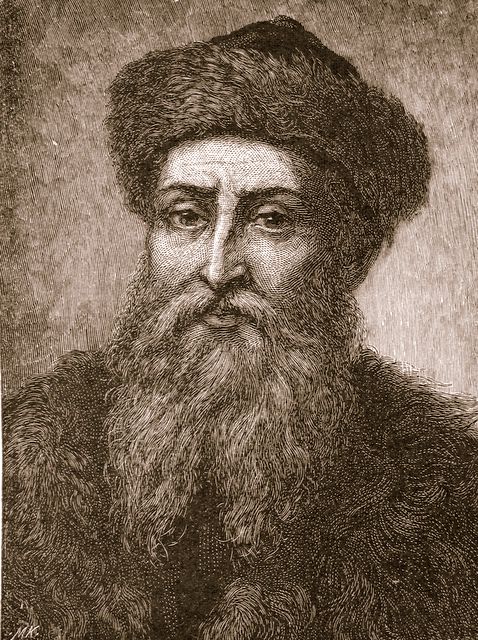
Johannes Gensfleisch zur Laden zum Gutenberg
Johannes Gutenberg (c. 1395 – February 3, 1468) was a German blacksmith, goldsmith, printer,and publisher who introduced printing to Europe. His invention of mechanical movable type printing started the Printing Revolution and is widely regarded as the most important event of the modern period. It played a key role in the development of the Renaissance, Reformation, the Age of Enlightenment, and the Scientific Revolution and laid the material basis for the modern knowledge-based economy and the spread of learning to the masses.
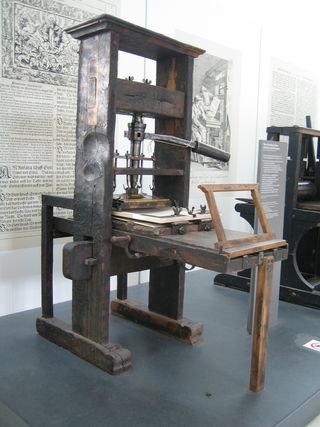
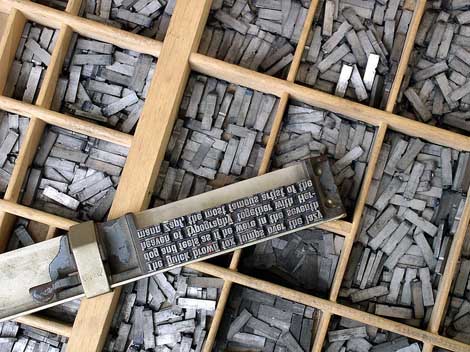
Gutenberg was the first European to use movable type printing, in around 1439. Among his many contributions to printing are: the invention of a process for mass-producing movable type; the use of oil-based ink; and the use of a wooden printing press similar to the agricultural screw presses of the period. His truly epochal invention was the combination of these elements into a practical system which allowed the mass production of printed books and was economically viable for printers and readers alike. Gutenberg's method for making type is traditionally considered to have included a type metal alloy and a hand mould for casting type.
In Renaissance Europe, the arrival of mechanical movable type printing introduced the era of mass communication which permanently altered the structure of society. The relatively unrestricted circulation of information and (revolutionary) ideas transcended borders, captured the masses in the Reformation and threatened the power of political and religious authorities; the sharp increase in literacy broke the monopoly of the literate elite on education and learning and bolstered the emerging middle class. Across Europe, the increasing cultural self-awareness of its people led to the rise of proto-nationalism, accelerated by the flowering of the European vernacular languages to the detriment of Latin's status as lingua franca. In the 19th century, the replacement of the hand-operated Gutenberg-style press by steam-powered rotary presses allowed printing on an industrial scale, while Western-style printing was adopted all over the world, becoming practically the sole medium for modern bulk printing.
The use of movable type was a marked improvement on the handwritten manuscript, which was the existing method of book production in Europe, and upon woodblock printing, and revolutionized European book-making. Gutenberg's printing technology spread rapidly throughout Europe and later the world.
His major work, the Gutenberg Bible (also known as the 42-line Bible), has been acclaimed for its high aesthetic and technical quality.
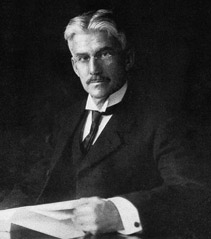
Albert Henry Munsell
(January 6, 1858 – June 28, 1918) was an American painter, teacher of art, and the inventor of the Munsell color system.
He was born in Boston, Massachusetts, attended and served on the faculty of Massachusetts Normal Art School, and died in nearby Brookine.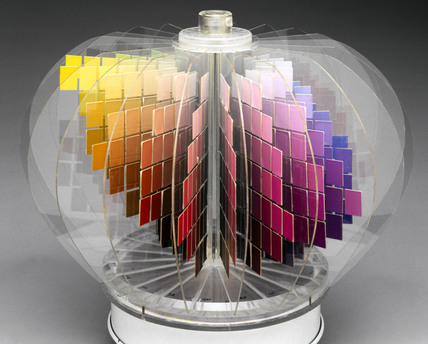
As a painter, he was noted for seascapes and portraits.
Munsell is famous for inventing the Munsell color system, an early attempt at creating an accurate system for numerically describing colors. He wrote three books about it: A Color Notation (1905), Atlas of the Munsell Color System (1915) and one published posthumously, A Grammar of Color: Arrangements of Strathmore Papers in a Variety of Printed Color Combinations According to The Munsell Color System (1921). The Munsell color order system has gained international acceptance and has served as the foundation for many color order systems, including CIELAB. In 1917, he founded the Munsell Color Company.
Munsell’s son, A.E.O. Munsell, continued to popularize Munsell's color system after his father's death.
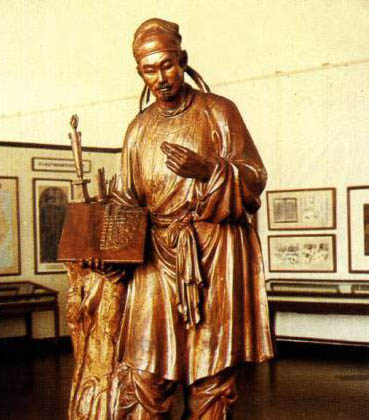
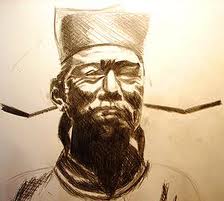
Bì Shēng (990–1051 AD)
was the inventor of the first known movable type technology. Bi Sheng's system was made of Chinese porcelain and was invented between 1041 and 1048 during Song Dynasty China. Movable type printing
Bi Sheng was a commoner and his ancestry and details were not recorded. He was recorded only in the Writings Beside the Meng CreekMengxi Bitan, or Dream Pool Essays by Chinese scholar, official, and polymath scientist Shen Kuo (1031–1095). Writings Beside the Meng Creek, however, gave detailed and sufficient description on the technical details of Bi Sheng's invention of movable type:
During the reign of Chingli, [1041–1048] Bi Sheng, a man of unofficial position, made movable type. His method was as follows: he took sticky clay and cut in it characters as thin as the edge of a coin. Each character formed, as it were, a single type. He baked them in the fire to make them hard. He had previously prepared an iron plate and he had covered his plate with a mixture of pine resin, wax, and paper ashes. When he wished to print, he took an iron frame and set it on the iron plate. In this he placed the types, set close together. When the frame was full, the whole made one solid block of type. He then placed it near the fire to warm it. When the paste [at the back] was slightly melted, he took a smooth board and pressed it over the surface, so that the block of type became as even as a whetstone.
For each character there were several types, and for certain common characters there were twenty or more types each, in order to be prepared for the repetition of characters on the same page. When the characters were not in use he had them arranged with paper labels, one label for each rhyme-group, and kept them in wooden cases.
Bi Sheng's fragile clay types were not practical for large-scale printing. The government official Wang Zhen (fl. 1290–1333 AD) improved Bi Sheng's fragile clay types by innovation through wood, as his process increased the speed of typesetting as well. Later in China by 1490 the bronze movable type was developed by the wealthy printer Hua Sui (1439–1513).
Wang Zhen ( 1290 – 1333)
Wang Zhen was an official of the Yuan Dynasty (1271 – 1368 AD) of China. He was one of the early innovators of the wooden movable type printing system. His illustrated agricultural treatise was also one of the most advanced of its day, covering a wide range of equipment and technologies available in the late 13th and early 14th century.
Wang Zhen was born in Shandong province, and spent many years as an official of both Anhui and Jiangxi provinces. From the years 1290 to 1301, he was a magistrate for Jingde, Anhui province, where he was a pioneer of the use of wooden movable type printing. The wooden movable type was described in Wang Zhen's publication of 1313 AD, known as the Nong Shu , or Book of Agriculture. Although the title describes the main focus of the work, it incorporated much more information on a wide variety of subjects that was not limited to the scope of agriculture. Wang Zhen's Nong Shu of 1313 was a very important medieval treatise outlining the application and use of the various Chinese sciences, technologies, and agricultural practices. From water powered bellows to movable type printing, it is considered a descriptive masterpiece on contemporary medieval Chinese technology.
Wang's movable type printing
In improving movable type printing, Wang Zhen mentioned an alternative method of baking earthenware printing type with earthenware frame in order to make whole blocks. Wang Zhen is best known for his usage of wooden movable type while he was a magistrate of Jingde in Anhui province from 1290 to 1301. His main contribution was improving the speed of typesetting with simple mechanical devices, along with the complex, systematic arrangement of wooden movable types.
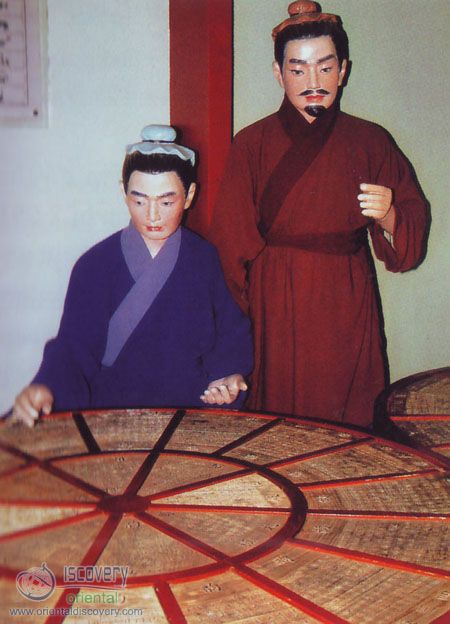
A revolving table typecase with individual movable type characters arranged primarily by rhyming scheme, from Wang Zhen's book of agriculture, published 1313 CE.
Wooden movable type had been used and experimented with by Bi Sheng in the 11th century, but it was discarded because wood was judged to be an unsuitable material to use. Wang Zhen improved the earlier experimented process by adding the methods of specific type cutting and finishing, making the type case and revolving table that made the process more efficient. In Wang Zhen's system, all the Chinese writing characters were organized by five different tones and according to rhyming, using a standard official book of Chinese rhymes. Two revolving tables were actually used in the process; one table that had official types from the book of rhymes, and the other which contained the most frequently used Chinese writing characters for quick selection. To make the entire process more efficient, each Chinese character was assigned a different number, so that when a number was called, that writing character would be selected. Rare and unusual characters that were not prescribed a number were simply crafted on the spot by wood-cutters when needed.
Two centuries before Hua Sui pioneered bronze-type printing in China in 1490 AD, Wang Zhen had experimented with printing using tin, a metal favored for its low melting point while casting. Thus, Chinese metal type of the 13th century using tin was unsuccessful because it was incompatible with the inking process. Although unsuccessful in Wang Zhen's time, the bronze metal type of Hua Sui in the late 15th century would be used for centuries in China, up until the late 19th century.
During the Qing Dynasty (1644 – 1911), wooden movable type was used on a much wider scale than even the previous Ming period. It was officially sponsored by the imperial court at Beijing, yet was widespread amongst private printing companies. The creation of movable type writing fonts became a wise enterprise of investment, since they were commonly pawned, sold, or presented as gifts during the Qing period.
There are notable differences between Wang Zhen's movable type process and Jin Jian's. Wang carved the written characters on wooden blocks and then sawed them apart, while Jin initiated the process by preparing type bodies before the characters were individually cut into types. For setting type, Wang employed a method of revolving tables where the type came to the workers, whereas Jin developed a system where the workers went to the organized type. Wang's frame was also added after the type had already been set, whereas Jin printed the ruled sheets and text separately on the same paper.
|