Chapter Two: The Bloodsports
It was with much discretion that
I approached the idea of publishing a page on this subject. The first matter
that must be made clear is that neither myself, nor anyone affiliated with
this site condones subjecting any animal to acts of violence. Anyone who
would commit such atrocities surely has serious ego problems and must also
possess an extreme propensity towards violence. Such people should seek
psychiatric therapy as their violent tendencies will surely be carried
over into humanity either directly through themselves or indirectly through
their dogs.
 Man's
history of violence is irrefutable, but this isn't a study of man's violence.
It is, perhaps, a study of just one of his innocent victims. Every breed
of domestic dog known to man is a product of selective breeding. Many have
outlived their original purpose. The Pomeranian used to be much larger
and used in a working capacity pulling sleds. There are still a few hunting
Cocker Spaniels to be found, but by and large they have become household
pets. The Bull and Terrier breeds have been bred away from fighting and
now occupy many places and fill roles in peoples lives to numerous to list.
Man's
history of violence is irrefutable, but this isn't a study of man's violence.
It is, perhaps, a study of just one of his innocent victims. Every breed
of domestic dog known to man is a product of selective breeding. Many have
outlived their original purpose. The Pomeranian used to be much larger
and used in a working capacity pulling sleds. There are still a few hunting
Cocker Spaniels to be found, but by and large they have become household
pets. The Bull and Terrier breeds have been bred away from fighting and
now occupy many places and fill roles in peoples lives to numerous to list.
Prior to assuming a position
in both urban and rural living as well as all points in between the breed
now known as the American Staffordshire Terrier (Amstaff) was an intelligent,
courageous, and fierce fighter possessing physical strength unrivaled by
any other. To say these dogs were developed to fight is only half true.
Indeed, they were developed to win.
Although developed for the purpose
of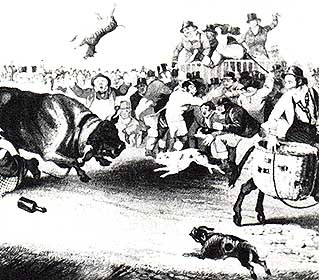 fighting
with other dogs people of the day enjoyed many such activities. It seemed
as if all creation offered more opportunities to exercise the violence
and oppression that people were feeling at that time. In the early development
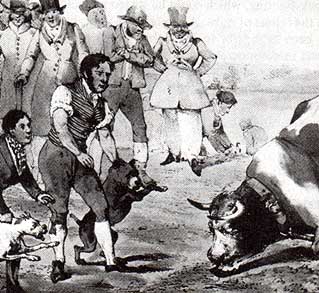
of the breed bull and bear baiting was quite popular. In this "sport" a
bull would be secured to a stake by a length of rope or chain measuring
15 feet and dogs would be released to pin the bull. This was accomplished
by grasping the bull's tender nose and hanging on until the bull submitted.
Bear baiting was a similar affair, but where the bull had hooves and horns
the bear had claws and teeth at his disposal, not to mention a better ability
to use them. There are documented accounts of English royalty (James I,
Charles I, and Queen Anne) endorsing, and even paying to observe, the activity.
fighting
with other dogs people of the day enjoyed many such activities. It seemed
as if all creation offered more opportunities to exercise the violence
and oppression that people were feeling at that time. In the early development
of the breed bull and bear baiting was quite popular. In this "sport" a
bull would be secured to a stake by a length of rope or chain measuring
15 feet and dogs would be released to pin the bull. This was accomplished
by grasping the bull's tender nose and hanging on until the bull submitted.
Bear baiting was a similar affair, but where the bull had hooves and horns
the bear had claws and teeth at his disposal, not to mention a better ability
to use them. There are documented accounts of English royalty (James I,
Charles I, and Queen Anne) endorsing, and even paying to observe, the activity.
"Horrid stories concerning
these baits include one about a butcher who brought his aging bitch to
a bait along with a litter of her pups that he wanted to sell. As soon
as the old bitch pinned the bull, the butcher began cutting her to pieces
with a cleaver. Since the bitch continued to hold the bull until she died
of the wounds inflicted by her owner, there was an instant demand for her
pups, which sold for five guineas apiece. Another fellow, in order to win
a bet, amputated the feet of his dog one at a time while the animal continued
to attack the bull on bleeding stumps as his owner had wagered. The bet
finally won, the owner cut off the dog's head to put the dog out of it's
misery. It was not unusual for a dog to be so badly gored that it's entrails
hung out, while the owner urged it to try the bull once more before it
died. Besides being gored, many brave dogs were crushed under the bull's
hooves."
(excerpt
from The American Staffordshire Terrier by Jacqueline Fraser, ISBN
0-07714-134-7)
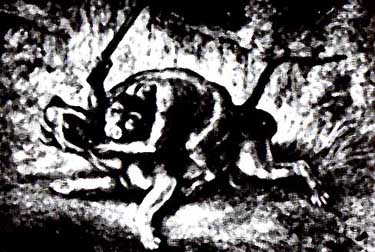 Other
activities dogs of the day were bred and trained to participate in included
ratting, raccoon and badger baiting, as well as any other type of fighting
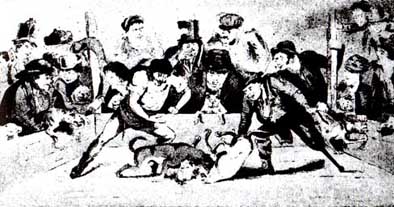
for which a formidable adversary could be found. Pictured at the left is
THE
MONKEY VERSUS BULLDOG as seen in the Sporting Magazine
1799.
Below and right is a picture of the Westminster pit where ratting, amongst
other activities, was quite popular. In ratting a dog would be charged
with killing a certain number of rats and then timed to determine
Other
activities dogs of the day were bred and trained to participate in included
ratting, raccoon and badger baiting, as well as any other type of fighting
for which a formidable adversary could be found. Pictured at the left is
THE
MONKEY VERSUS BULLDOG as seen in the Sporting Magazine
1799.
Below and right is a picture of the Westminster pit where ratting, amongst
other activities, was quite popular. In ratting a dog would be charged
with killing a certain number of rats and then timed to determine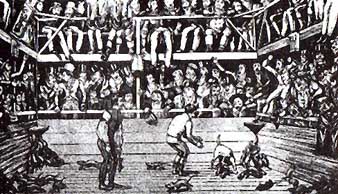 how long it took to kill every last rat.
Towards the early 1800s the bloodsports
began to grow out of fashion and were relegated to the rural and industrial
parts of the country. The Humane Acts of 1835 outlawed bull baiting and
other such "sports". This forced the determined participants, who were
likely driven by profits from gambling, underground.
It is important to note that
the poverty of the people that these fighting dogs fell to contributed
greatly to there hardiness. One who barely had enough to feed a dog couldn't
possibly maintain one that was in poor health. Poverty ensured survival
of the fittest.
 Another
important fact is that, while expected to battle fiercely, any dog that
turned on a handler or referee, even in the heat of the fight, was put
down. Consequentially dogs were selectively bred with a genetic predisposition
not to bite people. It's only when trained to do so that they will.
Another
important fact is that, while expected to battle fiercely, any dog that
turned on a handler or referee, even in the heat of the fight, was put
down. Consequentially dogs were selectively bred with a genetic predisposition
not to bite people. It's only when trained to do so that they will.
However dark the blot created
by the bloodsports on the history of this breed to deny it would be deceitful
and incorrect. We can only continue our struggle to put it behind the dogs
that we love and do everything possible to exonerate them.
Chapter
Three
Home
Index
If you have comments or suggestions, email us at[email protected]