 Fanciers
of the day often called there bull and terriers bulldogs and pictures indicate
that this was the case with "Bandit" from the Little House series.
Fanciers
of the day often called there bull and terriers bulldogs and pictures indicate
that this was the case with "Bandit" from the Little House series.
The Bull and Terrier
wins the heart of a nation
As previously mentioned, early Amstaffs played an important role in the early farms of the American frontier. Dogs, more often than not, were charged with the responsibilities of both rousting vermin and protecting children and livestock from predators. While their ability to defend the homestead against everything from rats to bears bolstered their popularity and propelled the development of the larger sized dogs of America, the breed was still primarily known for it's pit fighting abilities.
In 1898 the United Kennel Club was founded on what it called the American Pit Bull Terrier. While the UKC of today staunchly opposes dog fighting, the fledgling club was the first American registry to publish rules for pitting dogs against each other. Fighting dog owners of the period were the only ones maintaining records of the breedings they had conducted and these were the early registrants with the UKC.
There are accounts
of dogs in a more positive role during this time. Laura Ingalls Wilder,
author of "Little House on the Prairie" often referred to there "bulldog"
with affection. Fanciers
of the day often called there bull and terriers bulldogs and pictures indicate
that this was the case with "Bandit" from the Little House series.
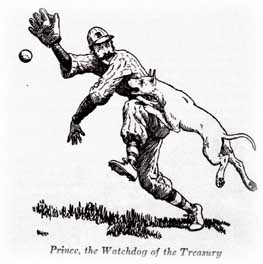
Another account of the bull and terrier is depicted at the left. "Prince" was owned by the Farmer's Deposit National Bank of Pittsburgh, Pennsylvania. While he earned the title "Watchdog of the Treasury" by assuming the role of bank guard he also enjoyed participating in America's favorite pastime. This particular picture is a depiction of the day Prince won the game for his fellow bank staff members.
The game was tied in the bottom of the ninth and the bank team was at bat. The batter hit a long fly ball into center field. In the excitement Prince broke loose and ran after the ball. While positioning himself for an easy out the center fielder noticed the charging beast. In an effort to keep one eye on the dog and the other on the ball the fielder dropped the latter. The runner brought home the winning point and Prince was a local hero not only as the bank's guard, but as the star player on the baseball team as well.
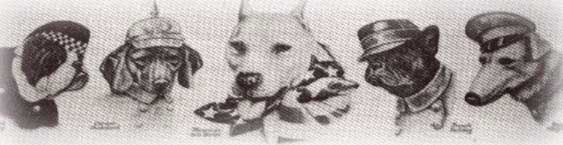
During World War I, when the nation needed inspiration more than ever, the Bull and Terrier hit a high point in popularity. It's strength, courage, and intelligent expression won a place in the heart of nearly every American. Either pictures, or caricatures of the dog adorned countless publications, not the least of which was "Life" magazine. The banner above shows a representative breed from each of the allied nations of W.W. I. The Bull and Terrier was chosen to represent America and, on the poster, was recognized as "The American Bull Terrier"
Another notable
member of Amstaff ancestry is a dog by the name of "Stubby". Stubby is
the most decorated dog in military history and was 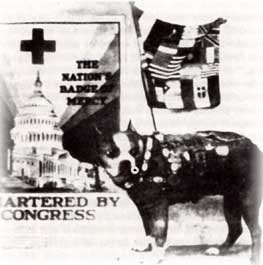 assigned
the rank of Sergeant. He received one of his medals for holding a German
spy at Chemin des Dames until U.S. forces arrived to apprehend him.
assigned
the rank of Sergeant. He received one of his medals for holding a German
spy at Chemin des Dames until U.S. forces arrived to apprehend him.
One story relates that Stubby was a stray that adopted U.S. troops in Italy or possibly France. As the breed usually does, he assumed a protective role and soon learned what was a threat and what wasn't. More than one of his medals were received for warning troops of gas attacks.
Stubby was formally received at the White House by presidents Wilson, Harding, and Coolidge. He was decorated by General Pershing personally and made a life member of the Red Cross, YMCA, and the American Legion.
Yet another member of Amstaff
history, and perhaps the most famous, was first registered with the U.K.C.
as Lucenay's Peter. Whelped on September 6th, 1929 by A. A. Keller
in California Pete was eventually purchased by 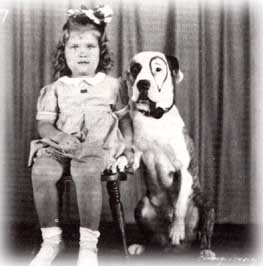 Harry
Lucenay and went on to become "Pete" of the "Little Rascals" comedy series.
He was also known as "Patch Eyed Pete" due to the circle around his eye
which was natural on the original Pete. The November, 1936 edition of the
A.K.C. stud books included Pete whose A.K.C. registered name was simply
"Pete". Pete performed for an entire nation on both the stage and on the
screen. Although cast in a comedic role, his intelligence and protective
nature, inherent to the breed, made him a hero to all, both child and adult.
Harry
Lucenay and went on to become "Pete" of the "Little Rascals" comedy series.
He was also known as "Patch Eyed Pete" due to the circle around his eye
which was natural on the original Pete. The November, 1936 edition of the
A.K.C. stud books included Pete whose A.K.C. registered name was simply
"Pete". Pete performed for an entire nation on both the stage and on the
screen. Although cast in a comedic role, his intelligence and protective
nature, inherent to the breed, made him a hero to all, both child and adult.
| However inappropriate, I'd like
to offer a side note at this point. These dogs were regarded with the highest
honor, respect, and love a nation, if not the world, could offer. However,
now they are the target of legislation throughout the world that would
have them obliterated. This is all due to irresponsible ownership and the
false perception that banning the breed will solve the problem.
Please, if you own or intend to own one of these dogs be responsible and purchase your dog from a reputable breeder, not a pet shop or some schmuck whose understanding of canine genetics doesn't reach past males and females make babies. |