Navigation: [Basic mousetrap] [intermediate] [oddly advanced] [feedback] [my golden concepts] [example mousetraps]
Since there is no "'site on mousetraps cars going up a 30' angle" I made this website. In full, it took me 3 months to think about these concepts. Even though all these are basic physics, and tons of making sense of everything. Also, many tips that come from other sites such as doc. physics and other great sites. I read the mousetrap book, and got some ideas from it, but didn't explain the motion of a mousetrap with lots of torque going up a hill, not down or straight. I looked at the mechanics of the ultimate mousetrap car, and how distance cars looked like. I have made this page sort of like a document (well more like a tutorial) (in this case, it uses roller coaster physics.) expect real pictures in about 2 weeks time
wow. i haven't updated this site in a year. well since i will never be in the mousetrap competition anymore, the purpose of this site is to further advance mousetrap competition (instead of just being crafty) and make people learn about how power is applied to linear motion. since there is no such site on the web (not one specifically about the mesa competition. i wonder what their reaction would be...?). i just read that for the 2003-2004 competition, their would be a variable mousetrap car that is meant for:accuracy, speed, and distanc up a ramp. i guess my site is perfect for that. So here are some useful links:
cal state fullerton mesa mousetrap rules
more links to come soon.....
The concepts of making a mousetrap that goes up a 30 degree angle ramp:
objective: since speed (aerodynamics) is not a factor, but distance up a 30' ramp and going farther matter:
-Keep it simple and light. Since no one dares to have mechanics on it and make it look complex, why bother if no one other than you does it
-weight of the thing, in relation to the torque and how far it will go
- gearing, so that speed is reduced to
produce a higher torque
-design, obviously the whole thing will determine this
-axis of the rear wheels in relation to gear to axis ratio
-harvesting power and tricks for better torque efficiency
-shape and size, which in this case, the wheels should be no bigger than a 6 inch diameter and the frame no bigger than 2 times the size of the axis (about there)
-traction, without it, it will go no where
-friction of the vehicle, being the wheels and the bearings
-center of gravity and how low it is. depending on design, the gravity may be different
-****for some reason rubber bands can't be used as the string on the pulley (similar to a gear)****
-having nothing to do with this, I am not a physics expert!, but read anyways.
The widely known basic
mousetrap car: 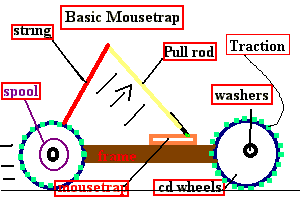
The best thing to do is learn the basics. In basic mousetrap cars, the car will typically have the following: frame (made of wood, metal etc), a standard mousetrap, 4 wheels or aerodynamic wheels* like a car (usually from a 3 inch diameter to the size of a record), very low torque, high distance on a straight surface, 2 straight rods for the axis of the wheels*, spool (torque spool)*, wheel traction with a rubbery source*, rubber washers or hot glue as the mounting piece between the wheels and axis*, a pull rod/stick thing (connected at the metal part of the spring mechanism with a stick, usually metal), string to connect from the top of the pull arm to the "torque" spool.....or you can call this the funtraps kit (I think doc. phizzix is not available anymore). An average because it has torque, goes slow (meaning the wheels go slow), and goes far. Good for distance, but not torque!
Now that you probably learned something new, that just explains what it looks
like and its purpos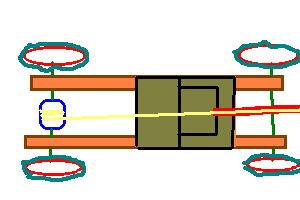 e
why it looks like that. Since the mousetrap car only needs
enough torque for the flat surface, it makes it fairly easy, but remember, test
it before you put it out there....or else it won't look good....for you. Since: haven't
shown any of my concepts yet, here are some basic things:
e
why it looks like that. Since the mousetrap car only needs
enough torque for the flat surface, it makes it fairly easy, but remember, test
it before you put it out there....or else it won't look good....for you. Since: haven't
shown any of my concepts yet, here are some basic things:
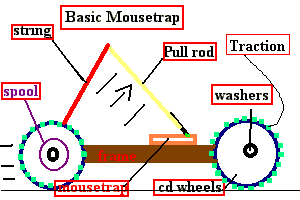
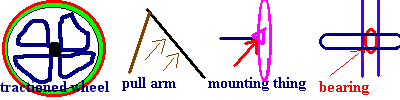
I think you know what the first 4 are, but then you say to yourself
"what the heck is a bearing." Well a bearing is a part of the
mousetrap that pretty much holds the axis of the rear wheels to the frame, which
also determines how the wheel will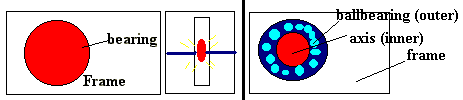 rotates by means of how it holds it and how much friction (in this case,
resistance of the frame to the axis) it exerts on the car. But then, there are
two types, bearing and ball-bearing. The difference between the two is that ball
bearing use metal balls to rotate the inner part of it while the outside is
connected to the frame, and bearings are things that adjust it. Therefore, ball
bearing are better because they exert less friction (yet are in your roller
skates), bearings are everywhere, less efficient)
rotates by means of how it holds it and how much friction (in this case,
resistance of the frame to the axis) it exerts on the car. But then, there are
two types, bearing and ball-bearing. The difference between the two is that ball
bearing use metal balls to rotate the inner part of it while the outside is
connected to the frame, and bearings are things that adjust it. Therefore, ball
bearing are better because they exert less friction (yet are in your roller
skates), bearings are everywhere, less efficient)
Basic tips
A. another tip that many sites don't have is how to pick the mousetrap (depending). since most likely unused mousetraps have more power because the metal part has not moved. but using a torque measurer (too expensive, but there is another way to do it mechanically, but that is way later!) one can calculate approximately how much torque your car has overall through rotation.
B. use of a light, extremely complex frame is another thing. almost everybody seems to make the wheels light, but what about the rest? The gears, frame, rubber washer, tread, and a bunch of other things, but too much words to explain. but the main thing is to pretty much make a bunch of holes that makes it lighter without losing structural stability, meaning a greater torque and speed.
C. another thing to do is picking the materials. But for one thing, the regular materials aren't always the best. A variation of material such as using light plastic instead of balsa wood, wire, fish string, guitar string (actually its a metal) instead of thread (string). instead of using c-d's, use the top of a cup container or one with the wax on it.
D. depending on complexity, the easier you can obtain the parts, the better. The best example is using Lego gears (obvious choice) instead of probably a car gearbox (car gearboxes are not good because they go too fast and think about it, it uses a continuous electric engine, but a 30 rpm or so output would be good). instead of rubber bands, use something that is more resistant to a smoother surface, a way to test it is by pressing it on your skin (but be sure it isn't sharp or dangerous looking :)
E. the construction. Always build from the beginning to the end, refining your ideas as you go. Using solder (its on your metal desk) and metal as a construction technique (because solder always sticks) instead of metal, plastic and using some type of tape.....but then using glue, especially super glue is very hard in large quantities.
F. Recycle. Just look around your dwelling place, and you may say to yourself "I can use this" or something like that. that's why my room is so messy :)
THE GOLDEN CONCEPTS OF THE
MECHANICAL MOUSETRAP CAR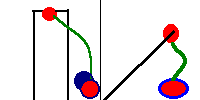
-using a weight on the end of the pull arm which will go in the direction that it should go in: down and with not much resistance (giving it way more power using the momentum of the hill to give it power and a concept that is platinum). Unlike the pull arm going going up, I would say that it wastes a lot of power trying to go up, also the weight idea would not work...unless it has enough power to to go beyond 90 degrees. Even though this adds mass according to the position of the mousetrap, I would advise making a place that is the heaviest so that it does not tip over or fall back, also this adds constructive torque to it
-using a device that keeps the level of the string constant (a common problem with mousetraps it that at the beginning, it has the most power. as the pull arm goes on it has less power. But then when the mousetraps arm goes beyond 90 degrees, it does something real weird, having less power and not as much resistance. My method of putting a weight on the tilted mousetrap will let it have more power as it goes down. it also applies to mousetrap that go straight, giving it more power.
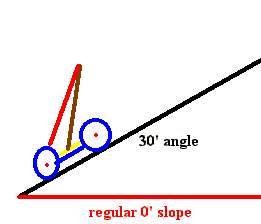
-having a mousetrap at a 30 degree angle, it means that the mousetrap must be tilted to give it more power.
-a mousetrap that can change position with a weight on the other end, meaning it probably can harvest more power with the other ideas and my concepts.
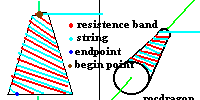
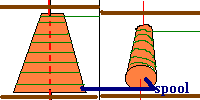 -changeable torque. Even though the only thing that was close to this
explanation was using a cone shaped torque enhancer (it changes torque like a
screw) that makes it more efficient. I reasoned to my self that as the mousetrap
goes higher, thus it will need more torque. Since mousetraps don't have lasting
power, it would be better to have a lower torque at the beginning and a a higher
toque at the top, but the only way and secret of doing this is putting
resistance bands on the torque cone in the direction of it coming out. The
endpoint is in blue and the point which the string begins is brown. a good
source is from cone shaped bobbys from a sewing machine. Higher it goes, means more torque!
-changeable torque. Even though the only thing that was close to this
explanation was using a cone shaped torque enhancer (it changes torque like a
screw) that makes it more efficient. I reasoned to my self that as the mousetrap
goes higher, thus it will need more torque. Since mousetraps don't have lasting
power, it would be better to have a lower torque at the beginning and a a higher
toque at the top, but the only way and secret of doing this is putting
resistance bands on the torque cone in the direction of it coming out. The
endpoint is in blue and the point which the string begins is brown. a good
source is from cone shaped bobbys from a sewing machine. Higher it goes, means more torque!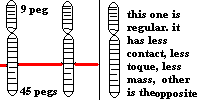
-doubler of the torque. instead of just having torque at the rear of the car, why
not have torque for the front wheels too. examples of such kinds of torque is
the weight on the pull arm and using more than 1 gear to increase torque (in
this case, gearing torque can be determined by the size of gear, how much
"pegs?" it has, and how much contact with the rest of it plus the
other torque equation)* more contacts gearing and pulleys means more torque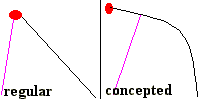 .
.
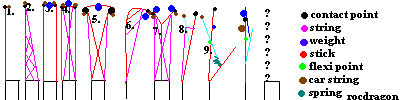
-a tilted pull arm that probably gives more torque, yet it is small and compact. (most likely in a v shape that is tilted). my theory is that a mousetrap can have a longer pull (like a regular pull arm that is long), yet has more torque (in this case, to determine torque is the distance from the pull arm to the mechanism itself without any gearing.) the ones below are possible combination of the pull rod.
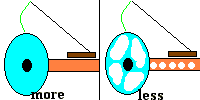
-shaving the thing like crazy so that it is lighter (but make sure you don't lose any structural support or hurt yourself.) The best way to do this is by shaving it with sand paper, a drill (to put a hole in) and weighing it (if you don't have one, I'm sure you can use one at the market?) . If it is just 1 gram less, it makes that much of a difference (average weight is about 4 grams I think?)
 -perpendicular
frame with ramp and position of the wheels. I would advise that if the mousetrap
is at about 85 degrees or so, I think it would work better. also to make the
frame flat, use wheels that are larger in the back, while the front is smaller,
meaning better efficiency (I know this from experience. if you think about it,
when a person or thing climbs up a hill, if both the wheels (or feet) are
about the same, it will use more energy because the momentum is off and the
"object" will fall over (and probably break). an example of this is
the year 2000 Olympic summer games flame stage that climbed the stands at
a slanted angle and the flame was flat. Also when someone is climbing a hill,
they slant their legs to adjust to a hill, meaning "full energy at the
beginning and less at the top because they get tired"). it also has to do
with gravity and other stuff bla bla bla bla....perpendicular mousetrap to a 30'
ramp.
-perpendicular
frame with ramp and position of the wheels. I would advise that if the mousetrap
is at about 85 degrees or so, I think it would work better. also to make the
frame flat, use wheels that are larger in the back, while the front is smaller,
meaning better efficiency (I know this from experience. if you think about it,
when a person or thing climbs up a hill, if both the wheels (or feet) are
about the same, it will use more energy because the momentum is off and the
"object" will fall over (and probably break). an example of this is
the year 2000 Olympic summer games flame stage that climbed the stands at
a slanted angle and the flame was flat. Also when someone is climbing a hill,
they slant their legs to adjust to a hill, meaning "full energy at the
beginning and less at the top because they get tired"). it also has to do
with gravity and other stuff bla bla bla bla....perpendicular mousetrap to a 30'
ramp.
EXAMPLE MOUSETRAP: Tips to design concepts
depending on the rules and how much you would like to commit, your design will show how creative (or smart) your mind actually is. here are some examples:
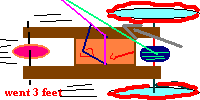 -This
design was made by a friend. Even though it does have the basics: 2 back wheels
made of CD's with tread and a front wheel, a big 45 peg torque gear, mousetrap
with pull arm, string, balsa wood frame and a somewhat perpendicular mousetrap
to ramp. it went three feet up a 30 degree incline. With a 2.5 inch radius and
using the circumference formula....I say it goes about 15 inches in a full
rotation, meaning that it rotated about 2 and a half times with that much torque
carrying it.
-This
design was made by a friend. Even though it does have the basics: 2 back wheels
made of CD's with tread and a front wheel, a big 45 peg torque gear, mousetrap
with pull arm, string, balsa wood frame and a somewhat perpendicular mousetrap
to ramp. it went three feet up a 30 degree incline. With a 2.5 inch radius and
using the circumference formula....I say it goes about 15 inches in a full
rotation, meaning that it rotated about 2 and a half times with that much torque
carrying it.
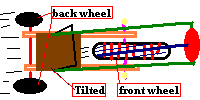 -Even
this one is roughly made of other designs, it uses my concepts in a stable
design. like the first one, this one uses concepts that never have been used
before (because this is currently the second year of the M.E.S.A. competition ).
how it works is by using a weight on the end of the pull arm so that the motion
of the pull arm goes back instead of front. The wheel is powered by the big
front wheel (which the outer part of it is bigger than the middle and also
serves as the torque enhancer machine thingy), the mousetrap is tilted, the
gearing is under instead of behind of the mousetrap. Even though I should
have added a constant angle string keeper between the wheel and mousetrap. I
have never tested or made this one, I just hoped it would work and I have no
idea how far it goes...and that's all for this one.
-Even
this one is roughly made of other designs, it uses my concepts in a stable
design. like the first one, this one uses concepts that never have been used
before (because this is currently the second year of the M.E.S.A. competition ).
how it works is by using a weight on the end of the pull arm so that the motion
of the pull arm goes back instead of front. The wheel is powered by the big
front wheel (which the outer part of it is bigger than the middle and also
serves as the torque enhancer machine thingy), the mousetrap is tilted, the
gearing is under instead of behind of the mousetrap. Even though I should
have added a constant angle string keeper between the wheel and mousetrap. I
have never tested or made this one, I just hoped it would work and I have no
idea how far it goes...and that's all for this one.
The third one of the bunch (has not been created nor tested)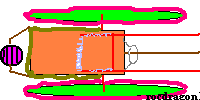 .
like the others, this one almost works the same. I derived this from extremely
early designs of the mousetrap car (I once looked at the first year of the mesa
video...or at least parts of it and had designs that used only the mousetrap as
the frame...but back then, they did not use CD's, they used 4 even wheels to
propel it up ;). Even though this sort of looks like a wheel chair, it is not.
The mousetrap is propelled by the CD's which are almost on the center of the
mousetrap, it has 1 small to even size with ramp wheel (note that it is only one
wheel and is held on their by metal/sticks/etc.). it is uses the angle keeper
rod, weight (not shown), gears (not shown), and string (the straight brown
thing). So I would say this is a modern attempt at early designs and is very
small (or about 5 inches in diameter or less.)
.
like the others, this one almost works the same. I derived this from extremely
early designs of the mousetrap car (I once looked at the first year of the mesa
video...or at least parts of it and had designs that used only the mousetrap as
the frame...but back then, they did not use CD's, they used 4 even wheels to
propel it up ;). Even though this sort of looks like a wheel chair, it is not.
The mousetrap is propelled by the CD's which are almost on the center of the
mousetrap, it has 1 small to even size with ramp wheel (note that it is only one
wheel and is held on their by metal/sticks/etc.). it is uses the angle keeper
rod, weight (not shown), gears (not shown), and string (the straight brown
thing). So I would say this is a modern attempt at early designs and is very
small (or about 5 inches in diameter or less.)
This is my mousetrap for E.C.S day (engineering and computer science day) at
about 80% completion (the only parts left to put on is the weight,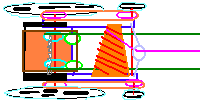 content angle
rod, string, and some brief testing. It uses about almost all of my concepts,
excepts that its not that light as I liked it to be and not shaved like crazy.
I'm not sure it will work because of its complexity and weight. But I call it
"The Conceptus" meaning to me "the concept mousetrap car of the
future" (meaning in a year or so). Here are some picture I made with my pc
camera :) on 2/19/02 (1 day before the meeting). here is the drawing on the left
and the real pictures below.
content angle
rod, string, and some brief testing. It uses about almost all of my concepts,
excepts that its not that light as I liked it to be and not shaved like crazy.
I'm not sure it will work because of its complexity and weight. But I call it
"The Conceptus" meaning to me "the concept mousetrap car of the
future" (meaning in a year or so). Here are some picture I made with my pc
camera :) on 2/19/02 (1 day before the meeting). here is the drawing on the left
and the real pictures below.
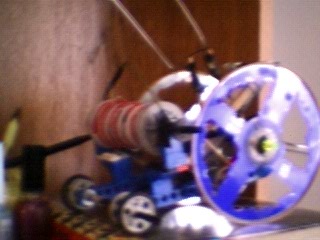 This
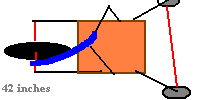
is my car after 100% completion. Even though I didn't win (on a 32 degree ramp),.here is the winning design (yet
terribly simple) of orange county at the right of the screen (this is how it approximately works
and looks like). the base is the mousetrap, the front wheels are two regular
small wheels (in grey) and the back is the tractioned CD wheel which is pulled
by one ribbon and is very light (in the blue). extremely simple, yet it went a
record 42 inches!
This
is my car after 100% completion. Even though I didn't win (on a 32 degree ramp),.here is the winning design (yet
terribly simple) of orange county at the right of the screen (this is how it approximately works
and looks like). the base is the mousetrap, the front wheels are two regular
small wheels (in grey) and the back is the tractioned CD wheel which is pulled
by one ribbon and is very light (in the blue). extremely simple, yet it went a
record 42 inches! 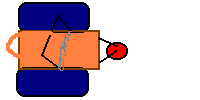
Here is what I think the second design looks like. it has large wheels in the back (tractioned by tennis racket grips.) it somewhat looks like this, but I do not know exactly.
-The best thing to do is to observe the actions of a mousetrap. one must actually look at a 30' angle, and see how steep it really is. Then I'd look at the mousetrap itself, and notice that the spring mechanism is really important and powers the whole thing. Even though it adds mass, it is contructive mass.
Copyright 2000-2003 by rocdragon12. All rights reserved.
Remember, I am not responsible if it works better or the same, it is your own imagination and logic that will make it better. please ask me more for info at [email protected]